Category Archives: Technology

Customer Retention vs. Acquisition in SaaS – What Actually Drives Growth

Most SaaS companies are built to acquire customers. Very few are built to keep and grow them.

That’s the problem.

Because in SaaS, growth doesn’t come from how many customers you win. It comes from what happens after the sale.


The traditional thinking

The default model is simple:

  • Invest in marketing
  • Drive pipeline
  • Close new customers
  • Repeat

It works. Until it doesn’t.

Because over time:

  • Customer acquisition gets more expensive
  • Sales cycles get longer
  • Conversion rates drop

And suddenly, growth slows.


The reality of SaaS growth

In SaaS, retention is not a support metric. It’s the foundation of growth.

If customers don’t stay, nothing compounds.

If they don’t expand, revenue stalls.

That’s why the strongest SaaS companies focus on:

  • High retention
  • Consistent expansion
  • Fast time to value

Not just new logo acquisition.


Why retention beats acquisition

Acquisition creates revenue. Retention protects it. Expansion multiplies it.

Without retention:

  • You’re constantly replacing lost revenue
  • Growth becomes fragile
  • Forecasting becomes unreliable

With strong retention:

  • Revenue compounds
  • Customer lifetime value increases
  • Growth becomes predictable

Where most SaaS companies get it wrong

They treat Customer Success as a support function.

Not a growth function.

So you see:

  • Reactive customer teams
  • No clear ownership of expansion
  • Metrics focused on activity, not outcomes
  • No alignment between sales and Customer Success

The result?

Retention underperforms and expansion never quite materialises.


The shift from Customer Success to Customer Growth

The best SaaS companies are making a shift.

From:

👉 Customer Success as support

To:

👉 Customer Success as a revenue engine

That means:

  • Defining customer value early
  • Aligning sales and post-sale around outcomes
  • Tracking leading indicators, not just churn
  • Building expansion into the lifecycle

What this means for founders and CEOs

If you’re leading a SaaS business, this is not a trade-off.

You need both, but the balance matters.

If your growth is driven only by acquisition:

  • You’ll always be under pressure to sell more
  • Your cost of growth will keep increasing

If your growth is driven by retention and expansion:

  • Revenue compounds
  • Growth becomes more efficient
  • The business becomes more valuable

Bringing it together

Customer acquisition gets you started. Customer retention and expansion are what scale the business.

That’s the difference between:

👉 chasing growth and…
👉 building a growth engine


CTA (link this properly)

If you’re thinking about how to improve retention, reduce churn or build a Customer Success function that actually drives growth:

👉 See how I work as a fractional Customer Success leader.

Why SaaS Growth Breaks After the Sale (and How to Fix It)

Introduction

Most SaaS companies think they have a pipeline problem.

They don’t.

They have a conversion problem after the deal.

Revenue doesn’t just come from winning customers. It comes from what happens next. – adoption, value realisation and expansion.

And this is where growth quietly breaks.


The Real Problem Isn’t Sales

SaaS leaders spend a lot of time optimising:

  • Lead generation
  • Conversion rates
  • Sales efficiency

But once the deal is signed, things become far less structured.

The assumption is simple:

“We’ve sold the value, now the customer will realise it.”

In reality, that rarely happens consistently.


Where Growth Actually Breaks

Growth doesn’t fail at the point of sale.

It breaks in the gap between:

  • What was sold
  • What is delivered
  • What the customer actually achieves

This shows up in familiar ways:

  • Slow or partial adoption
  • Customers using features but not achieving outcomes
  • Expansion opportunities that never materialise
  • Churn risk appearing late in the lifecycle

By the time it’s visible, the damage is already done.


The Hidden Revenue Leak

Every SaaS business has a flow:

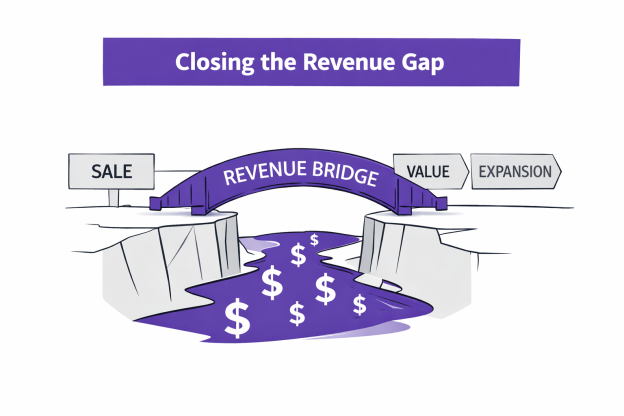
Sale → Adoption → Value → Expansion

If that flow is not connected and managed:

Revenue is lost.

Not always immediately.

But over time:

  • Deals don’t expand
  • Renewals become harder
  • Growth becomes unpredictable

This is why many companies feel like they are working harder for the same results.

Because they are.


Why Customer Success Alone Doesn’t Fix It

This is often labelled as a Customer Success issue.

It isn’t. It’s a system issue.

Common problems include:

  • Weak handover between sales and post-sale teams
  • No clear definition of what “value” actually means for the customer
  • Lack of ownership for outcomes
  • Misalignment between sales, CS and product

Customer Success can’t fix this in isolation. Because the problem doesn’t sit in one team.


What High-Growth SaaS Companies Do Differently

Companies that scale efficiently do one thing well:

They control what happens after the sale.

That means:

  • Clear alignment between sales, CS and product
  • Defined customer outcomes from day one
  • Strong ownership of value realisation
  • Early visibility of risk and opportunity
  • A structured path to expansion

In these organisations, growth feels more predictable. Because it is.


How to Fix Where Growth Breaks

If you want to improve growth, start here:

1. Define Value Clearly:

What does success look like for the customer? Not usage. Not features. Outcomes.

2. Strengthen the Handover:

Make sure context, expectations and goals carry through from sales into delivery.

3. Track Leading Indicators:

Don’t wait for churn. Track adoption, engagement and value signals early.

4. Align Teams Around Outcomes:

Sales, customer success and product need to be aligned around customer success, not just their own metrics.

5. Build a Path to Expansion:

Expansion should not be opportunistic. It should be designed into the lifecycle.


Final Thought

Most SaaS companies don’t struggle to win customers. They struggle to turn those customers into long-term, expanding revenue.

That’s where growth really happens. And that’s where it often breaks.


Call to Action

If growth feels harder than it should, it’s worth asking a simple question:

Where does it break after the sale?

How AI Will Impact Customer Success Teams

For the past two years there has been a loud debate about AI in Customer Success.

  • Will it replace Customer Success Managers?
  • Will AI run renewals?
  • Will customers even want to speak to humans?

These are great questions but they miss the real shift that is happening.

AI will not replace Customer Success. It will expose weak Customer Success teams.

Because when automation removes the operational work, what remains is the hardest part of the role. Helping customers achieve real business outcomes.


The Work That AI Will Remove

A large part of Customer Success work today is operational.

  • Preparing reports
  • Updating dashboards
  • Summarising meetings
  • Chasing internal teams for updates

This is not where value is createdIt is simply the administrative cost of running a customer-facing organisation. AI is already automating much of this work.

AI is changing how customer success teams operate. I’ve broken this down in detail in this guide to AI in customer success.

Modern Customer Success platforms can:

  • summarise customer calls
  • analyse product usage data
  • identify churn risk signals
  • generate account summaries
  • recommend next best actions

According to the Gainsight Customer Success Index, 52% of Customer Success teams already use AI in their workflows, and 91% expect it to significantly impact their strategy.

Source

In other words, the administrative layer of Customer Success is starting to disappear and that is where the real shift begins.


What Remains When Automation Arrives

When AI removes the operational workload, something interesting happens. The role becomes clearer. Customer Success is not about managing activity. It is about creating value.

The companies getting this right focus Customer Success on three things.

(1) Helping customers achieve measurable outcomes:

Not feature adoption. Not product usage. Actual business impact.

(2) Connecting product capabilities to customer strategy:

The best CSMs increasingly look more like advisors than account managers
They understand the customer’s business model and help align technology to it

(3) Identifying growth opportunities

Expansion revenue rarely comes from sales pressure
It comes from customers realising the product is solving real problems
When that happens, growth follows naturally


The Uncomfortable Reality For Many Teams

Many Customer Success organisations were built for a different era. An era where simply maintaining relationships created value.

That model is under pressure. AI will not remove Customer Success roles. But it will remove the work that previously hid weak operating models. Teams that rely on:

  • manual reporting
  • reactive engagement
  • relationship management without measurable outcomes

… will find it harder to justify their role. Because AI can replicate most of that activity.

What AI cannot replace (today) is commercial judgement and strategic thinking.


What Great CSMs Will Look Like In 5 Years

As automation spreads across the industry, the profile of a strong Customer Success Manager will change. Three capabilities will matter far more than they do today.

(1) Business understanding: CSMs will need to understand how their customers actually create value. Industry knowledge becomes more important than product knowledge.

(2) Commercial thinking: Great Customer Success leaders will understand how retention, expansion and customer outcomes connect. They will think like revenue leaders.

(3) Strategic communication: Customers do not need another dashboard walkthrough. They need someone who can translate product capability into business impact.

The role then becomes far less operational and more advisory and strategic.


What Leaders Should Do Now

If you run a SaaS business, AI should not be viewed as a headcount reduction tool inside Customer Success. It should be viewed as a capability shift. The goal is not to remove Customer Success.

The goal is to remove the operational friction around it. This allows teams to focus on the work that actually drives growth. Helping customers succeed.

Because in subscription businesses, customer success is not just a support function. It is one of the most powerful growth levers a company has.


The Real Impact Of AI On Customer Success

The future of Customer Success will not be defined by automation. It will be defined by clarity. Once AI removes the administrative work, the purpose of the function becomes obvious. Customer Success exists to help customers achieve outcomes that make them want to stay. And to expand.

The teams that can demonstrate that clearly will become more valuable than ever.

The teams that cannot will struggle to justify their place.

Because AI does not remove Customer Success, it exposes it.


Want To Go Deeper?

If you’re thinking about retention, expansion or how AI fits into your strategy, I work with a small number of SaaS companies on exactly this.

👉 If you’re rethinking your approach, let’s talk.
The Next Era of Customer Success

It’s Changing

For years Customer Success was framed as a pro-active support function. Helpful. Important. But rarely commercial.

That framing made sense in the early days of SaaS. Companies were still learning how subscription businesses behaved. Retention mattered but growth still came primarily from new logos.

But it’s no longer true and it’s something that many companies still struggle with.

Today many SaaS companies generate as much growth from existing customers as they do from new ones. Expansion revenue, renewals and product adoption have become the most predictable drivers of performance.

Which means Customer Success is changing. It is moving from a relationship function to something far more strategic. A revenue system.


The Signals Are Already Visible

Over the last year the direction of travel has become clearer. AI adoption inside Customer Success teams is accelerating quickly.

According to the Gainsight Customer Success Index:

  • 52% of Customer Success teams are already using AI
  • 91% expect AI to significantly impact their strategy

Source

But at the executive level there is still scepticism. The PwC Global CEO Survey found that 56% of CEOs say AI has not yet delivered meaningful financial returns.

Source

That gap matters. Technology is evolving quickly. Operating models are not.

Many organisations are still working out how AI, Customer Success and revenue growth actually connect.


Customer Success Is Your Revenue Engine

The companies getting this right are changing how they design Customer Success. They are no longer measuring activity. They are measuring outcomes and valued delivered to customers.

Growth depends on what happens after the deal. This is explored in more detail in this guide to AI in customer success.

Instead of focusing on engagement scores, meeting counts or dashboard activity, they focus on metrics that boards understand immediately.

  • Gross revenue retention
  • Net revenue retention
  • Expansion revenue
  • Time to value
  • Cost to serve

When Customer Success is built around these metrics it becomes one of the most predictable growth levers in a SaaS business. Often the most efficient one. Because growing existing customers is almost always cheaper than acquiring new ones.


The Mistake Many Companies Still Make

Despite the maturity of the discipline, many organisations still run Customer Success like a relationship management team.

  • More meetings
  • More check-ins
  • More quarterly reviews

But simple activity is not value. Customers do not renew because a meeting happened. They renew because the product is delivering measurable outcomes inside their organisation.

The next generation of Customer Success therefore looks different.

It is more:

  • Data driven
  • Operationally scalable
  • Focused on outcomes

The goal is not to talk to customers more. The goal is to help customers achieve value faster. Let’s call it value acceleration.


Where AI Actually Fits

AI will not replace Customer Success. But it will change how it operates. The biggest impact will be scale.

AI is already helping teams:

  • Identify churn risk earlier
  • Analyse product usage patterns
  • Summarise customer conversations
  • Automate onboarding steps
  • Surface expansion opportunities

This allows Customer Success teams to manage significantly larger portfolios of customers while focusing human effort on the moments that matter most.

The work becomes more strategic and yes, more commercial.


The Debate Shaping The Industry

There is still one unresolved question in Customer Success that is being asked too many times – should Customer Success own revenue?

Some companies expect Customer Success teams to manage renewals and expansion. Others separate the roles.

Customer Success focuses on value. Sales focuses on commercial negotiation.

There is no universal answer yet but the direction of travel is clear.

Customer Success is moving closer to revenue ownership whether organisations formally recognise it or not. Because retention and expansion are where sustainable growth increasingly comes from.


What CEOs & Founders Should Focus On Now

If you run a SaaS business today, three questions matter.

(1) Do we know exactly why customers renew?

If the answer is vague, your retention strategy is fragile.

(2) Can we predict churn before it happens?

Most organisations still rely on lagging indicators. By the time a customer is clearly unhappy, it is often too late.

(3) Is Customer Success designed to scale?

Human-heavy operating models break quickly once companies grow beyond a few hundred customers. Digital journeys, automation and AI are becoming essential infrastructure. Not optional improvements.


The Next Phase Of Customer Success

Customer Success is no longer a new discipline. But it is entering a new phase.

The first era focused on customer experience. The next era will focus on something much simpler and that is Revenue retention.

The companies that understand this shift early will build more resilient SaaS businesses.

And the leaders who design Customer Success around revenue outcomes will have one of the most powerful growth levers in modern software.


Want To Go Deeper?

If you’re thinking about retention, expansion or how AI fits into your strategy, I work with a small number of SaaS companies on exactly this.

👉 If you’re rethinking your approach, let’s talk.
AI has already arrived in Customer Success, the question now is what we do with it?

AI isn’t coming for Customer Success jobs. It’s already here.

Most of the work we used to treat as essential has quietly moved into the background.
Health scores. Renewal reminders. Basic check-ins. The admin that once filled our days is now handled by systems that never get tired.

And that’s a good thing.

Because it forces us to confront something the industry has avoided for too long. The value of a CSM has never been in tasks. It’s always been in thinking.

AI in customer success.


The Shift Nobody Can Ignore

As automation expands across the customer journey, the gap between activity and impact gets wider. CS teams that still define value by volume will struggle. Teams that define value by commercial thinking will thrive.

In 2025, every CSM needs a commercial mindset. Not to sell. But to understand the economics behind every customer conversation.

That’s the real shift.


Why Commercial Thinking Matters

The best CSMs already know the answer to one simple question:

How does our product make this customer more successful in a measurable way?

  • They understand margins
  • They understand cost savings
  • They understand how technology changes the economics of a customer’s business

They talk about return not renewal. Impact not activity. Value not volume.

And that’s where AI draws a sharper line than many expected.

If you’re looking at how AI fits into customer success more broadly, this guide to AI in customer success breaks it down.


Automation Doesn’t Replace Judgment

AI can process. It can surface insights. It can flag risk.

But it can’t replace partnership, judgment or business acumen.

These are the skills that turn a CSM from a task executor into a strategic operator. These are the skills that get Customer Success a seat at the table. And these are the skills that AI only makes more important, not less.


The New Line Between Replaceable & Essential

As more of the workflow becomes automated, the industry is heading towards a split. Not between junior and senior roles. But between replaceable and essential roles.

Replaceable roles cling to tasks. Essential roles understand the customer’s economics and use that understanding to guide decisions.

That’s where the profession is heading. And it’s where the opportunity lies for every CSM who wants to build a durable career as AI scales.


Here’s The Real Question

If Customer Success wants to evolve, it has to speak the language of business, not tasks. It has to show how decisions drive outcomes, not how many activities got logged.

And that means one thing.

Every CS leader needs to help their teams build commercial muscle.

Every CSM needs to learn how to anchor conversations in value.

And every organisation needs to decide whether CS will be a cost centre or a growth engine.

AI has already changed the role. Now it’s on us to decide what Customer Success becomes next.

How are you helping your team develop that commercial edge this year?


Want To Go deeper?

If you’re thinking about retention, expansion or how AI fits into your strategy, I work with a small number of SaaS companies on exactly this.

👉 If you’re rethinking your approach, let’s talk.

Customer-Led Growth: Why the Best Companies Now Grow with Their Customers

Growth models come and go.

For years, companies believed success came from selling harder, marketing louder or building flashier products. But something fundamental has shifted in how growth actually happens and the smartest organisations are responding.

That shift is what we call Customer-Led Growth (CLG).

It’s not a buzzword. It’s a structural change in how businesses grow and how customers expect to be treated.


How We Got Here

If you zoom out over the last two decades, you can see a clear evolution in how companies approached growth:

  • Sales-Led Growth (SLG): The old world of cold calls, quotas and closing deals – growth depended on the size and skill of the sales team

  • Marketing-Led Growth (MLG): Then came the era of brand and lead generation – marketing became the growth engine, filling the top of the funnel with demand

  • Product-Led Growth (PLG): The SaaS revolution flipped things again. Users could try before they buy and the product itself became the salesperson, think Slack, Zoom or Notion

Each of these models worked in its time. But as markets matured and customers gained power, the economics changed.

Acquisition costs rose. Switching costs fell. Buyers became more informed, more connected and far less patient.

The next evolution – Customer-Led Growth – isn’t about selling to customers at all. It’s about growing with them.


What Customer-Led Growth Really Means

Customer-Led Growth is simple in principle – your growth comes from helping customers achieve the outcomes they care about most.

When customers succeed they:

  • Stay longer (reducing churn)
  • Buy more (expansion revenue)
  • Tell others (advocacy).

That creates a compounding loop of growth powered not by marketing spend or sales pressure but by real, measurable customer value.

In plain English: you win because your customers do.

Imagine pushing a heavy car up a hill (sales-led). Exhausting. Then imagine cresting the top, and gravity takes over – the car starts rolling itself (customer-led). CLG is that gravity: momentum created by genuine customer success.


The Problem CLG Solves

For years, companies have measured the wrong thing. They’ve obsessed over acquisition metrics – leads, MQLs and pipeline coverage – without real proof that customers were succeeding after the sale.

The result?

Leaky buckets. Growth targets met one quarter, lost the next.

Customer-Led Growth changes the operating model. It forces teams to answer harder questions:

  • Are our customers realising value from what we’ve sold?
  • Can we prove it?
  • How quickly can we identify and fix friction before it becomes churn?

That shift changes how every team works – not just Customer Success.

Product, marketing, sales, support and leadership all align around one core idea – sustainable growth depends on recurring, compounding customer value.


A Quick Bit of History

The roots of CLG stretch back to three movements that collided over the last 15 years:

  1. Relationship marketing: The idea that long-term customer relationships are more profitable than one-off transactions.

  2. Customer Success: Born in SaaS, it turned retention into a discipline rather than an afterthought.

  3. The “Jobs To Be Done” framework: Focused on understanding what customers are really trying to achieve, not just what they’re buying.

Combine these and you get the foundation of Customer-Led Growth – listen deeply, deliver measurable outcomes and feed that insight back into the business.


The Early Pioneers

Several companies quietly pioneered CLG before the term existed:

  • HubSpot built its “flywheel” model around customer advocacy rather than lead funnels

  • Salesforce scaled Customer Success as a growth engine, not a support function

  • Adobe restructured its business from selling software licences to measuring active usage because usage equals value

  • Atlassian let its customers sell for them by creating self-serve journeys and community-driven growth

Each realised the same truth – the most reliable growth doesn’t come from new customers, it comes from the success of existing ones.


Why Now

Several forces are making CLG not just smart but essential:

  • Economic pressure: It’s now 5-7 times cheaper to keep a customer than acquire a new one

  • Market saturation: In SaaS and tech especially, buyers have near-infinite choice and differentiation comes from outcomes, not features

  • Data and AI: Companies can now see exactly where customers succeed or struggle and can act before they churn

  • Changing buyer psychology: Customers expect partnership, not persuasion, they want proof of value, not just promises

The modern customer isn’t looking for a vendor. They’re looking for a co-pilot and long term partner.


The Core Principle

Customer-Led Growth rests on one idea: Growth is the natural by-product of customers being  successful.

That sounds obvious but operationalising it is hard.

It means:

  • Success teams measured not on happiness (NPS) but on value realisation
  • Sales comp plans tied to long-term retention, not short-term bookings
  • Product roadmaps prioritising customer outcomes, not internal politics

It’s not a campaign. It’s a culture.


Takeaway

Customer-Led Growth isn’t about being nicer to customers. It’s about building businesses that last. When customers see clear, measurable success – they don’t just renew. They expand, advocate and bring others with them.

That’s growth you can trust – because it’s built on proof, not persuasion.


Want To Go deeper?

If you’re thinking about retention, expansion or how AI fits into your strategy, I work with a small number of SaaS companies on exactly this.

👉 If you’re rethinking your approach, let’s talk.

The Future of Customer Success with AI: Why Human + Machine Wins Every Time

The era of reactive Customer Success – firefighting churn and hoping renewals stick – is well and truly over. We’re entering a new phase where AI becomes a force-multiplier for CS teams.
And yes, it means some uncomfortable shifts for us – here’s what that means.

From Operations To Strategic Growth

Many CS teams still run like service desks – onboarding, adoption monitoring, renewals.
But with the AI tools now available, that model’s outdated.

AI helps you:

  • Spot early churn signals before it’s too late
  • Surface expansion opportunities inside existing accounts
  • Turn data from reporting to revenue-shaping

Infographic showing "The AI-Powered Customer Success Flywheel" - how data, insight, action, value, and retention form a continuous loop.

I explore this shift further in AI and customer retention value, where we look at how predictive data models are changing renewal strategy and growth forecasting.

My take: If you’re still tracking logins as a measure of success, you’re playing last decade’s game. Start measuring expansion rate, health-score movement and churn proactively averted.


The Hybrid Human & AI Dynamic

Let’s settle it: AI won’t replace CSMs. It will redefine them.

  • Low-touch accounts will be handled by automation
  • High-value accounts will get human, strategic focus

AI clears the admin noise so CSMs can focus on relationships, outcomes and (measurable) value creation.

This kind of shift demands new leadership models – I break that down in fractional leadership in Customer Success, including how part-time senior leaders can scale AI adoption faster than traditional org structures.

My take: Future-proof your role by mastering adoption analytics, customer value mapping and data-driven storytelling. The check-in and help model is over.


Hyper-Personalisation At Scale

AI makes it possible to deliver personalised experiences at scale. From predictive onboarding to sentiment-based renewal timing – your customers now expect it.

Diagram comparing AI automation and human CSM roles - "Let AI handle volume. Let humans handle value."

Examples:

  • Predict which onboarding path works best for a specific persona
  • Trigger interventions based on real-time usage or sentiment
  • Tailor renewal outreach to context, not template

My take: The winners in 2026 will treat every customer – even low-tier ones – as growth potential. AI gives you that lever.


Ethics, Governance & Trust

With power comes responsibility. AI in CS isn’t just about dashboards and prediction models – it’s about trust.

Guardrails matter:

  • Be transparent when AI is acting on behalf of your team
  • Audit outputs for bias or unfairness
  • Protect data and get explicit consent where needed

My take: Without governance, your AI strategy becomes a liability. Treat ethics as part of your operating model – not an afterthought.


The Next-Gen Playbook

Focus Area What to Do
Start with small wins Pilot churn prediction or personalised onboarding
Build your data foundation Standardise usage, sentiment, and engagement metrics
Redefine roles Upskill CSMs in data literacy and strategy
Scale intelligently Use AI for volume; use people for value
Govern everything Audit outputs, define KPIs, track both efficiency and outcomes

Many organisations need outside perspective to implement this playbook. My Customer Success advisory and consulting services help define those AI-enabled strategies and operational changes.


Closing Thoughts

If you treat AI as optional, you’ll fall behind. AI isn’t here to replace Customer Success – it’s here to amplify it.

Let machines handle volume. Let humans handle value.

That’s the model of the future.

For more real-world conversations on AI, growth, and leadership, tune in to the Breakthrough SaaS Growth with The Jasons podcast.


Sources


Want To Go deeper?

If you’re thinking about retention, expansion or how AI fits into your strategy, I work with a small number of SaaS companies on exactly this.

👉 If you’re rethinking your approach, let’s talk.

What Home Renovation Taught Me About Leadership & Customer Success

Change the space – keep what matters

My home office is mid-renovation, so I’ve temporarily moved into my daughter Sophie’s old room. She’s safely back at university – no clashes over desk time.

It’s a change of scene, but not without a few familiar touches.

The Lego Saturn V, ISS, Lunar Lander and Death Star sets all came with me.

They’ve been dusted off and now stand proudly in the new temporary setup.

Lego in room

Lego in room


Change Is Healthy

Sometimes, a change of environment resets your perspective. A fresh backdrop brings fresh ideas. The small shake-ups matter. They remind you that disruption isn’t something to fear – it’s often what unlocks progress.

Reno in action


Keep What Inspires You

Those Lego builds aren’t just decoration.

They’re reminders of creativity, patience and problem-solving – the same traits that drive good leadership and customer success.

Whatever your workspace looks like, keep the things that inspire you within sight. They anchor your thinking when everything else is shifting.

Keeping this Lego and the rest


Customer Success In Real Life

The decorator doing the heavy lifting has worked with us for over 20 years.

That’s what real customer success looks like: consistency, quality service, the expected outcomes, trust and mutual respect.

The best partnerships – at home or at work – are the ones that last because both sides keep showing up.


The Takeaway

  1. Change the space
  2. Keep what matters
  3. It’s true for offices, teams and strategies alike

Want To Go deeper?

If you’re thinking about retention, expansion or how AI fits into your strategy, I work with a small number of SaaS companies on exactly this.

👉 If you’re rethinking your approach, let’s talk.

Customer Success Trends That Matter in 2025

Everyone’s talking about AI, automation, and customer data. But here’s the reality: it’s no longer about data – it’s about decisions.

The best Customer Success teams in 2025 aren’t drowning in dashboards. They’re using insight to make faster, smarter moves that drive measurable value.

Let’s break down the three trends that really matter this year…

AI-driven Onboarding

AI isn’t replacing onboarding – it’s personalising and simplifying it. The new wave of CS platforms can map customer intent, predict setup friction and automate the right nudges before humans even step in.

The impact?

  • Faster time to value

  • Lower early-life churn

  • CSMs free to focus on higher-value conversations

Companies getting this right blend automation with empathy – AI handles scale, humans deliver trust.


Predictive Churn Models

Predictive analytics have matured. In 2025, they’re no longer just nice-to-have. CS teams now combine usage data, sentiment, and behavioural signals to spot churn before it happens and to decide which interventions matter most.

The shift isn’t technical. It’s cultural.

It’s about moving from “why did we lose them?” to “how do we keep them?”.


Value-Based Renewal Plays

Renewals aren’t transactions anymore – they’re validations of value. Leaders are tying renewal motions to quantified customer outcomes, not generic success stories.

That means:

  • Shared success plans

  • ROI tracking baked into customer value reviews

  • Cross-functional alignment with sales, engineering, marketing and product

It’s how SaaS companies turn retention into their growth engine.


The Bottom Line

Customer Success in 2025 is about decision intelligence – using the right signals to act faster, retain longer and grow smarter.

It’s not about having more data. It’s about making better decisions with it.


Want To Go deeper?

If you’re thinking about retention, expansion or how AI fits into your strategy, I work with a small number of SaaS companies on exactly this.

👉 If you’re rethinking your approach, let’s talk.

Service Obsession: The Growth Lever SaaS Keeps Ignoring

Most teams still chase growth like magpies. New logos, shiny pricing moves, AI fluff. Then they wonder why churn quietly eats the gains.

The biggest driver of durable SaaS growth is service obsession. Not theatre. Not a slogan on a wall. The day-to-day discipline of serving customers so well they do not want to leave.


What Service Obsession Actually Means

It is not simply “be nice”. It is a system.

  • Proactive problem solving
    Fix issues before customers notice. Ship the small fix that removes a daily annoyance.

  • Ownership to outcome
    No dead hand-offs. One owner carries the ball to done.

  • Tiny details, big compounding
    The 2 minute change that saves a user 20 clicks. The follow up that lands when you said it would.

  • Customer voice at the table
    Product, pricing, roadmap reviewed through a customer impact lens, not only an internal efficiency lens.

  • Loyalty before logos
    Renew, expand, then acquire. Not the other way round.


Why It Works

  • Trust lowers churn
    When customers trust you to show up, they give you time to fix things.

  • Frictionless value unlocks expansion
    Small quality-of-life improvements get used, then they get bought.

  • Advocacy is the cheapest marketing
    Happy customers sell for you in rooms you are not in.


The Numbers That Matter

If you lean into service obsession, track these to prove it is working:

  • NRR by cohort and segment

  • Time to first value and time to second value

  • Bug fix lead time for top 10 recurring issues

  • Support to product loop speed

  • Renewal risk removed per week

  • Referenceable accounts created per quarter

You will notice none of these require viral posts or fancy pricing. They require operational consistency.


The Playbook

If you’re thinking about retention, expansion or how AI fits into your strategy, I work with a small number of SaaS companies on exactly this.

👉 If you’re rethinking your approach, let’s talk.

0 – 30 days: foundations

  • Map the top 10 customer paper cuts. Fix three this month. Tell customers.

  • Create a single owner list for your top 20 renewal risks. One name per account.

  • Add a 15 minute weekly “NRR stand-up” across CS, Product, Support, Sales. Review risks, fixes, next actions.

  • Publish a public changelog. Small fixes included.

30 – 60 days: flywheel

  • Launch one proactive trigger. Example: detect stalled onboarding at day 7, auto open a task with a human call.

  • Introduce “fast lanes” for high pain bugs. Agree an SLA with Product.

  • Make expansion a consequence of value. Add usage-based nudges that point to the next paid capability.

60 – 90 days: scale

  • Build a customer fix backlog with a standing weekly capacity allocation. Always ship at least one small win.

  • Turn your top 10 happiest customers into named advocates with a clear ask and give.

  • Share a monthly NRR memo to the exec team. One page. Trends, risks, wins, asks.


Objections You Will Hear

  • “It does not scale.”
    The paradox is the point. Do unscalable things to earn the right to scale. Trust compounds faster than paid ads.

  • “We need to focus on acquisition.”
    Fine. But leaked revenue kills CAC payback. Patch the bucket before you pour more in.

  • “This is just support.”
    Support reacts. Service obsession designs the system so customers do not need support.


What Good Looks Like

  • The company fixes the small things fast. Customers notice. Your CSMs spend less time firefighting and more time coaching.

  • Roadmap updates link back to customer outcomes, not only feature counts.

  • Renewals feel like a thank you, not an ambush. Many convert to multi-year by choice.

  • Sales bring CS into deals early because it helps them win and stick.


A Simple Scorecard

Give yourself a blunt weekly score out of 5 for each:

  • Paper cuts (small issues that can hurt) removed

  • Renewal risk reduced

  • Advocacy created

  • Time from customer pain to fix shipped

  • Product decisions with a clear customer outcome stated

Trend the scores. Review every Friday. Fix one thing before you go home.


Start This Week

  • Pick one customer who is lukewarm. Call them. Ask what is getting in the way of value. Remove it within 72 hours.

  • Ship one small product improvement that reduces a frequent support ticket.

  • Publish a two sentence changelog. Tell customers what you fixed and why.

  • Close one renewal early by earning it, not discounting it.


Closing Thought

Service obsession is not a hack. It is the system. When you build it in, growth stops feeling like a treadmill and starts compounding on its own.


Want To Go deeper?

If you’re thinking about retention, expansion or how AI fits into your strategy, I work with a small number of SaaS companies on exactly this.

👉 If you’re rethinking your approach, let’s talk.