Tag Archives: Customer Experience

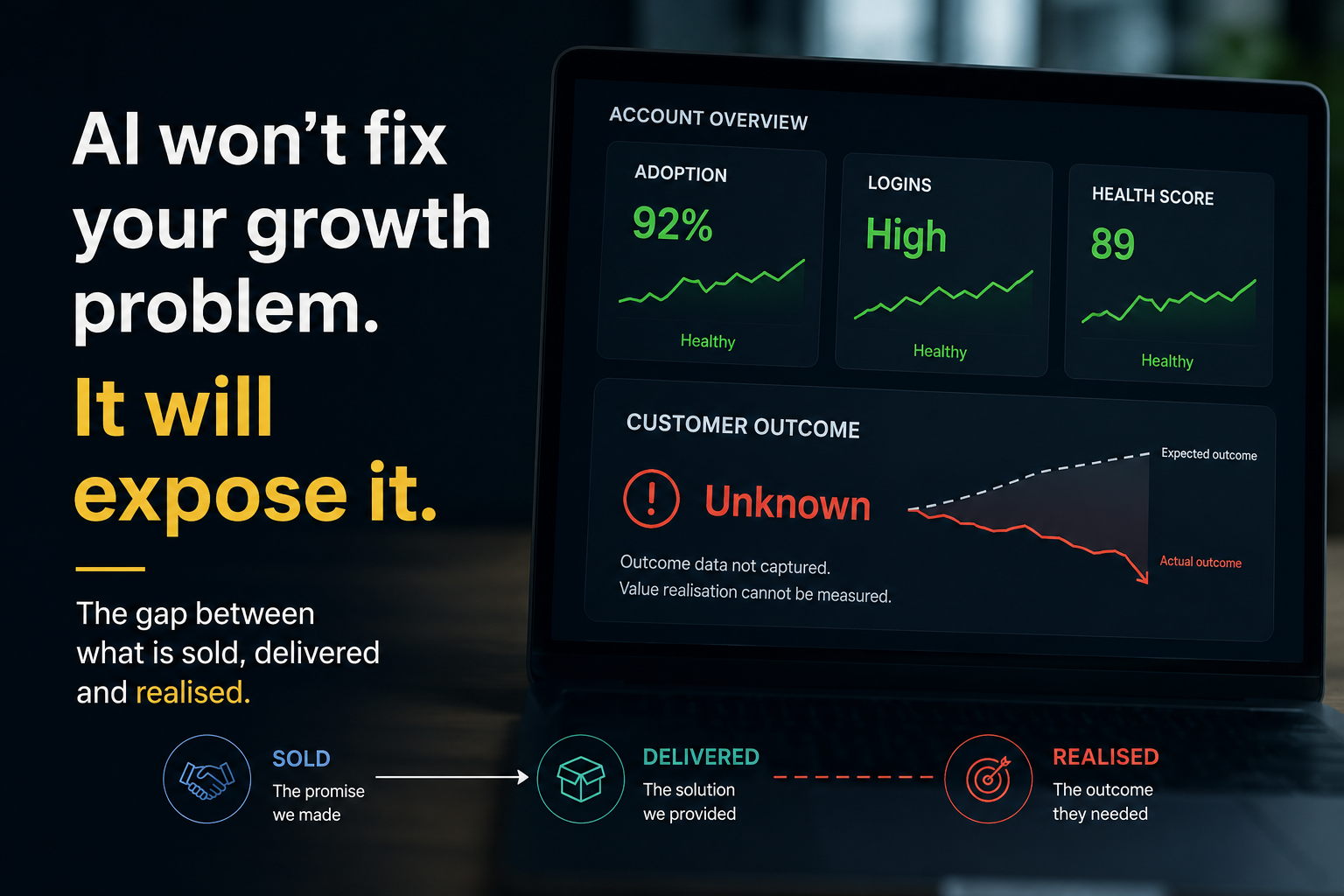
AI won’t fix your growth problem – it will expose it

The gap between what is sold, delivered and realised in SaaS customer success

Most SaaS companies have become very good at measuring what they sell.

Bookings.
ARR.
Pipeline.
Win rates.

Some are reasonably good at measuring what they deliver.

Implementation completed.
Training delivered.
Success plans created.
Support tickets resolved.

Far fewer can tell you whether customers are actually achieving the outcomes they bought the product to achieve in the first place.

That gap matters more than most leadership teams realise.

It’s the gap between what was sold, what was delivered and what was ultimately realised by the customer.

And it’s where churn begins.


The most dangerous metric nobody measures

Imagine a customer buys your platform to reduce onboarding time from 30 days to 10.

The sales team closes the deal.

The implementation team deploys the product.

The Customer Success team runs training sessions.

Usage looks healthy.

Everyone internally believes the account is a success.

But six months later the customer is still taking 28 days to onboard new users.

The software was deployed.

The customer logged in.

The project was completed.

Yet the outcome never happened.

From the customer’s perspective, the investment failed.

Most SaaS businesses have no systematic way of spotting this.

They track activity.

They track adoption.

They track engagement.

They rarely track whether the original business problem was solved.


Why AI is making this problem impossible to hide

Many SaaS leaders believe AI will help them improve retention.

They’re partly right.

AI can identify patterns humans miss.

It can analyse usage data at scale.

It can spot declining engagement.

It can flag customers who look likely to churn.

It can even suggest actions for Customer Success teams to take.

But there is a problem.

AI can only analyse the data it can see.

If your business isn’t measuring customer outcomes, AI cannot magically create them.

Instead, it exposes the weakness.

Faster.

More accurately.

And often more publicly.

AI might tell you a customer’s usage is falling.

What it cannot tell you is whether the customer ever achieved the outcome they bought your solution for.

Because most companies never captured that information in the first place.


The three gaps that quietly destroy growth

Gap 1: The sales reality gap

The customer buys based on one expectation.

The product delivers something slightly different.

Nobody notices until renewal.

The wider the gap between promise and reality, the greater the retention risk.

Gap 2: The delivery gap

The customer receives the software but never fully adopts it.

Features are available.

Processes remain unchanged.

People revert to old ways of working.

The implementation succeeds.

The transformation fails.

Gap 3: The value realisation gap

The customer uses the platform regularly.

Adoption metrics look healthy.

Yet the business outcome never materialises.

Usage exists.

Value does not.

This is often the most dangerous gap because traditional SaaS metrics make everything look healthy.


Why expansion revenue depends on realised value

Many leadership teams view renewals and expansion as separate motions.

Customers don’t.

A customer who achieves meaningful outcomes naturally becomes more open to expansion.

A customer who is still waiting to see value rarely wants to buy more.

This is why the strongest Net Revenue Retention figures usually come from organisations that obsess over customer outcomes rather than product usage.

Expansion is often a lagging indicator of realised value.

Customers buy more when they believe the first investment worked.

Simple.


The question every leadership team should ask

If I stopped one of your account teams in the corridor and asked:

“Why did this customer buy?”

Could they answer?

More importantly:

“What measurable business outcome has the customer achieved since buying?”

Could they answer that too?

If not, you may have a value realisation problem hiding behind healthy-looking adoption metrics.


What to do next

  1. What business outcome were they trying to achieve when they purchased?
  2. How will that outcome be measured?
  3. Has it actually been achieved?

Not implemented.

Not trained.

Not onboarded.

Achieved.

Then build your customer operating model around those answers.

Track them during onboarding.

Review them in customer meetings.

Report them to executives.

Use AI to help analyse them.

But don’t expect AI to create them.

Because AI won’t fix your growth problem.

It will expose it.

And if your customers are not achieving value today, the evidence is about to become impossible to ignore.


Final thought

The next generation of SaaS winners won’t be the companies with the most AI.

They’ll be the companies with the clearest understanding of customer value.

AI will simply make that difference visible.

AI will not fix your Customer Success model – it will expose it

The wrong AI question in Customer Success

Most SaaS companies are asking how AI can make CS more efficient.

The better question is what broken post-sale process they are about to automate.

  • AI makes weak post-sale execution more visible
  • Unclear onboarding becomes faster confusion
  • Poor sales handoffs become cleaner-looking ambiguity
  • Activity-based CS becomes automated noise
  • Weak ownership becomes harder to hide
  • Efficiency is only useful when the model is right

Faster is not automatically better.

AI can help CS teams move faster, but only if the work is pointing at realised customer value.

What an AI-ready CS model needs

  • Clear customer outcomes
  • Faster time to value
  • Better handoffs
  • Value-based health signals
  • Commercial accountability

The real opportunity

The winners will not be the companies that automate the most.

They will be the companies that redesign post-sale around value first, then use AI to scale what works.

Before you automate CS, fix the model

I help B2B SaaS companies fix the gap between what is sold, what is delivered and what customers actually achieve. If retention, expansion or AI-enabled CS is on your leadership agenda, this is the work to start with.

See how I help SaaS companies improve retention, expansion and customer value.

Most SaaS Companies Don’t Need A Bigger Customer SuccessTeam

Why Hiring Another CSM Rarely Fixes Churn

Most SaaS companies respond to churn the same way.

They hire…

  • Another CSM
  • Maybe a Head of Customer Success
  • Sometimes a VP

It feels like progress, but it rarely fixes the real problem.

Because churn is not always a capacity issue.

More often, it is a design issue .

Infographic to download and save below…


The Real Problem

If your customer success function is not clearly driving retention and expansion, adding more people usually creates more activity.

More calls
More QBRs
More dashboards
More internal updates

But not necessarily better outcomes and often, no clear link to revenue.

That is where many SaaS companies get stuck.

They build a bigger customer success team before they have built a proper customer success model.


Where A Customer Success Advisor Fits

A customer success advisor does not simply add more hands.

They help fix the operating model.

That usually means:

  • defining what customer value actually looks like
  • aligning sales, customer success and product around that value
  • building a repeatable system for retention and expansion
  • creating earlier visibility of renewal risk
  • making customer success commercially accountable

This is not about doing more.

It is about doing the right things consistently.


The Pattern I See Repeatedly

Across SaaS companies, the pattern is often the same.

  • Sales sells one version of value
  • The customer expects something slightly different
  • Customer success tries to bridge the gap
  • Product is not always close enough to what is happening after the sale
  • Leadership only sees the issue when churn appears

By then, the problem has usually been building for months.


Why This Matters Now

AI is making this more obvious.

It is now easier than ever to:

  • automate activity
  • generate insights
  • scale customer outreach
  • produce reports
  • identify signals

But none of that fixes a broken model.

In fact, AI can make the problem worse.

If the customer success model is unclear, AI simply helps you scale unclear work faster.

That is not transformation. That is organised noise.


What Good Looks Like

When customer success is working properly, the business feels different.

Retention becomes more predictable.

Expansion becomes systematic, not opportunistic.

Customer success has a clear commercial role.

Sales, product and CS are aligned around the same customer outcomes.

Leadership trusts the numbers because the numbers connect to reality.

That is the shift from customer success as support to customer success as a growth engine.


Practical Takeaway

Before hiring another CSM, ask one question:

Do we know exactly how customer success drives revenue in our business?

Not in theory.

In practice.

  • By segment
  • By customer stage
  • By renewal risk
  • By expansion opportunity
  • By measurable value delivered

If the answer is not clear, another hire will not fix it.

It may simply make the current problem more expensive.


Final Thought

If you are trying to improve retention or make customer success more commercially accountable, the real work usually starts before the next hire.

It starts with the model.

The team can only scale what the business has designed properly.

👉 Customer success advisor

AI has already arrived in Customer Success, the question now is what we do with it?

AI isn’t coming for Customer Success jobs. It’s already here.

Most of the work we used to treat as essential has quietly moved into the background.
Health scores. Renewal reminders. Basic check-ins. The admin that once filled our days is now handled by systems that never get tired.

And that’s a good thing.

Because it forces us to confront something the industry has avoided for too long. The value of a CSM has never been in tasks. It’s always been in thinking.

AI in customer success.


The Shift Nobody Can Ignore

As automation expands across the customer journey, the gap between activity and impact gets wider. CS teams that still define value by volume will struggle. Teams that define value by commercial thinking will thrive.

In 2025, every CSM needs a commercial mindset. Not to sell. But to understand the economics behind every customer conversation.

That’s the real shift.


Why Commercial Thinking Matters

The best CSMs already know the answer to one simple question:

How does our product make this customer more successful in a measurable way?

  • They understand margins
  • They understand cost savings
  • They understand how technology changes the economics of a customer’s business

They talk about return not renewal. Impact not activity. Value not volume.

And that’s where AI draws a sharper line than many expected.

If you’re looking at how AI fits into customer success more broadly, this guide to AI in customer success breaks it down.


Automation Doesn’t Replace Judgment

AI can process. It can surface insights. It can flag risk.

But it can’t replace partnership, judgment or business acumen.

These are the skills that turn a CSM from a task executor into a strategic operator. These are the skills that get Customer Success a seat at the table. And these are the skills that AI only makes more important, not less.


The New Line Between Replaceable & Essential

As more of the workflow becomes automated, the industry is heading towards a split. Not between junior and senior roles. But between replaceable and essential roles.

Replaceable roles cling to tasks. Essential roles understand the customer’s economics and use that understanding to guide decisions.

That’s where the profession is heading. And it’s where the opportunity lies for every CSM who wants to build a durable career as AI scales.


Here’s The Real Question

If Customer Success wants to evolve, it has to speak the language of business, not tasks. It has to show how decisions drive outcomes, not how many activities got logged.

And that means one thing.

Every CS leader needs to help their teams build commercial muscle.

Every CSM needs to learn how to anchor conversations in value.

And every organisation needs to decide whether CS will be a cost centre or a growth engine.

AI has already changed the role. Now it’s on us to decide what Customer Success becomes next.

How are you helping your team develop that commercial edge this year?


Want To Go deeper?

If you’re thinking about retention, expansion or how AI fits into your strategy, I work with a small number of SaaS companies on exactly this.

👉 If you’re rethinking your approach, let’s talk.

The Future of Customer Success with AI: Why Human + Machine Wins Every Time

The era of reactive Customer Success – firefighting churn and hoping renewals stick – is well and truly over. We’re entering a new phase where AI becomes a force-multiplier for CS teams.
And yes, it means some uncomfortable shifts for us – here’s what that means.

From Operations To Strategic Growth

Many CS teams still run like service desks – onboarding, adoption monitoring, renewals.
But with the AI tools now available, that model’s outdated.

AI helps you:

  • Spot early churn signals before it’s too late
  • Surface expansion opportunities inside existing accounts
  • Turn data from reporting to revenue-shaping

Infographic showing "The AI-Powered Customer Success Flywheel" - how data, insight, action, value, and retention form a continuous loop.

I explore this shift further in AI and customer retention value, where we look at how predictive data models are changing renewal strategy and growth forecasting.

My take: If you’re still tracking logins as a measure of success, you’re playing last decade’s game. Start measuring expansion rate, health-score movement and churn proactively averted.


The Hybrid Human & AI Dynamic

Let’s settle it: AI won’t replace CSMs. It will redefine them.

  • Low-touch accounts will be handled by automation
  • High-value accounts will get human, strategic focus

AI clears the admin noise so CSMs can focus on relationships, outcomes and (measurable) value creation.

This kind of shift demands new leadership models – I break that down in fractional leadership in Customer Success, including how part-time senior leaders can scale AI adoption faster than traditional org structures.

My take: Future-proof your role by mastering adoption analytics, customer value mapping and data-driven storytelling. The check-in and help model is over.


Hyper-Personalisation At Scale

AI makes it possible to deliver personalised experiences at scale. From predictive onboarding to sentiment-based renewal timing – your customers now expect it.

Diagram comparing AI automation and human CSM roles - "Let AI handle volume. Let humans handle value."

Examples:

  • Predict which onboarding path works best for a specific persona
  • Trigger interventions based on real-time usage or sentiment
  • Tailor renewal outreach to context, not template

My take: The winners in 2026 will treat every customer – even low-tier ones – as growth potential. AI gives you that lever.


Ethics, Governance & Trust

With power comes responsibility. AI in CS isn’t just about dashboards and prediction models – it’s about trust.

Guardrails matter:

  • Be transparent when AI is acting on behalf of your team
  • Audit outputs for bias or unfairness
  • Protect data and get explicit consent where needed

My take: Without governance, your AI strategy becomes a liability. Treat ethics as part of your operating model – not an afterthought.


The Next-Gen Playbook

Focus Area What to Do
Start with small wins Pilot churn prediction or personalised onboarding
Build your data foundation Standardise usage, sentiment, and engagement metrics
Redefine roles Upskill CSMs in data literacy and strategy
Scale intelligently Use AI for volume; use people for value
Govern everything Audit outputs, define KPIs, track both efficiency and outcomes

Many organisations need outside perspective to implement this playbook. My Customer Success advisory and consulting services help define those AI-enabled strategies and operational changes.


Closing Thoughts

If you treat AI as optional, you’ll fall behind. AI isn’t here to replace Customer Success – it’s here to amplify it.

Let machines handle volume. Let humans handle value.

That’s the model of the future.

For more real-world conversations on AI, growth, and leadership, tune in to the Breakthrough SaaS Growth with The Jasons podcast.


Sources


Want To Go deeper?

If you’re thinking about retention, expansion or how AI fits into your strategy, I work with a small number of SaaS companies on exactly this.

👉 If you’re rethinking your approach, let’s talk.

AI Didn’t Rewrite Customer Success – It Rewired It

For years, we’ve obsessed over dashboards – health scores, usage data, adoption charts and a lot more.

All useful, but all missing something – and something super important for both our customers and us.

AI’s pulled the rug a bit. It’s made us look past the numbers and ask a harder question – what value do customers actually feel?

That’s where the real work is now. The tech can show us what’s happening, but only people can explain why it matters. Only people can connect the dots between insight and impact.

It’s not that Customer Success has become easier. Far from it. The job’s getting sharper. More strategic. Less about coverage, more about clarity.

I’ve always said data without context is noise. AI has turned up the volume.

If you’re looking at how AI fits into customer success more broadly, this guide to AI in customer success breaks it down.

And that’s the shift smart CS leaders are already leaning into – where human judgment becomes the real competitive edge.

If you’re looking at how AI fits into customer success more broadly, this guide to AI in customer success breaks it down.


Want To Go deeper?

If you’re thinking about retention, expansion or how AI fits into your strategy, I work with a small number of SaaS companies on exactly this.

👉 If you’re rethinking your approach, let’s talk.

What Home Renovation Taught Me About Leadership & Customer Success

Change the space – keep what matters

My home office is mid-renovation, so I’ve temporarily moved into my daughter Sophie’s old room. She’s safely back at university – no clashes over desk time.

It’s a change of scene, but not without a few familiar touches.

The Lego Saturn V, ISS, Lunar Lander and Death Star sets all came with me.

They’ve been dusted off and now stand proudly in the new temporary setup.

Lego in room

Lego in room


Change Is Healthy

Sometimes, a change of environment resets your perspective. A fresh backdrop brings fresh ideas. The small shake-ups matter. They remind you that disruption isn’t something to fear – it’s often what unlocks progress.

Reno in action


Keep What Inspires You

Those Lego builds aren’t just decoration.

They’re reminders of creativity, patience and problem-solving – the same traits that drive good leadership and customer success.

Whatever your workspace looks like, keep the things that inspire you within sight. They anchor your thinking when everything else is shifting.

Keeping this Lego and the rest


Customer Success In Real Life

The decorator doing the heavy lifting has worked with us for over 20 years.

That’s what real customer success looks like: consistency, quality service, the expected outcomes, trust and mutual respect.

The best partnerships – at home or at work – are the ones that last because both sides keep showing up.


The Takeaway

  1. Change the space
  2. Keep what matters
  3. It’s true for offices, teams and strategies alike

Want To Go deeper?

If you’re thinking about retention, expansion or how AI fits into your strategy, I work with a small number of SaaS companies on exactly this.

👉 If you’re rethinking your approach, let’s talk.

Why Fractional Leadership Is the Growth Engine Most Companies Overlook

Scaling a business isn’t a straight line. It’s a series of leaps and the moments between them are often where things stall.

You’ve built traction, customers are onboard, revenue’s growing… but the next phase needs something different: deeper experience, sharper structure, and leadership that can flex with pace.


The Missing Piece In The Middle

Most companies hit a point where they’ve outgrown their early playbooks but aren’t yet ready for a full-time exec bench.

Hiring senior talent outright can feel like overkill. But staying without it means growth slows, customers drift, and teams start solving the same problems twice.

Fractional leaders bridge that gap. They bring in decades of operational know-how for a fraction of the cost – but more importantly, they bring clarity when the organisation’s in flux.

They know how to stabilise and accelerate at the same time.


Strategic Experience, Without The Drag

A good fractional leader isn’t a consultant. They roll up their sleeves, diagnose fast and embed systems that last beyond their engagement.

For Customer Success and Customer Growth in particular, that means:

  • Turning renewal and expansion into repeatable motions rather than one-off wins

  • Building customer health and data models that inform product and sales, not sit in a dashboard

  • Creating playbooks that enable your team to deliver value consistently, with or without a senior leader in the room

It’s hands-on strategy. Immediate traction without the long recruitment cycle or executive overhead.


Fresh Eyes In Familiar Territory

Another quieter advantage is perspective.

Internal teams are often too close to their own noise. A fractional leader can spot gaps in process, people and product alignment that everyone else has normalised.

Because they’ve seen patterns repeat across industries, they can cut through politics and legacy thinking to focus on what actually drives retention, advocacy and scalable growth.


A Model Built For Modern Growth

The world’s moved on from fixed org charts and often extended hiring cycles.

Fractional leadership gives companies the ability to bring in seasoned operators exactly when they’re needed, to design a customer success function, lead a transformation or reset go-to-market alignment.

It’s fast, focused and measurable. And in a market where customer expectations shift faster than headcount budgets, that kind of agility isn’t optional.


The Real Win

Fractional leadership isn’t a stopgap, it’s a growth strategy.

It helps organisations move with intent, guided by leaders who’ve already navigated the traps you’re walking toward.

And when it’s done right, the value doesn’t leave when they do. It scales with your team, your customers and your next chapter of growth.

Read next: Customer Growth Isn’t Magic – It’s Design


Want To Go deeper?

If you’re thinking about retention, expansion or how AI fits into your strategy, I work with a small number of SaaS companies on exactly this.

👉 If you’re rethinking your approach, let’s talk.

From Retention To Expansion: How AI Drives Compounding Growth

In one of my last posts, I looked at how AI helps protect retention – the real growth engine. But retention is only half the story. The real prize in SaaS comes when customers not only stay, but grow.


Why Expansion Is Harder Than It Looks

Most SaaS teams talk about “land & expand” – but the expand part often relies on heroic effort:

  • CSMs spotting upsell chances by instinct

  • Leaders scrambling to pull value data together before renewals

  • Execs parachuted in to save shaky deals

That model doesn’t scale, and it leaves too much growth on the table.


How AI Changes The Expansion Playbook

AI turns guesswork into foresight:

  • Expansion scoring: pinpoints which accounts are most likely to grow

  • Predictive renewals: shows which deals need early attention

  • Automated ROI stories: packages the evidence in the customer’s own business terms

Instead of reacting late, teams can walk into renewal and expansion conversations armed with data-backed growth paths.


Embedding AI Into Everyday CS

The best CS teams are already using AI to:

  • Map whitespace opportunities in account planning

  • Auto-build outcome packs for customer value reviews (the old QBRs and EBRs)

  • Identify promoters ready for advocacy programmes

Each of these increases revenue without burning out people.


The Compounding Effect

Retention gives you stability. Expansion gives you momentum. AI is what makes both scalable. The companies that crack AI-powered expansion won’t just hit renewal targets – they’ll create a compounding loop where customers renew, grow and advocate, driving growth from within.


Want To Go deeper?

If you’re thinking about retention, expansion or how AI fits into your strategy, I work with a small number of SaaS companies on exactly this.

👉 If you’re rethinking your approach, let’s talk.

Service Obsession: The Growth Lever SaaS Keeps Ignoring

Most teams still chase growth like magpies. New logos, shiny pricing moves, AI fluff. Then they wonder why churn quietly eats the gains.

The biggest driver of durable SaaS growth is service obsession. Not theatre. Not a slogan on a wall. The day-to-day discipline of serving customers so well they do not want to leave.


What Service Obsession Actually Means

It is not simply “be nice”. It is a system.

  • Proactive problem solving
    Fix issues before customers notice. Ship the small fix that removes a daily annoyance.

  • Ownership to outcome
    No dead hand-offs. One owner carries the ball to done.

  • Tiny details, big compounding
    The 2 minute change that saves a user 20 clicks. The follow up that lands when you said it would.

  • Customer voice at the table
    Product, pricing, roadmap reviewed through a customer impact lens, not only an internal efficiency lens.

  • Loyalty before logos
    Renew, expand, then acquire. Not the other way round.


Why It Works

  • Trust lowers churn
    When customers trust you to show up, they give you time to fix things.

  • Frictionless value unlocks expansion
    Small quality-of-life improvements get used, then they get bought.

  • Advocacy is the cheapest marketing
    Happy customers sell for you in rooms you are not in.


The Numbers That Matter

If you lean into service obsession, track these to prove it is working:

  • NRR by cohort and segment

  • Time to first value and time to second value

  • Bug fix lead time for top 10 recurring issues

  • Support to product loop speed

  • Renewal risk removed per week

  • Referenceable accounts created per quarter

You will notice none of these require viral posts or fancy pricing. They require operational consistency.


The Playbook

If you’re thinking about retention, expansion or how AI fits into your strategy, I work with a small number of SaaS companies on exactly this.

👉 If you’re rethinking your approach, let’s talk.

0 – 30 days: foundations

  • Map the top 10 customer paper cuts. Fix three this month. Tell customers.

  • Create a single owner list for your top 20 renewal risks. One name per account.

  • Add a 15 minute weekly “NRR stand-up” across CS, Product, Support, Sales. Review risks, fixes, next actions.

  • Publish a public changelog. Small fixes included.

30 – 60 days: flywheel

  • Launch one proactive trigger. Example: detect stalled onboarding at day 7, auto open a task with a human call.

  • Introduce “fast lanes” for high pain bugs. Agree an SLA with Product.

  • Make expansion a consequence of value. Add usage-based nudges that point to the next paid capability.

60 – 90 days: scale

  • Build a customer fix backlog with a standing weekly capacity allocation. Always ship at least one small win.

  • Turn your top 10 happiest customers into named advocates with a clear ask and give.

  • Share a monthly NRR memo to the exec team. One page. Trends, risks, wins, asks.


Objections You Will Hear

  • “It does not scale.”
    The paradox is the point. Do unscalable things to earn the right to scale. Trust compounds faster than paid ads.

  • “We need to focus on acquisition.”
    Fine. But leaked revenue kills CAC payback. Patch the bucket before you pour more in.

  • “This is just support.”
    Support reacts. Service obsession designs the system so customers do not need support.


What Good Looks Like

  • The company fixes the small things fast. Customers notice. Your CSMs spend less time firefighting and more time coaching.

  • Roadmap updates link back to customer outcomes, not only feature counts.

  • Renewals feel like a thank you, not an ambush. Many convert to multi-year by choice.

  • Sales bring CS into deals early because it helps them win and stick.


A Simple Scorecard

Give yourself a blunt weekly score out of 5 for each:

  • Paper cuts (small issues that can hurt) removed

  • Renewal risk reduced

  • Advocacy created

  • Time from customer pain to fix shipped

  • Product decisions with a clear customer outcome stated

Trend the scores. Review every Friday. Fix one thing before you go home.


Start This Week

  • Pick one customer who is lukewarm. Call them. Ask what is getting in the way of value. Remove it within 72 hours.

  • Ship one small product improvement that reduces a frequent support ticket.

  • Publish a two sentence changelog. Tell customers what you fixed and why.

  • Close one renewal early by earning it, not discounting it.


Closing Thought

Service obsession is not a hack. It is the system. When you build it in, growth stops feeling like a treadmill and starts compounding on its own.


Want To Go deeper?

If you’re thinking about retention, expansion or how AI fits into your strategy, I work with a small number of SaaS companies on exactly this.

👉 If you’re rethinking your approach, let’s talk.