There’s a number circulating right now that should make every SaaS founder and leader sit up.
AI-native SaaS products have a median gross revenue retention rate of 40%. For context, the B2B SaaS median is 82%. That’s not a rounding error – it’s a 42-point gap and it’s prompting a lot of people to conclude that AI-native products are fundamentally harder to retain.
They’re wrong. And the data proves it.
What “AI Tourist” Actually Means
ChartMogul coined the phrase “AI tourist” to describe what’s driving this churn pattern. Users sign up because the product looks interesting, the demo is slick and the pricing is low enough to not require a procurement conversation. They experiment for a few weeks, hit a wall – maybe the use case isn’t quite right, maybe a competitor ships something shinier – and they’re gone.
This isn’t a story about bad AI. It’s a story about how people buy things they don’t need to commit to.
When the barrier to entry is $19 or $29 a month, the barrier to exit is equally low. There’s no contract to navigate, no internal stakeholder who championed the purchase, no workflow that breaks if the tool disappears. The customer signed up alone and they’ll leave alone.
That’s the AI tourist. They came for a look around. They were never planning to stay.
The Price Point Data Is Striking
Here’s where the conventional narrative falls apart.
ChartMogul’s data segments AI-native SaaS products by price point, and the retention picture is almost entirely determined by what you charge – not what the AI does.
Products priced above £200 (roughly $250) per month see 70% gross revenue retention and 85% net revenue retention. That’s essentially the same as traditional B2B SaaS. Products priced between $50 and $249 per month see 45% GRR and 61% NRR. Products priced below $50 per month see 23% GRR – meaning nearly 80% of revenue churns out within a year.
Same technology. Same category. Entirely different retention profile.
The variable isn’t the product. It’s who’s buying it, how they’re buying it and what’s at stake if they stop.
Why This Matters for CS Teams
If you’re a leader at an AI-native company and your retention numbers look ugly, the temptation is to reach for customer success playbooks. More onboarding touchpoints. Better health score models. Proactive outreach at 30 days.
Some of that will help at the margins. But if your core problem is that you’re selling a $29/month tool to individuals who don’t have a business outcome attached to it, no customer success motion fixes that. You’re putting a retention programme on top of a churn machine.
The commercial diagnosis here is uncomfortable but important: the customer success function can’t compensate for a flawed go-to-market model.
What you can do – and this is where customer success genuinely earns its seat in the room – is make the business case for moving upmarket. The data is unambiguous. When AI-native products sell to genuine business buyers at $250+ per month, they retain like traditional SaaS. The AI isn’t the risk. The self-serve, consumer-grade pricing model is.
What Moving Upmarket Actually Looks Like
Moving upmarket isn’t just raising prices. It’s a set of decisions about who you sell to, how they buy and how deeply embedded your product becomes in their actual workflows.
A few things tend to shift when you go from self-serve consumer to B2B buyer.
There’s a procurement process, which means there’s an internal champion. That person’s reputation is partly tied to the tool working. They don’t cancel without a conversation first.
There’s an integration layer. Your product connects to their CRM, their Slack, their ticketing system. Ripping it out takes effort. Switching costs go up.
There’s an outcome attached. The business bought the tool to achieve something specific – reduce support volume, increase renewal rates, speed up onboarding. You can measure it. You can show progress. That’s the foundation of a genuine retention conversation.
None of this happens at $25 or £25 a month. It happens when the deal is significant enough that both sides take it seriously.
The Lesson That Extends Beyond AI-Native SaaS
The AI tourist effect isn’t just a problem for AI-native companies. It’s a warning signal for any SaaS business that’s drifted toward self-serve growth without examining the retention consequences.
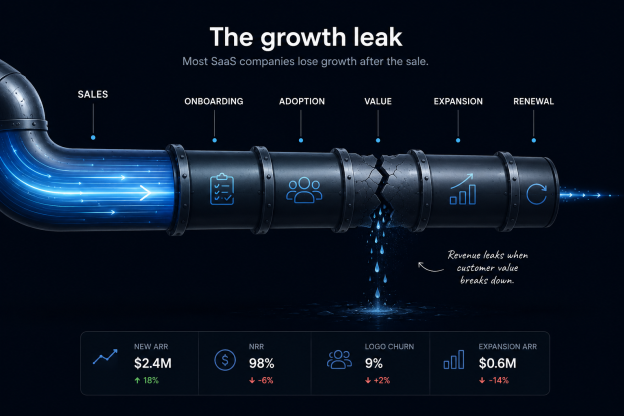
The economics look attractive at first. Low CAC, fast time-to-revenue, no sales headcount required. But if you’re churning 60%-70% of revenue annually, you’re running a leaky bucket – and growth is just masking the leak.
The companies that will build durable NRR in this environment are the ones embedding themselves into critical business workflows, selling to buyers who have accountability for outcomes and building customer success motions that tie directly to measurable value.
That’s not a new idea. But the AI tourist data gives it a specificity that’s hard to argue with.
The Practical Takeaway
If you’re a customer focused leader in an AI-native company, here’s the question worth putting to your leadership team: are the customers we’re churning the ones who were ever going to stay?
If the answer is no – if you’re churning self-serve, low-ACV, low-commitment buyers at the bottom of your customer base – then the retention conversation needs to start with pricing and ICP, not onboarding sequences.
The AI isn’t the problem. The market motion is.
Get that diagnosis right and the customer success playbook becomes much more straightforward.
Want to Talk Through What This Means for Your Business?
If you’re a SaaS leader wrestling with retention in an AI-native product – or advising a company that is – I work with customer success and revenue teams to build operating models that hold up under board scrutiny.
Book a 30-minute conversation and let’s look at the actual numbers together.
Or follow me on LinkedIn where I write about this kind of thing every week – commercial customer success, retention mechanics and what’s actually changing in the post-sale world.
Sources: ChartMogul SaaS Retention Report – The AI Churn Wave (2025/2026); ChartMogul The New Normal for SaaS Retention