Tag Archives: value

Most SaaS companies don’t have a sales problem – they have a value delivery problem

Your sales engine is running.

Pipeline looks healthy. New logos are coming in. Revenue targets appear achievable.

But your NRR is telling a different story.

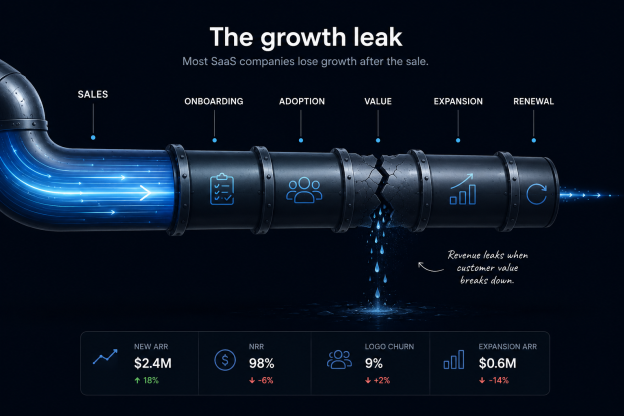
Somewhere between contract signature and renewal, growth is leaking.

Customers are going live but not expanding. Adoption exists but commercial momentum stalls. Customer Success teams are busy, yet leadership still struggles to clearly connect post-sale activity to retention and expansion outcomes.

This is one of the most common problems in SaaS right now.

And most companies feel it long before they can properly articulate it.

Why SaaS growth leaks after the sale

Most SaaS organisations are heavily optimised around acquisition.

Sales, marketing and product investment often dominate strategic conversations because they are easier to measure in the short term. Pipeline growth feels visible. New ARR feels tangible.

Post-sale execution is different.

The warning signs usually appear gradually:

  • Renewals become reactive
  • Expansion becomes unpredictable
  • Onboarding drags
  • Customers stay “active” without achieving meaningful outcomes
  • Customer Success becomes overloaded with activity but commercially unclear

Over time, growth slows despite continued acquisition investment.

That is when leadership teams start asking harder questions about retention, customer value and operational efficiency.

The gap between adoption and customer value

One of the biggest mistakes SaaS companies make is confusing product usage with realised value.

A customer logging in regularly does not automatically mean they are successful.

Many organisations measure:

  • logins
  • feature usage
  • meeting volume
  • ticket response times

But customers do not renew because they attended QBRs.

They renew because the product helped them achieve a business outcome that mattered.

That gap between activity and realised value is where many SaaS businesses quietly lose expansion opportunities.

The strongest Customer Success organisations understand this clearly. They align onboarding, adoption and ongoing engagement around measurable customer outcomes rather than internal process metrics.

Why Customer Success becomes commercially unclear

In many SaaS businesses, Customer Success evolves reactively.

The function grows quickly as customer numbers increase, but ownership boundaries often remain vague.

Sales owns revenue.

Support owns problems.

Product owns features.

Customer Success ends up sitting somewhere in the middle trying to hold everything together.

The result is predictable:

  • unclear commercial accountability
  • inconsistent customer experiences
  • fragmented definitions of value
  • poor cross-functional alignment

This is why some CS teams appear extremely busy while leadership still struggles to see measurable commercial impact.

The issue is rarely effort. It is operating design.

We recently discussed this exact shift on our podcast Breakthrough SaaS Growth with The Jasons in our episode From Customer Success to Customer Growth – The Next Evolution of SaaS, where we explored why Customer Success is increasingly evolving into a commercial growth function rather than simply a post-sale support layer.

How AI is exposing weak post-sale execution

As I covered in my article on AI-enabled Customer Success, the companies gaining advantage are not simply automating support tasks. They are redesigning how customer value is delivered.

Not because AI itself is causing churn, but because it exposes operational weaknesses much faster than before.

Weak onboarding becomes visible earlier.

Poor adoption patterns surface sooner.

Customers expect faster time-to-value and more proactive engagement.

Companies that simply automate broken post-sale processes will struggle.

The organisations gaining advantage are the ones redesigning how customer value is delivered in the first place.

They are using AI to:

  • identify churn risk earlier
  • improve customer visibility
  • reduce onboarding friction
  • surface expansion opportunities
  • scale proactive engagement

But the technology only works when the underlying operating model is aligned around customer outcomes.

AI does not fix value delivery problems.

It exposes them.

What high-performing SaaS companies do differently

The strongest SaaS companies treat post-sale execution as a growth function, not a support function.

They align sales, product and Customer Success around shared customer outcomes.

They focus on:

  • faster time-to-value
  • measurable business impact
  • operational clarity
  • scalable customer engagement
  • retention and expansion as board-level metrics

Most importantly, they understand that sustainable SaaS growth does not break at acquisition.

It breaks after the sale when customers stop progressing.

By the time NRR starts falling, the underlying problems have usually existed for months.

Sometimes years.

That is why the companies outperforming right now are not necessarily the ones automating the most.

They are the ones aligning their organisation around realised customer value.

Many SaaS companies already know something is breaking post-sale. The challenge is diagnosing where the operational gaps actually sit.

That’s typically where a Customer Success advisor can help bring clarity.

Customer Retention vs. Acquisition in SaaS – What Actually Drives Growth

Most SaaS companies are built to acquire customers. Very few are built to keep and grow them.

That’s the problem.

Because in SaaS, growth doesn’t come from how many customers you win. It comes from what happens after the sale.


The traditional thinking

The default model is simple:

  • Invest in marketing
  • Drive pipeline
  • Close new customers
  • Repeat

It works. Until it doesn’t.

Because over time:

  • Customer acquisition gets more expensive
  • Sales cycles get longer
  • Conversion rates drop

And suddenly, growth slows.


The reality of SaaS growth

In SaaS, retention is not a support metric. It’s the foundation of growth.

If customers don’t stay, nothing compounds.

If they don’t expand, revenue stalls.

That’s why the strongest SaaS companies focus on:

  • High retention
  • Consistent expansion
  • Fast time to value

Not just new logo acquisition.


Why retention beats acquisition

Acquisition creates revenue. Retention protects it. Expansion multiplies it.

Without retention:

  • You’re constantly replacing lost revenue
  • Growth becomes fragile
  • Forecasting becomes unreliable

With strong retention:

  • Revenue compounds
  • Customer lifetime value increases
  • Growth becomes predictable

Where most SaaS companies get it wrong

They treat Customer Success as a support function.

Not a growth function.

So you see:

  • Reactive customer teams
  • No clear ownership of expansion
  • Metrics focused on activity, not outcomes
  • No alignment between sales and Customer Success

The result?

Retention underperforms and expansion never quite materialises.


The shift from Customer Success to Customer Growth

The best SaaS companies are making a shift.

From:

👉 Customer Success as support

To:

👉 Customer Success as a revenue engine

That means:

  • Defining customer value early
  • Aligning sales and post-sale around outcomes
  • Tracking leading indicators, not just churn
  • Building expansion into the lifecycle

What this means for founders and CEOs

If you’re leading a SaaS business, this is not a trade-off.

You need both, but the balance matters.

If your growth is driven only by acquisition:

  • You’ll always be under pressure to sell more
  • Your cost of growth will keep increasing

If your growth is driven by retention and expansion:

  • Revenue compounds
  • Growth becomes more efficient
  • The business becomes more valuable

Bringing it together

Customer acquisition gets you started. Customer retention and expansion are what scale the business.

That’s the difference between:

👉 chasing growth and…
👉 building a growth engine


CTA (link this properly)

If you’re thinking about how to improve retention, reduce churn or build a Customer Success function that actually drives growth:

👉 See how I work as a fractional Customer Success leader.

Why Customer Centricity Matters More Than Ever

Today’s customers have changed – dramatically. They’re always on, always connected and always expecting more. They’re comparing you to the best experience they’ve ever had anywhere, not just to your closest competitor. That’s a very high bar.

Customer Centricity

Customer Centricity

The businesses that will thrive now aren’t necessarily the biggest, the cheapest or the flashiest. They’re the ones that truly put the customer at the heart of their strategy.

Customer Centricity Isn’t a Buzzword

It’s not a slogan you stick on a wall. It’s a way of working. That means:

  • Talking about customers in every team meeting, not just the quarterly review.

  • Replacing “what’s easiest for us?“ with “what’s right for the customer?“

  • Measuring success by outcomes achieved, not just internal activity completed.

The Stakes Are Higher

Customers have more choice than ever before. Switching is easy and loyalty is fragile. If you’re not showing value in every interaction, someone else will.

Technology Isn’t the Shortcut

AI, automation and analytics can help – but only if they’re aligned to what your customers actually need. Automating a bad process doesn’t make it customer-centric. Predictive insights are useless if you’re not acting on them.

The Real Payoff

Customer-centric organisations:

  • Build trust and credibility faster

  • See higher retention and growth

  • Adapt quicker because they understand changing needs

This isn’t about being nice to customers. It’s about building a sustainable business in a world where expectations keep climbing.

Why it's important

Why it’s important

Customer centricity used to be a differentiator. Now, it’s the entry ticket.

The Next Chapter in Customer Engagement: Beyond QBRs to Customer Value Reviews

It’s clear we’re on a transformative journey when we look at how to deliver real value to our customers, but how do we effectively implement this shift?

1️⃣ Customised Value Pathways: It’s about creating tailored review schedules that resonate with each customer’s unique journey, not a one-size-fits-all approach.

2️⃣ Deep-Dive into Customer Worlds: Stepping into our customers’ shoes, understanding their challenges and ambitions, and aligning our services to support their strategic objectives.

3️⃣ Ongoing Value Assessment: Continuous interaction is key. We’re talking regular check-ins, not just quarterly reviews, to ensure we’re constantly adapting to and meeting evolving needs.

4️⃣ Accurate Trend Analysis: Keeping a close eye on business trends and progress is essential. It ensures that the value we deliver is not only current but also predictive and proactive.

This evolution in our approach is more than just a change in schedule; it’s a fundamental shift in mindset. What steps are you taking to make your customer reviews more dynamic and value-driven?

Unlocking Customer Lifetime Value: The Key to Long-term Success

Introduction:

Customer Lifetime Value (CLTV) holds the key to long-term success in business. Unraveling the potential of CLTV is crucial for building lasting relationships and driving sustained revenue growth.

Understanding CLTV:

Customer Lifetime Value is not solely about revenue but about fostering enduring value for customers. It is a vital metric for gauging an organization’s growth and prosperity. For instance, consider a subscription-based service like Netflix, where a loyal customer who subscribes for years contributes substantially to the company’s CLTV.

Viewing Value from Different Angles:

CLTV is more than just revenue; it encompasses different perspectives of value. Identifying and aligning with the customer’s definition of value is crucial. An example could be a luxury car brand that offers exceptional customer service, providing value that extends beyond the purchase.

Applying CLTV in Practice:

Measuring CLTV beyond revenue involves assessing advocacy, referrals, and recommendations, which are immensely valuable. Forecasting CLTV requires a careful consideration of customer segments and past profiles. For example, a software company may analyze user adoption metrics to predict long-term value.

Customer Success Has Changed

“Customer Success has changed”

The world has changed and very rapidly over the last few years and our what were “traditional” customer success teams and functions have shifted massively and there’s more change to come.

  1. Burnout was already high but now churn is rising and so are layoffs.
  2. The SaaS model that defined much of the 2010s and early 2020s was predicated upon having access to near-unlimited capital.
  3. Customer Success was already struggling through three distinct crises: Overextended roles, high stress and unrealistic expectations, and previous leniency on metrics.

It’s a wakeup call! We need to think differently and shift:

  1. Streamline Customer Success roles to focus on core value delivery.
  2. Adjust job expectations and provide sufficient support to prevent burnout.
  3. Identify which metrics matter to customers upfront and focus all your energy on driving those to demonstrate the value your solution provides early and often.

We need to start refocusing on customer value and change our thinking and approach.