Tag Archives: customer growth

The Next Era of Customer Success

It’s Changing

For years Customer Success was framed as a pro-active support function. Helpful. Important. But rarely commercial.

That framing made sense in the early days of SaaS. Companies were still learning how subscription businesses behaved. Retention mattered but growth still came primarily from new logos.

But it’s no longer true and it’s something that many companies still struggle with.

Today many SaaS companies generate as much growth from existing customers as they do from new ones. Expansion revenue, renewals and product adoption have become the most predictable drivers of performance.

Which means Customer Success is changing. It is moving from a relationship function to something far more strategic. A revenue system.


The Signals Are Already Visible

Over the last year the direction of travel has become clearer. AI adoption inside Customer Success teams is accelerating quickly.

According to the Gainsight Customer Success Index:

  • 52% of Customer Success teams are already using AI
  • 91% expect AI to significantly impact their strategy

Source

But at the executive level there is still scepticism. The PwC Global CEO Survey found that 56% of CEOs say AI has not yet delivered meaningful financial returns.

Source

That gap matters. Technology is evolving quickly. Operating models are not.

Many organisations are still working out how AI, Customer Success and revenue growth actually connect.


Customer Success Is Your Revenue Engine

The companies getting this right are changing how they design Customer Success. They are no longer measuring activity. They are measuring outcomes and valued delivered to customers.

Growth depends on what happens after the deal. This is explored in more detail in this guide to AI in customer success.

Instead of focusing on engagement scores, meeting counts or dashboard activity, they focus on metrics that boards understand immediately.

  • Gross revenue retention
  • Net revenue retention
  • Expansion revenue
  • Time to value
  • Cost to serve

When Customer Success is built around these metrics it becomes one of the most predictable growth levers in a SaaS business. Often the most efficient one. Because growing existing customers is almost always cheaper than acquiring new ones.


The Mistake Many Companies Still Make

Despite the maturity of the discipline, many organisations still run Customer Success like a relationship management team.

  • More meetings
  • More check-ins
  • More quarterly reviews

But simple activity is not value. Customers do not renew because a meeting happened. They renew because the product is delivering measurable outcomes inside their organisation.

The next generation of Customer Success therefore looks different.

It is more:

  • Data driven
  • Operationally scalable
  • Focused on outcomes

The goal is not to talk to customers more. The goal is to help customers achieve value faster. Let’s call it value acceleration.


Where AI Actually Fits

AI will not replace Customer Success. But it will change how it operates. The biggest impact will be scale.

AI is already helping teams:

  • Identify churn risk earlier
  • Analyse product usage patterns
  • Summarise customer conversations
  • Automate onboarding steps
  • Surface expansion opportunities

This allows Customer Success teams to manage significantly larger portfolios of customers while focusing human effort on the moments that matter most.

The work becomes more strategic and yes, more commercial.


The Debate Shaping The Industry

There is still one unresolved question in Customer Success that is being asked too many times – should Customer Success own revenue?

Some companies expect Customer Success teams to manage renewals and expansion. Others separate the roles.

Customer Success focuses on value. Sales focuses on commercial negotiation.

There is no universal answer yet but the direction of travel is clear.

Customer Success is moving closer to revenue ownership whether organisations formally recognise it or not. Because retention and expansion are where sustainable growth increasingly comes from.


What CEOs & Founders Should Focus On Now

If you run a SaaS business today, three questions matter.

(1) Do we know exactly why customers renew?

If the answer is vague, your retention strategy is fragile.

(2) Can we predict churn before it happens?

Most organisations still rely on lagging indicators. By the time a customer is clearly unhappy, it is often too late.

(3) Is Customer Success designed to scale?

Human-heavy operating models break quickly once companies grow beyond a few hundred customers. Digital journeys, automation and AI are becoming essential infrastructure. Not optional improvements.


The Next Phase Of Customer Success

Customer Success is no longer a new discipline. But it is entering a new phase.

The first era focused on customer experience. The next era will focus on something much simpler and that is Revenue retention.

The companies that understand this shift early will build more resilient SaaS businesses.

And the leaders who design Customer Success around revenue outcomes will have one of the most powerful growth levers in modern software.


Want To Go Deeper?

If you’re thinking about retention, expansion or how AI fits into your strategy, I work with a small number of SaaS companies on exactly this.

👉 If you’re rethinking your approach, let’s talk.

Strategic Customer Success for Growth: A Guide for CSMs and Business Leaders

Introduction

In the fast-paced world of SaaS and technology, Customer Success Managers (CSMs) are the linchpins of growth. But are you working strategically with your customers, or are you stuck in a reactive loop? This blog post aims to shift your mindset towards a more strategic approach to customer success, driving not just retention but also growth.

Why Strategy Matters in Customer Success

  • Beyond Firefighting – being reactive solves problems but doesn’t drive growth. Strategic planning helps you anticipate customer needs.
  • Alignment with business goals – a strategic approach ensures that your customer success efforts directly contribute to business objectives.

Key elements of strategic Customer Success include:

  1. Customer Segmentation – High-Value vs Low-Value: Not all customers require the same level of attention. Segment them to allocate resources more effectively.
  2. Success Planning –  Individualised Roadmaps: Create success plans tailored to each customer segment, outlining milestones and KPIs.

3. Proactive Engagement – Customer Value Review: Regularly review metrics, value being generated and set new goals, ensuring you and your customers are aligned.

4. Risk Identification –  Early Warning Systems: Use data analytics to identify accounts that may be at risk of churning.

Implementing Your Strategy

Step 1: Data Gathering –  Collect Metrics: Understand customer behaviour through data. Use tools like NPS and CSAT scores as initial indicators.

Step 2: Actionable Insights –  Data-Driven Decisions: Use the data to inform your strategic plans.

Step 3: Execution –  Team Alignment: Ensure that your team understands the strategy and how to implement it.

Conclusion

Strategic customer success is not just a buzzword; it’s a necessity in today’s competitive market. By focusing on a more strategic approach, CSMs can drive real growth, not just prevent churn. So, take the leap from being a good CSM to a great, strategically-minded one. Your bottom line will thank you.

A practical guide to customer centricity

We know the theory and we know we need to be more customer centric. The biggest challenge for many organisations is how do it, at both the strategic organisational level and at the more tactical operational level.

I’ve worked with and for many organisations going through their own journey to be more customer centric, at both large well-established global organisations and more niche startup organisations and have been privileged to be in positions with them where I’ve been part of that change.

One of the more strategic level changes that is crucial for success is getting your customer leadership at the right level. It’s great to see more and more organisations across different industries and sectors investing in Chief Customer Officer or similar exec level roles now and the number has grown significantly over the last few years (and continues to grow).

Having the right leadership gives you the voice of the customer at the leadership table, having someone focused on driving customer growth and value and bringing the customer conversations to the exec and board level.

I really like this concise definition of a Chief Customer Officer:

“An executive who provides the comprehensive and authoritative view of the customer and creates corporate and customer strategy at the highest levels of the company to maximise customer acquisition, retention, and profitability.”

The customer leadership role – Chief Customer Officer or other – gives you:

  • Visibility – to understand and see what is happening to your customers
  • Clarity – of what happens when a prospect becomes a customer
  • Balance of power – creating the 3rd organisational pillar (with sales and operations)
  • Sales focus – allowing sales to focus on new business without customer distractions
  • Feedback – into what is happening outside of the business (the so called magic loop)
  • Signalling – the external messaging that we are customer centric

The magic loop above is:

Plan and Build (product management and engineering) vs. Demand and Sales (Marketing and Sales) vs. Customer Experience (Customer Success).

At the more tactical level though – in terms of things you could do more immediately – here are a number of great practical ideas for driving customer centricity in your organisation:

  1. Create a mission statement that impacts your customers and that includes customers
  2. Be a customer – yes role play (across all teams)
  3. Visit your customers – all execs and, even better, all teams
  4. Implement a customer forum or community (customers talking to each other)
  5. Create a voice of customer programme (and close that feedback loop)
  6. Bring your customer feedback into every meeting across the business
  7. Democratise customer insights and make them visible to everyone in the organisation
  8. Link team compensation to the customer and have customer focused goals
  9. Hire for customer orientation and customer empathy (and onboard them like customers)

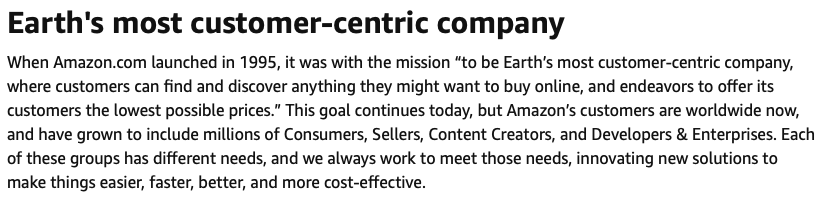
I really, really like Amazon’s mission statement:

Numbers 6 and 7 above can be very powerful when done well and I’ve seen the idea of a customer feedback wall used very well and to great effect – where you include and share the very, very good, the good, the bad and the ugly.

Do these ideas resonate with you? What things have you done in your organisations to drive the journey to being more customer centric? And what has the impact been with your customers?

If you’re interested in chatting customer centricity or customer success, please do reach out to me – I always love hearing your own journeys and challenges and ideas (and good coffee).

And don’t forget to listen to my latest podcast with Jason Whitehead from Trituns on getting your customer onboarding right from earlier this month. Click here to listen to this one and others in the series.

Being customer centric shouldn’t just be a concept

Being customer centric shouldn’t just be a concept – we need to approach it as our company missions.

We’ve been trying to be more customer centric for a long while but only 14% of leaders think they actually are and only 11% think our customers would say we are. I’ve never met an exec or business leader who says that they weren’t customer centric.

From the Harvard Business Review last year – “The most common, and perhaps the greatest, barrier to customer centricity is the lack of a customer-centric organisational culture. At most companies the culture remains product-focused or sales-driven, or customer centricity is considered a priority only for certain functions such as marketing.“

Being customer centric

A great way to think about customer centricity that really resonates with me:

“A business is customer centric when it delivers on-going growing value to and for their customers.”

I really like this because…

  1. It’s not just for the short term and the now
  2. It’s about the what (the value) and the who
  3. It allows for customers to include customers as we know them, employees and shareholders and investors

The reason being customer centric is important is not only the obvious – that our customers stay loyal when they have good experiences and the product and sales are delivering on our promises, but also as our customers keep evolving and changing, so too are the ways that we operationalise that and support those customers.

If you are customer centric, it means that you are observing that evolution that’s happening to your customer base, and you’re able to be very agile and nimble in responding to that as a business.

Being customer centric is easy to say but hard to do and it doesn’t come organically. It needs organisation wide buy-in and sponsorship, from sales, to finance, to operations, to support, to customer success, to delivery! We live at a time of unprecedented customer expectations both for business customers and our end consumers, and being customer centric is critical. Why now? Think about your ultimate consumers – they’re you and your expectations have changed. Forrester research have stated “This new world requires leaders to think and act differently“ and George Colony, Forrester CEO predicts, if a company is not customer-centric, they’ll simply be out of business between 5 – 10 years. What are you doing to be more customer centric today? I’m going to share some practical ideas and examples over the next couple of days of things I’ve seen work very well with different companies.

“Customer Centricity is a journey and not a destination.”