Why Customer Success Needs a “State of AI” Report

If you’ve spent any time on LinkedIn recently, you’ll have seen no shortage of posts about AI and Customer Success.

Some predict the end of the Customer Success Manager. Others claim AI will transform everything overnight. Most fall somewhere in between.

The problem is that there’s very little agreement on what’s actually happening.


After dozens of conversations with Customer Success leaders, SaaS executives and founders over the past year, I’ve noticed something interesting.

We’re all talking about AI.

We’re just not talking about the same thing.

Some teams are experimenting with meeting summaries and email drafts.

Others are building AI into customer workflows.

Some are measuring productivity.

Others are trying to rethink their entire post-sales operating model.

These are completely different conversations.


What seems clear is that AI has moved beyond experimentation. It is becoming part of day-to-day Customer Success.

The more interesting questions are no longer whether teams should use AI, but how they should use it and what impact it is really having.


From where I sit, a few themes keep appearing.

  • AI is removing repetitive work but increasing expectations.
  • It is exposing weak processes rather than fixing them.
  • It is making commercial judgement more valuable, not less.
  • It is forcing Customer Success leaders to rethink what great performance actually looks like.

I don’t think the biggest story is that AI is replacing Customer Success.

I think it’s changing what good Customer Success looks like.

That’s a much more interesting conversation.


Over the coming months, I’m going to capture the patterns I’m seeing through my advisory work, podcast conversations and discussions with Customer Success leaders.

The goal is simple.

To build a practical picture of how AI is really changing Customer Success, separating the hype from what’s happening in real SaaS organisations.


I’d love to hear what you’re seeing too.

What’s been the biggest change in your Customer Success team since AI became part of everyday work?

Why AI Is Exposing the Biggest Weakness in SaaS

Everyone seems to be asking how AI will change SaaS. But the bigger question is what AI Customer Success is already exposing about weak onboarding, poor adoption and broken customer ownership.

How will AI change SaaS?

I think they’re asking the wrong question.

The more interesting question is this.

What weaknesses has AI already exposed?

Because AI isn’t creating most of the problems we’re seeing.

It’s revealing the ones that were already there.


SaaS has relied on inefficient growth for years

For a long time, many SaaS businesses could grow despite themselves.

Products were new.

Competition was lower.

Customers accepted long onboarding projects.

Renewals often happened because switching was painful.

Growth covered a lot of operational weaknesses.

Today those weaknesses are becoming impossible to hide.


Customers now expect value immediately

AI has fundamentally changed customer expectations.

People no longer compare your onboarding to another SaaS vendor.

They compare it to using ChatGPT.

They expect answers instantly.

They expect software to guide them.

They expect adoption to happen naturally.

They expect measurable value much earlier.

If they don’t get it, they don’t wait six months.

They look elsewhere.


Most Customer Success teams cannot solve this alone

This is where many companies make another mistake.

They assume Customer Success owns retention.

It doesn’t.

Customer Success influences retention.

The business owns retention.

Poor implementation.

Weak product adoption.

Confusing pricing.

Low product quality.

Disconnected data.

Misaligned Sales promises.

These aren’t Customer Success problems.

They’re company problems.

Yet Customer Success is often expected to fix them anyway.


The companies winning with AI are doing something different

The most successful SaaS businesses aren’t simply adding AI features.

They’re redesigning how customers achieve outcomes.

They’re asking questions like:

  • Where does customer effort slow adoption?
  • Which moments predict long-term success?
  • What can AI automate without removing human relationships?
  • How quickly can a customer reach measurable value?

Notice the focus.

Not features.

Outcomes.


Customer Success becomes more commercial, not less

There’s a misconception that AI reduces the need for Customer Success.

I think the opposite is happening.

Routine work will increasingly disappear.

Status updates.

Basic reporting.

Simple customer queries.

Manual account preparation.

All of these become easier.

Which means Customer Success professionals have more time to do the work that actually moves revenue.

Driving adoption.

Identifying expansion opportunities.

Building executive relationships.

Helping customers realise measurable business value.

That’s where the future sits.


Founders should pay attention

If your AI strategy is focused only on product capability, you’re missing a much bigger opportunity.

Ask yourself:

  • How long does it take a customer to realise value?
  • Where do customers lose momentum?
  • Which teams own customer outcomes?
  • Can every leader explain why customers renew?

Because AI won’t fix a broken operating model.

It will simply expose it faster.


Final thought

The next generation of SaaS winners won’t be the companies with the smartest AI.

They’ll be the companies that remove friction from every stage of the customer journey.

AI is just the accelerator.

Retention is still the destination.

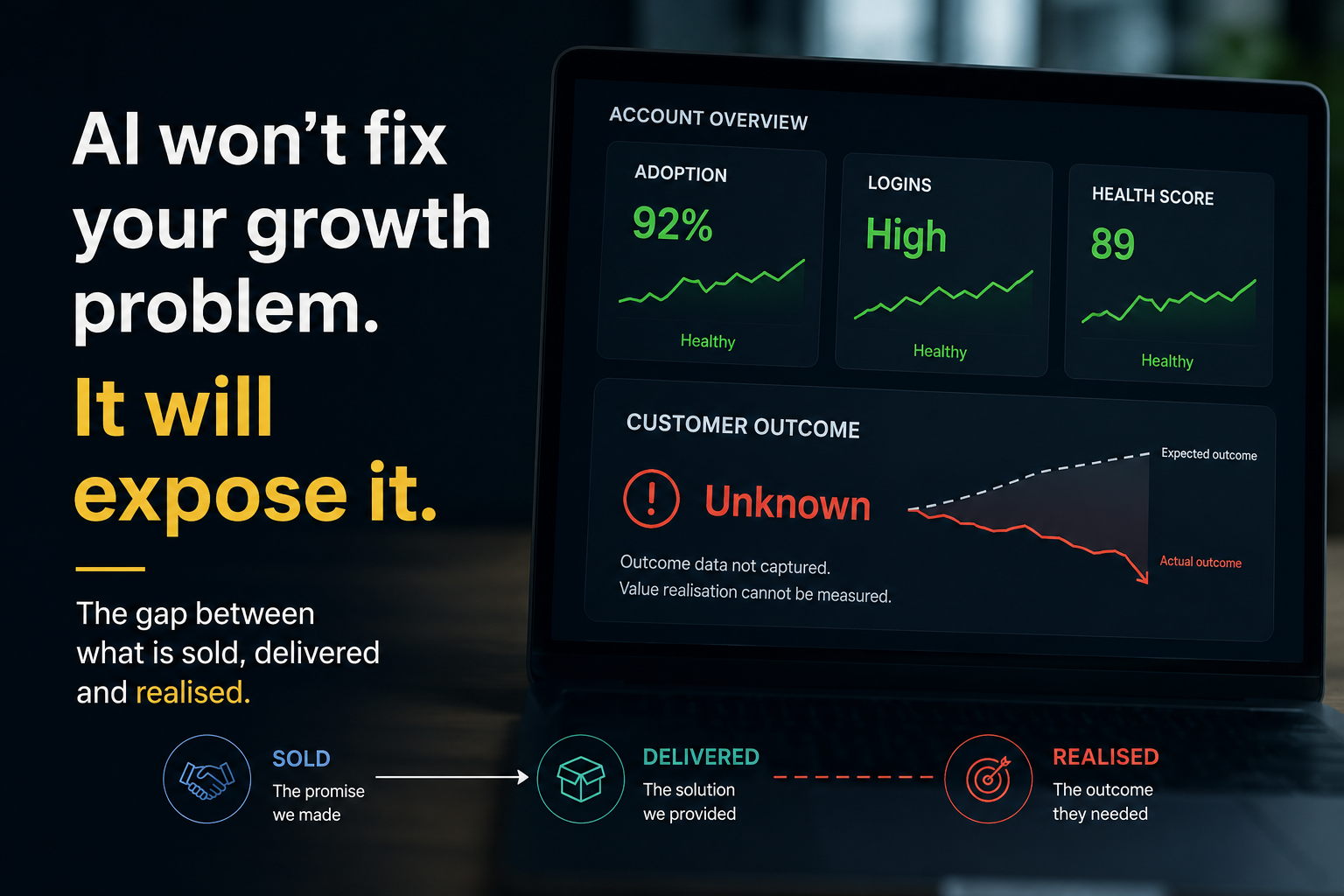
AI won’t fix your growth problem – it will expose it

The gap between what is sold, delivered and realised in SaaS customer success

Most SaaS companies have become very good at measuring what they sell.

Bookings.
ARR.
Pipeline.
Win rates.

Some are reasonably good at measuring what they deliver.

Implementation completed.
Training delivered.
Success plans created.
Support tickets resolved.

Far fewer can tell you whether customers are actually achieving the outcomes they bought the product to achieve in the first place.

That gap matters more than most leadership teams realise.

It’s the gap between what was sold, what was delivered and what was ultimately realised by the customer.

And it’s where churn begins.


The most dangerous metric nobody measures

Imagine a customer buys your platform to reduce onboarding time from 30 days to 10.

The sales team closes the deal.

The implementation team deploys the product.

The Customer Success team runs training sessions.

Usage looks healthy.

Everyone internally believes the account is a success.

But six months later the customer is still taking 28 days to onboard new users.

The software was deployed.

The customer logged in.

The project was completed.

Yet the outcome never happened.

From the customer’s perspective, the investment failed.

Most SaaS businesses have no systematic way of spotting this.

They track activity.

They track adoption.

They track engagement.

They rarely track whether the original business problem was solved.


Why AI is making this problem impossible to hide

Many SaaS leaders believe AI will help them improve retention.

They’re partly right.

AI can identify patterns humans miss.

It can analyse usage data at scale.

It can spot declining engagement.

It can flag customers who look likely to churn.

It can even suggest actions for Customer Success teams to take.

But there is a problem.

AI can only analyse the data it can see.

If your business isn’t measuring customer outcomes, AI cannot magically create them.

Instead, it exposes the weakness.

Faster.

More accurately.

And often more publicly.

AI might tell you a customer’s usage is falling.

What it cannot tell you is whether the customer ever achieved the outcome they bought your solution for.

Because most companies never captured that information in the first place.


The three gaps that quietly destroy growth

Gap 1: The sales reality gap

The customer buys based on one expectation.

The product delivers something slightly different.

Nobody notices until renewal.

The wider the gap between promise and reality, the greater the retention risk.

Gap 2: The delivery gap

The customer receives the software but never fully adopts it.

Features are available.

Processes remain unchanged.

People revert to old ways of working.

The implementation succeeds.

The transformation fails.

Gap 3: The value realisation gap

The customer uses the platform regularly.

Adoption metrics look healthy.

Yet the business outcome never materialises.

Usage exists.

Value does not.

This is often the most dangerous gap because traditional SaaS metrics make everything look healthy.


Why expansion revenue depends on realised value

Many leadership teams view renewals and expansion as separate motions.

Customers don’t.

A customer who achieves meaningful outcomes naturally becomes more open to expansion.

A customer who is still waiting to see value rarely wants to buy more.

This is why the strongest Net Revenue Retention figures usually come from organisations that obsess over customer outcomes rather than product usage.

Expansion is often a lagging indicator of realised value.

Customers buy more when they believe the first investment worked.

Simple.


The question every leadership team should ask

If I stopped one of your account teams in the corridor and asked:

“Why did this customer buy?”

Could they answer?

More importantly:

“What measurable business outcome has the customer achieved since buying?”

Could they answer that too?

If not, you may have a value realisation problem hiding behind healthy-looking adoption metrics.


What to do next

  1. What business outcome were they trying to achieve when they purchased?
  2. How will that outcome be measured?
  3. Has it actually been achieved?

Not implemented.

Not trained.

Not onboarded.

Achieved.

Then build your customer operating model around those answers.

Track them during onboarding.

Review them in customer meetings.

Report them to executives.

Use AI to help analyse them.

But don’t expect AI to create them.

Because AI won’t fix your growth problem.

It will expose it.

And if your customers are not achieving value today, the evidence is about to become impossible to ignore.


Final thought

The next generation of SaaS winners won’t be the companies with the most AI.

They’ll be the companies with the clearest understanding of customer value.

AI will simply make that difference visible.

The psychology of customer success: why customers don’t do what you expect

Most Customer Success problems aren’t technology problems.

They’re people problems.

That’s becoming even more obvious as AI changes how SaaS companies operate.

We spend huge amounts of time talking about onboarding frameworks, customer health scores, playbooks, QBRs and adoption metrics.

Yet one of the biggest challenges remains surprisingly simple.

Customers don’t always do what we expect them to do.

They don’t always follow best practice.

They don’t always adopt new processes.

They don’t always use the features that would help them most.

And they don’t always change simply because we tell them they should.

The reason is straightforward.

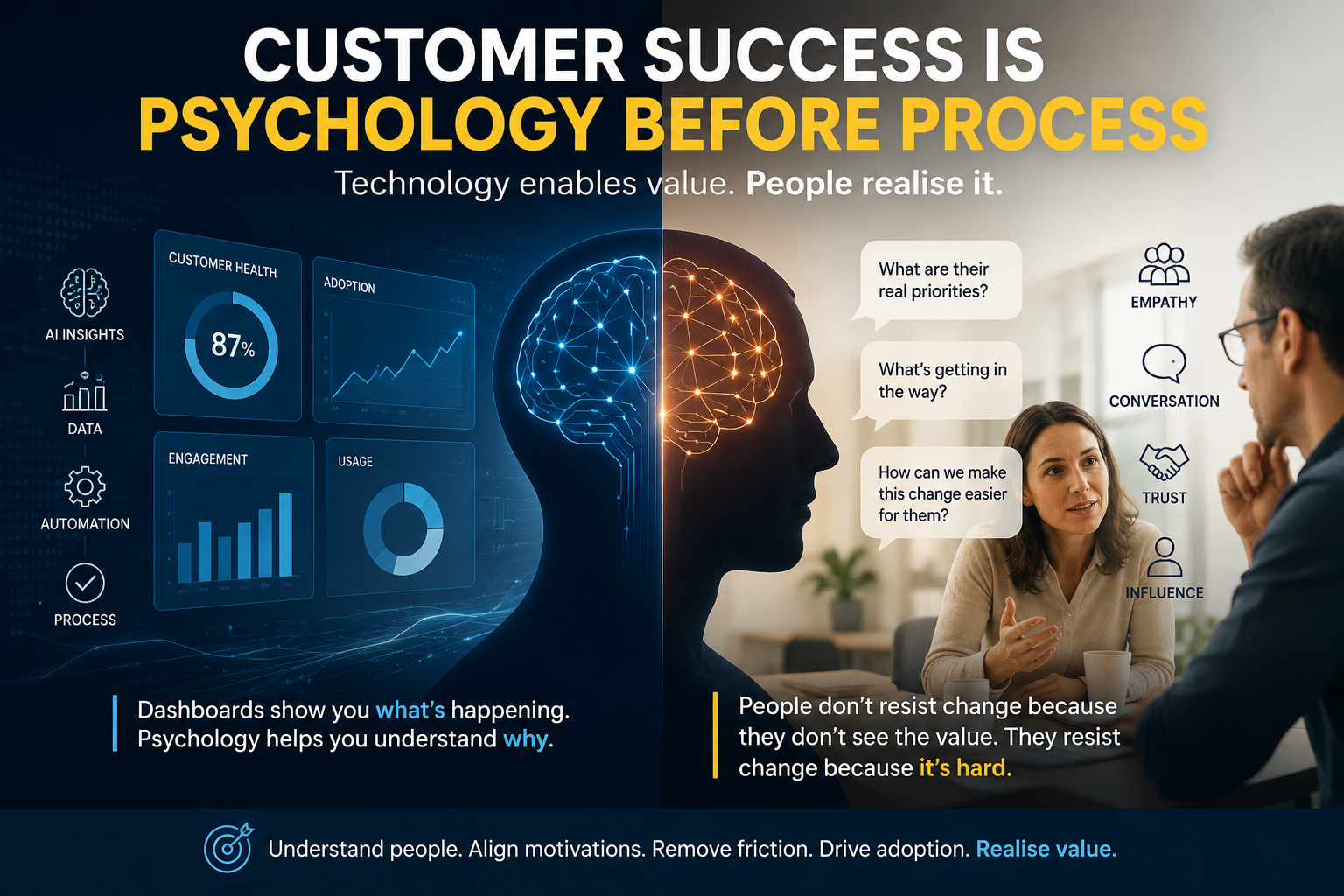
Customer Success is not just about software.

It’s about human behaviour.
The mistake many SaaS companies make

Many post-sale teams still assume that if a customer understands the value, they will automatically take action.

Experience suggests otherwise.

Most customers already know what they should be doing.

The problem is rarely a lack of information.

The problem is motivation, competing priorities, organisational politics and resistance to change.

A customer may agree with every recommendation you make.

That doesn’t mean they will act on it.

They still have a day job.

They still have internal pressures.

They still have other stakeholders pulling them in different directions.

Customer Success leaders who understand this tend to be more effective than those who simply focus on process and activity.

Every customer is dealing with a different set of incentives

One of the biggest lessons in Customer Success is that organisations don’t buy software.

People do.

And those people often have very different motivations.

The executive sponsor may be focused on revenue growth.

The department leader may be focused on operational efficiency.

The end user may simply want their day to be easier.

All three can be using the same platform.

All three can have completely different definitions of success.

This is why customer engagement often breaks down.

The Customer Success team is talking about business outcomes.

The customer is thinking about workload, internal politics and competing priorities.

Both sides believe they are having the same conversation.

Often they are not.

Why change is so difficult

Most Customer Success initiatives require customers to change something.

That might be:

  • A process
  • A workflow
  • A reporting structure
  • A technology stack
  • A way of thinking

The challenge is that people rarely change because they are told to.

They change when the benefits outweigh the perceived risks.

The bigger the change, the more important psychology becomes.

This is one reason why adoption often stalls after implementation.

The software works.

The project is technically complete.

But the organisation has not fully changed its behaviour.

The technology is live.

The transformation is not.

The role of emotional intelligence

The best Customer Success professionals understand that success is not driven by presentations.

It’s driven by conversations.

Specifically, conversations that help customers think differently.

This requires emotional intelligence.

It requires the ability to:

  • Listen carefully
  • Understand motivations
  • Recognise concerns
  • Build trust
  • Challenge assumptions
  • Ask better questions

In many cases, the right question creates more progress than the perfect slide deck.

The goal is not simply to provide answers.

The goal is to help customers see problems differently.

Why this matters even more in the age of AI

AI is making Customer Success more efficient.

It is not making customers less human.

In fact, the opposite may be happening.

As automation increases, the human elements become more valuable.

  • Empathy
  • Trust
  • Judgement
  • Influence

The ability to navigate organisational complexity.

These are increasingly difficult to automate.

AI can tell you which customer is at risk.

It cannot always tell you why people inside that organisation are behaving the way they are.

That is why I’ve argued before that AI won’t fix your Customer Success mode if the underlying post-sale operating model is already weak.

That still requires human understanding.

The real job of Customer Success

Customer Success is often described as helping customers achieve value.

That’s true.

But beneath that is something more fundamental.

The real job is helping people change.

Helping organisations adopt new behaviours.

Helping teams work differently.

Helping leaders make better decisions.

Helping customers overcome the barriers that stop value being realised.

The companies that understand customer psychology tend to achieve stronger adoption, better retention and more expansion.

Not because they have better software.

Because they understand the people using it.

And in Customer Success, people remain the most important variable of all.

Final thought

The future of Customer Success will involve more automation, more AI and more data.

But it will also require a deeper understanding of human behaviour.

Customers are not workflows.

They are people.

The sooner SaaS companies recognise that, the more effective their Customer Success strategies will become.
The revenue leak starts after the sale

Most SaaS founders know revenue is leaking somewhere.

They can see it in the numbers.

Renewals are harder than they should be.
Expansion is slower than expected.
NRR starts to drift.
Customers look fine until they suddenly are not.

So the business looks at the usual suspects.

The renewal process.
The onboarding journey.
The sales handover.
The health score.
The CSM cadence.

All useful places to look.

But often, they are not where the leak starts.

The leak starts earlier.

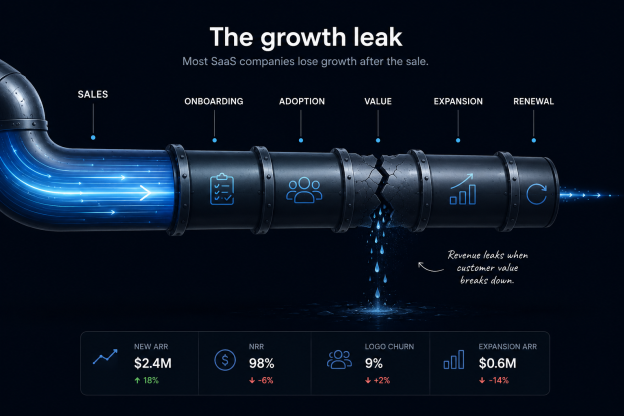
It starts the moment a customer signs and nobody clearly owns whether they achieve what was promised.

The deal is not the outcome

A signed deal feels like progress.

And it is.

But for the customer, nothing has been realised yet.

  • They have not bought a contract
  • They have not bought access to software
  • They have not bought an onboarding plan

They have bought an outcome.

That might be faster reporting, lower risk, reduced manual work, better visibility, higher productivity or stronger revenue performance.

Whatever it is, someone inside your business needs to own whether the customer gets there.

  • Not loosely
  • Not culturally
  • Not “the team”

Actually own it.

Because when everyone owns the customer outcome, nobody does.

Where the gap opens

The gap opens between what sales commits and what the customer experiences.

  • Sales sells the promise
  • Onboarding gets the customer live
  • Customer Success runs the cadence
  • Support handles the issues
  • Product tracks usage
  • Finance watches the renewal number

But who owns the customer getting what they paid for?

That is the uncomfortable question.

Because in many SaaS businesses, the answer is vague.

  • Everyone is involved
  • Nobody is accountable

And that is where churn starts to build.

  • Not at renewal
  • Not when the customer complains
  • Not when usage drops

Much earlier.

It starts when the business loses sight of the original promise.

Usage is not proof of value

This is where many SaaS teams fool themselves.

A customer can be onboarded and still not be successful.

They can log in and still not see value.

They can attend QBRs and still not believe the product is critical.

They can use the software and still struggle to explain the commercial impact.

Usage matters.

But usage is not the same as value.

Activity is not the same as progress.

A completed onboarding is not the same as a customer who has achieved what they were sold.

That distinction matters because renewals are not won by activity.

They are won by evidence of value.

Customer Success cannot fix this alone

When retention weakens, companies often assume they have a Customer Success problem.

Sometimes they do.

But often, they have a post-sale ownership problem.

Customer Success cannot fully own value if the sales promise was never captured properly.

It cannot prove impact if success criteria were never agreed.

It cannot drive expansion if the customer never reached first value.

It cannot rescue a relationship if the business treated the sale as the finish line.

CS has a critical role.

But post-sale value is not a department.

It is a commercial operating discipline.

That means sales, onboarding, product, support, finance and leadership all need to be aligned around the same question:

Did the customer get what they paid for?

A simple test

Ask five questions after every deal closes:

  1. What outcome did the customer buy?
  2. What did sales promise or imply?
  3. Who owns first value?
  4. How will we prove value has been realised?
  5. When will leadership know if the customer is off track?

If the answers are vague, you have found the leak.

Not a theoretical leak.

A commercial one.

The kind that shows up later as slow adoption, weak expansion, renewal risk and declining NRR.

The real ownership question

The best SaaS businesses do not treat the sale as the finish line.

They treat it as the start of the value obligation.

That is the shift.

From “we sold it” to “they realised it”.

From customer handoff to customer ownership.

From activity tracking to value evidence.

So the real question is not:

“Do we have a Customer Success team?”

Most companies do.

The better question is:

Who in your business owns what happens after the sale?

If the answer is unclear, that is where the revenue is leaking.

AI will not fix your Customer Success model – it will expose it

The wrong AI question in Customer Success

Most SaaS companies are asking how AI can make CS more efficient.

The better question is what broken post-sale process they are about to automate.

  • AI makes weak post-sale execution more visible
  • Unclear onboarding becomes faster confusion
  • Poor sales handoffs become cleaner-looking ambiguity
  • Activity-based CS becomes automated noise
  • Weak ownership becomes harder to hide
  • Efficiency is only useful when the model is right

Faster is not automatically better.

AI can help CS teams move faster, but only if the work is pointing at realised customer value.

What an AI-ready CS model needs

  • Clear customer outcomes
  • Faster time to value
  • Better handoffs
  • Value-based health signals
  • Commercial accountability

The real opportunity

The winners will not be the companies that automate the most.

They will be the companies that redesign post-sale around value first, then use AI to scale what works.

Before you automate CS, fix the model

I help B2B SaaS companies fix the gap between what is sold, what is delivered and what customers actually achieve. If retention, expansion or AI-enabled CS is on your leadership agenda, this is the work to start with.

See how I help SaaS companies improve retention, expansion and customer value.

SaaS isn’t dying – weak retention is

“SaaS is dead.”

We’re hearing this a lot this year.

And to be fair, some SaaS companies probably are in trouble.

But AI is not the real reason.

Most of the companies struggling right now were already vulnerable long before generative AI arrived.

They had:

  • weak onboarding
  • poor adoption
  • low product engagement
  • unclear customer ownership
  • expansion that depended on heroic account management
  • customers renewing because switching felt painful rather

AI didn’t create those problems.

It exposed them faster.

The real shift happening in SaaS

For years, many SaaS businesses benefited from inertia.

Once embedded, software tended to stay.

Customers tolerated:

  • clunky workflows
  • slow implementation
  • weak reporting
  • poor support experiences
  • limited adoption
  • shelfware across departments

Not because they loved the product.

Because replacing it felt harder than keeping it.

That equation is changing very quickly now.

AI has introduced a completely different conversation into boardrooms and leadership teams:

“Why are we paying for this software at all?”

That question creates pressure everywhere:

  • product
  • pricing
  • onboarding
  • adoption
  • renewals
  • Customer Success

And the companies that cannot answer it clearly are starting to feel exposed.

AI is compressing the time between disappointment and churn

This is the bit many SaaS leaders still underestimate.

AI is accelerating customer expectations far faster than most operating models can adapt.

Customers now expect:

  • faster outcomes
  • simpler workflows
  • better automation
  • more intelligence
  • less manual effort
  • clearer commercial value

That means weak post-sale execution becomes visible much earlier.

Poor onboarding becomes obvious faster.

Weak adoption becomes measurable faster.

Slow time-to-value becomes commercially dangerous faster.

The old SaaS model could sometimes survive despite operational friction.

That gets much harder when buyers believe AI alternatives may exist.

Especially when CFOs are looking for areas to reduce software spend.

This is why retention now matters so much commercially

A lot of SaaS leadership teams still talk about retention as if it is a support metric.

It is not.

Retention has become a proxy for business quality.

Investors know it.
Acquirers know it.
Boards know it.

Strong retention signals:

  • real customer value
  • embedded workflows
  • operational dependency
  • trusted relationships
  • durable revenue
  • expansion potential

Weak retention signals the opposite.

That is why the valuation gap between strong-retention SaaS businesses and weak-retention SaaS businesses is becoming much more obvious.

The market is rewarding companies that genuinely keep and grow customers.

And increasingly punishing those that relied on inertia.

Customer Success teams are feeling the pressure first

This is where the conversation becomes uncomfortable.

Many Customer Success teams were never actually designed to drive commercial outcomes.

They were designed to:

  • manage accounts
  • run QBRs
  • maintain relationships
  • respond to issues
  • improve sentiment

That was often enough when SaaS budgets were expanding rapidly.

It is not enough now.

Because renewal conversations no longer start 90 days before contract end.

They start much earlier.

They start the moment a customer begins questioning:

  • platform value
  • adoption
  • efficiency
  • commercial return
  • internal usage
  • AI alternatives

That changes the role of Customer Success entirely.

The strongest CS teams now operate much closer to:

  • value realisation
  • operational alignment
  • commercial outcomes
  • adoption strategy
  • expansion enablement
  • executive stakeholder management

The role is becoming more strategic because the pressure on proving value has become more strategic.

The SaaS companies surviving this shift look very different

The companies navigating this period well usually have a few things in common.

They:

  • reach value quickly
  • embed deeply into workflows
  • align product usage to operational outcomes
  • create executive-level customer relationships
  • treat onboarding as revenue infrastructure
  • measure customer progression rather than customer activity

Most importantly, they make themselves difficult to remove because customers can clearly see the business impact.

Not because migration sounds painful.

That distinction matters far more in the AI era.

SaaS is not dying

Weak SaaS is.

The companies in trouble are often the ones that:

  • over-relied on feature growth
  • underinvested in customer outcomes
  • confused activity with value
  • treated Customer Success as a service layer rather than a growth function

AI simply accelerated the correction.

And in truth, that correction was probably coming anyway.

The SaaS businesses that survive the next few years will not necessarily be the ones with the most AI features.

They will be the ones that can consistently prove operational value after the sale.

Because in the end, customers do not renew software.

They renew outcomes.


Related reading

AI is exposing weak post-sale execution much faster than most SaaS companies realise.

You can also read more here:


Where this becomes a growth problem

Most retention problems are not renewal problems.

They are onboarding, adoption and value realisation problems that appear later in revenue numbers.

That’s exactly the gap I help SaaS companies fix.

The AI Tourist Effect

There’s a number circulating right now that should make every SaaS founder and leader sit up.

AI-native SaaS products have a median gross revenue retention rate of 40%. For context, the B2B SaaS median is 82%. That’s not a rounding error – it’s a 42-point gap and it’s prompting a lot of people to conclude that AI-native products are fundamentally harder to retain.

They’re wrong. And the data proves it.

What “AI Tourist” Actually Means

ChartMogul coined the phrase “AI tourist” to describe what’s driving this churn pattern. Users sign up because the product looks interesting, the demo is slick and the pricing is low enough to not require a procurement conversation. They experiment for a few weeks, hit a wall – maybe the use case isn’t quite right, maybe a competitor ships something shinier – and they’re gone.

This isn’t a story about bad AI. It’s a story about how people buy things they don’t need to commit to.

When the barrier to entry is $19 or $29 a month, the barrier to exit is equally low. There’s no contract to navigate, no internal stakeholder who championed the purchase, no workflow that breaks if the tool disappears. The customer signed up alone and they’ll leave alone.

That’s the AI tourist. They came for a look around. They were never planning to stay.

The Price Point Data Is Striking

Here’s where the conventional narrative falls apart.

ChartMogul’s data segments AI-native SaaS products by price point, and the retention picture is almost entirely determined by what you charge – not what the AI does.

Products priced above £200 (roughly $250) per month see 70% gross revenue retention and 85% net revenue retention. That’s essentially the same as traditional B2B SaaS. Products priced between $50 and $249 per month see 45% GRR and 61% NRR. Products priced below $50 per month see 23% GRR – meaning nearly 80% of revenue churns out within a year.

Same technology. Same category. Entirely different retention profile.

The variable isn’t the product. It’s who’s buying it, how they’re buying it and what’s at stake if they stop.

Why This Matters for CS Teams

If you’re a leader at an AI-native company and your retention numbers look ugly, the temptation is to reach for customer success playbooks. More onboarding touchpoints. Better health score models. Proactive outreach at 30 days.

Some of that will help at the margins. But if your core problem is that you’re selling a $29/month tool to individuals who don’t have a business outcome attached to it, no customer success motion fixes that. You’re putting a retention programme on top of a churn machine.

The commercial diagnosis here is uncomfortable but important: the customer success function can’t compensate for a flawed go-to-market model.

What you can do – and this is where customer success genuinely earns its seat in the room – is make the business case for moving upmarket. The data is unambiguous. When AI-native products sell to genuine business buyers at $250+ per month, they retain like traditional SaaS. The AI isn’t the risk. The self-serve, consumer-grade pricing model is.

What Moving Upmarket Actually Looks Like

Moving upmarket isn’t just raising prices. It’s a set of decisions about who you sell to, how they buy and how deeply embedded your product becomes in their actual workflows.

A few things tend to shift when you go from self-serve consumer to B2B buyer.

There’s a procurement process, which means there’s an internal champion. That person’s reputation is partly tied to the tool working. They don’t cancel without a conversation first.

There’s an integration layer. Your product connects to their CRM, their Slack, their ticketing system. Ripping it out takes effort. Switching costs go up.

There’s an outcome attached. The business bought the tool to achieve something specific – reduce support volume, increase renewal rates, speed up onboarding. You can measure it. You can show progress. That’s the foundation of a genuine retention conversation.

None of this happens at $25 or £25 a month. It happens when the deal is significant enough that both sides take it seriously.

The Lesson That Extends Beyond AI-Native SaaS

The AI tourist effect isn’t just a problem for AI-native companies. It’s a warning signal for any SaaS business that’s drifted toward self-serve growth without examining the retention consequences.

The economics look attractive at first. Low CAC, fast time-to-revenue, no sales headcount required. But if you’re churning 60%-70% of revenue annually, you’re running a leaky bucket – and growth is just masking the leak.

The companies that will build durable NRR in this environment are the ones embedding themselves into critical business workflows, selling to buyers who have accountability for outcomes and building customer success motions that tie directly to measurable value.

That’s not a new idea. But the AI tourist data gives it a specificity that’s hard to argue with.

The Practical Takeaway

If you’re a customer focused leader in an AI-native company, here’s the question worth putting to your leadership team: are the customers we’re churning the ones who were ever going to stay?

If the answer is no – if you’re churning self-serve, low-ACV, low-commitment buyers at the bottom of your customer base – then the retention conversation needs to start with pricing and ICP, not onboarding sequences.

The AI isn’t the problem. The market motion is.

Get that diagnosis right and the customer success playbook becomes much more straightforward.


Want to Talk Through What This Means for Your Business?

If you’re a SaaS leader wrestling with retention in an AI-native product – or advising a company that is – I work with customer success and revenue teams to build operating models that hold up under board scrutiny.

Book a 30-minute conversation and let’s look at the actual numbers together.

Or follow me on LinkedIn where I write about this kind of thing every week – commercial customer success, retention mechanics and what’s actually changing in the post-sale world.


Sources: ChartMogul SaaS Retention Report – The AI Churn Wave (2025/2026); ChartMogul The New Normal for SaaS Retention

Most SaaS companies don’t have a sales problem – they have a value delivery problem

Your sales engine is running.

Pipeline looks healthy. New logos are coming in. Revenue targets appear achievable.

But your NRR is telling a different story.

Somewhere between contract signature and renewal, growth is leaking.

Customers are going live but not expanding. Adoption exists but commercial momentum stalls. Customer Success teams are busy, yet leadership still struggles to clearly connect post-sale activity to retention and expansion outcomes.

This is one of the most common problems in SaaS right now.

And most companies feel it long before they can properly articulate it.

Why SaaS growth leaks after the sale

Most SaaS organisations are heavily optimised around acquisition.

Sales, marketing and product investment often dominate strategic conversations because they are easier to measure in the short term. Pipeline growth feels visible. New ARR feels tangible.

Post-sale execution is different.

The warning signs usually appear gradually:

  • Renewals become reactive
  • Expansion becomes unpredictable
  • Onboarding drags
  • Customers stay “active” without achieving meaningful outcomes
  • Customer Success becomes overloaded with activity but commercially unclear

Over time, growth slows despite continued acquisition investment.

That is when leadership teams start asking harder questions about retention, customer value and operational efficiency.

The gap between adoption and customer value

One of the biggest mistakes SaaS companies make is confusing product usage with realised value.

A customer logging in regularly does not automatically mean they are successful.

Many organisations measure:

  • logins
  • feature usage
  • meeting volume
  • ticket response times

But customers do not renew because they attended QBRs.

They renew because the product helped them achieve a business outcome that mattered.

That gap between activity and realised value is where many SaaS businesses quietly lose expansion opportunities.

The strongest Customer Success organisations understand this clearly. They align onboarding, adoption and ongoing engagement around measurable customer outcomes rather than internal process metrics.

Why Customer Success becomes commercially unclear

In many SaaS businesses, Customer Success evolves reactively.

The function grows quickly as customer numbers increase, but ownership boundaries often remain vague.

Sales owns revenue.

Support owns problems.

Product owns features.

Customer Success ends up sitting somewhere in the middle trying to hold everything together.

The result is predictable:

  • unclear commercial accountability
  • inconsistent customer experiences
  • fragmented definitions of value
  • poor cross-functional alignment

This is why some CS teams appear extremely busy while leadership still struggles to see measurable commercial impact.

The issue is rarely effort. It is operating design.

We recently discussed this exact shift on our podcast Breakthrough SaaS Growth with The Jasons in our episode From Customer Success to Customer Growth – The Next Evolution of SaaS, where we explored why Customer Success is increasingly evolving into a commercial growth function rather than simply a post-sale support layer.

How AI is exposing weak post-sale execution

As I covered in my article on AI-enabled Customer Success, the companies gaining advantage are not simply automating support tasks. They are redesigning how customer value is delivered.

Not because AI itself is causing churn, but because it exposes operational weaknesses much faster than before.

Weak onboarding becomes visible earlier.

Poor adoption patterns surface sooner.

Customers expect faster time-to-value and more proactive engagement.

Companies that simply automate broken post-sale processes will struggle.

The organisations gaining advantage are the ones redesigning how customer value is delivered in the first place.

They are using AI to:

  • identify churn risk earlier
  • improve customer visibility
  • reduce onboarding friction
  • surface expansion opportunities
  • scale proactive engagement

But the technology only works when the underlying operating model is aligned around customer outcomes.

AI does not fix value delivery problems.

It exposes them.

What high-performing SaaS companies do differently

The strongest SaaS companies treat post-sale execution as a growth function, not a support function.

They align sales, product and Customer Success around shared customer outcomes.

They focus on:

  • faster time-to-value
  • measurable business impact
  • operational clarity
  • scalable customer engagement
  • retention and expansion as board-level metrics

Most importantly, they understand that sustainable SaaS growth does not break at acquisition.

It breaks after the sale when customers stop progressing.

By the time NRR starts falling, the underlying problems have usually existed for months.

Sometimes years.

That is why the companies outperforming right now are not necessarily the ones automating the most.

They are the ones aligning their organisation around realised customer value.

Many SaaS companies already know something is breaking post-sale. The challenge is diagnosing where the operational gaps actually sit.

That’s typically where a Customer Success advisor can help bring clarity.

Most SaaS Companies Don’t Need A Bigger Customer SuccessTeam

Why Hiring Another CSM Rarely Fixes Churn

Most SaaS companies respond to churn the same way.

They hire…

  • Another CSM
  • Maybe a Head of Customer Success
  • Sometimes a VP

It feels like progress, but it rarely fixes the real problem.

Because churn is not always a capacity issue.

More often, it is a design issue .

Infographic to download and save below…


The Real Problem

If your customer success function is not clearly driving retention and expansion, adding more people usually creates more activity.

More calls
More QBRs
More dashboards
More internal updates

But not necessarily better outcomes and often, no clear link to revenue.

That is where many SaaS companies get stuck.

They build a bigger customer success team before they have built a proper customer success model.


Where A Customer Success Advisor Fits

A customer success advisor does not simply add more hands.

They help fix the operating model.

That usually means:

  • defining what customer value actually looks like
  • aligning sales, customer success and product around that value
  • building a repeatable system for retention and expansion
  • creating earlier visibility of renewal risk
  • making customer success commercially accountable

This is not about doing more.

It is about doing the right things consistently.


The Pattern I See Repeatedly

Across SaaS companies, the pattern is often the same.

  • Sales sells one version of value
  • The customer expects something slightly different
  • Customer success tries to bridge the gap
  • Product is not always close enough to what is happening after the sale
  • Leadership only sees the issue when churn appears

By then, the problem has usually been building for months.


Why This Matters Now

AI is making this more obvious.

It is now easier than ever to:

  • automate activity
  • generate insights
  • scale customer outreach
  • produce reports
  • identify signals

But none of that fixes a broken model.

In fact, AI can make the problem worse.

If the customer success model is unclear, AI simply helps you scale unclear work faster.

That is not transformation. That is organised noise.


What Good Looks Like

When customer success is working properly, the business feels different.

Retention becomes more predictable.

Expansion becomes systematic, not opportunistic.

Customer success has a clear commercial role.

Sales, product and CS are aligned around the same customer outcomes.

Leadership trusts the numbers because the numbers connect to reality.

That is the shift from customer success as support to customer success as a growth engine.


Practical Takeaway

Before hiring another CSM, ask one question:

Do we know exactly how customer success drives revenue in our business?

Not in theory.

In practice.

  • By segment
  • By customer stage
  • By renewal risk
  • By expansion opportunity
  • By measurable value delivered

If the answer is not clear, another hire will not fix it.

It may simply make the current problem more expensive.


Final Thought

If you are trying to improve retention or make customer success more commercially accountable, the real work usually starts before the next hire.

It starts with the model.

The team can only scale what the business has designed properly.

👉 Customer success advisor