Introduction
Most SaaS companies think they have a pipeline problem.
They don’t.
They have a conversion problem after the deal.
Revenue doesn’t just come from winning customers. It comes from what happens next. – adoption, value realisation and expansion.
And this is where growth quietly breaks.
The Real Problem Isn’t Sales
SaaS leaders spend a lot of time optimising:
- Lead generation
- Conversion rates
- Sales efficiency
But once the deal is signed, things become far less structured.
The assumption is simple:
“We’ve sold the value, now the customer will realise it.”
In reality, that rarely happens consistently.
Where Growth Actually Breaks
Growth doesn’t fail at the point of sale.
It breaks in the gap between:
- What was sold
- What is delivered
- What the customer actually achieves
This shows up in familiar ways:
- Slow or partial adoption
- Customers using features but not achieving outcomes
- Expansion opportunities that never materialise
- Churn risk appearing late in the lifecycle
By the time it’s visible, the damage is already done.
The Hidden Revenue Leak
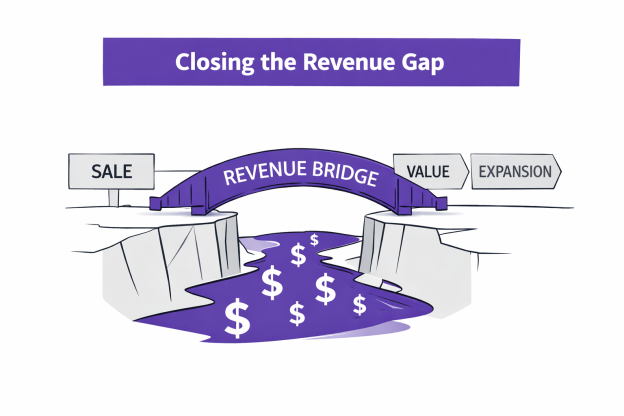
Every SaaS business has a flow:
Sale → Adoption → Value → Expansion
If that flow is not connected and managed:
Revenue is lost.
Not always immediately.
But over time:
- Deals don’t expand
- Renewals become harder
- Growth becomes unpredictable
This is why many companies feel like they are working harder for the same results.
Because they are.
Why Customer Success Alone Doesn’t Fix It
This is often labelled as a Customer Success issue.
It isn’t. It’s a system issue.
Common problems include:
- Weak handover between sales and post-sale teams
- No clear definition of what “value” actually means for the customer
- Lack of ownership for outcomes
- Misalignment between sales, CS and product
Customer Success can’t fix this in isolation. Because the problem doesn’t sit in one team.
What High-Growth SaaS Companies Do Differently
Companies that scale efficiently do one thing well:
They control what happens after the sale.

That means:
- Clear alignment between sales, CS and product
- Defined customer outcomes from day one
- Strong ownership of value realisation
- Early visibility of risk and opportunity
- A structured path to expansion
In these organisations, growth feels more predictable. Because it is.
How to Fix Where Growth Breaks
If you want to improve growth, start here:
1. Define Value Clearly:
What does success look like for the customer? Not usage. Not features. Outcomes.
2. Strengthen the Handover:
Make sure context, expectations and goals carry through from sales into delivery.
3. Track Leading Indicators:
Don’t wait for churn. Track adoption, engagement and value signals early.
4. Align Teams Around Outcomes:
Sales, customer success and product need to be aligned around customer success, not just their own metrics.
5. Build a Path to Expansion:
Expansion should not be opportunistic. It should be designed into the lifecycle.
Final Thought
Most SaaS companies don’t struggle to win customers. They struggle to turn those customers into long-term, expanding revenue.
That’s where growth really happens. And that’s where it often breaks.
Call to Action
If growth feels harder than it should, it’s worth asking a simple question:
Where does it break after the sale?