Tag Archives: Chief Customer Officer

Customer-Led Growth: Why the Best Companies Now Grow with Their Customers

Growth models come and go.

For years, companies believed success came from selling harder, marketing louder or building flashier products. But something fundamental has shifted in how growth actually happens and the smartest organisations are responding.

That shift is what we call Customer-Led Growth (CLG).

It’s not a buzzword. It’s a structural change in how businesses grow and how customers expect to be treated.


How We Got Here

If you zoom out over the last two decades, you can see a clear evolution in how companies approached growth:

  • Sales-Led Growth (SLG): The old world of cold calls, quotas and closing deals – growth depended on the size and skill of the sales team

  • Marketing-Led Growth (MLG): Then came the era of brand and lead generation – marketing became the growth engine, filling the top of the funnel with demand

  • Product-Led Growth (PLG): The SaaS revolution flipped things again. Users could try before they buy and the product itself became the salesperson, think Slack, Zoom or Notion

Each of these models worked in its time. But as markets matured and customers gained power, the economics changed.

Acquisition costs rose. Switching costs fell. Buyers became more informed, more connected and far less patient.

The next evolution – Customer-Led Growth – isn’t about selling to customers at all. It’s about growing with them.


What Customer-Led Growth Really Means

Customer-Led Growth is simple in principle – your growth comes from helping customers achieve the outcomes they care about most.

When customers succeed they:

  • Stay longer (reducing churn)
  • Buy more (expansion revenue)
  • Tell others (advocacy).

That creates a compounding loop of growth powered not by marketing spend or sales pressure but by real, measurable customer value.

In plain English: you win because your customers do.

Imagine pushing a heavy car up a hill (sales-led). Exhausting. Then imagine cresting the top, and gravity takes over – the car starts rolling itself (customer-led). CLG is that gravity: momentum created by genuine customer success.


The Problem CLG Solves

For years, companies have measured the wrong thing. They’ve obsessed over acquisition metrics – leads, MQLs and pipeline coverage – without real proof that customers were succeeding after the sale.

The result?

Leaky buckets. Growth targets met one quarter, lost the next.

Customer-Led Growth changes the operating model. It forces teams to answer harder questions:

  • Are our customers realising value from what we’ve sold?
  • Can we prove it?
  • How quickly can we identify and fix friction before it becomes churn?

That shift changes how every team works – not just Customer Success.

Product, marketing, sales, support and leadership all align around one core idea – sustainable growth depends on recurring, compounding customer value.


A Quick Bit of History

The roots of CLG stretch back to three movements that collided over the last 15 years:

  1. Relationship marketing: The idea that long-term customer relationships are more profitable than one-off transactions.

  2. Customer Success: Born in SaaS, it turned retention into a discipline rather than an afterthought.

  3. The “Jobs To Be Done” framework: Focused on understanding what customers are really trying to achieve, not just what they’re buying.

Combine these and you get the foundation of Customer-Led Growth – listen deeply, deliver measurable outcomes and feed that insight back into the business.


The Early Pioneers

Several companies quietly pioneered CLG before the term existed:

  • HubSpot built its “flywheel” model around customer advocacy rather than lead funnels

  • Salesforce scaled Customer Success as a growth engine, not a support function

  • Adobe restructured its business from selling software licences to measuring active usage because usage equals value

  • Atlassian let its customers sell for them by creating self-serve journeys and community-driven growth

Each realised the same truth – the most reliable growth doesn’t come from new customers, it comes from the success of existing ones.


Why Now

Several forces are making CLG not just smart but essential:

  • Economic pressure: It’s now 5-7 times cheaper to keep a customer than acquire a new one

  • Market saturation: In SaaS and tech especially, buyers have near-infinite choice and differentiation comes from outcomes, not features

  • Data and AI: Companies can now see exactly where customers succeed or struggle and can act before they churn

  • Changing buyer psychology: Customers expect partnership, not persuasion, they want proof of value, not just promises

The modern customer isn’t looking for a vendor. They’re looking for a co-pilot and long term partner.


The Core Principle

Customer-Led Growth rests on one idea: Growth is the natural by-product of customers being  successful.

That sounds obvious but operationalising it is hard.

It means:

  • Success teams measured not on happiness (NPS) but on value realisation
  • Sales comp plans tied to long-term retention, not short-term bookings
  • Product roadmaps prioritising customer outcomes, not internal politics

It’s not a campaign. It’s a culture.


Takeaway

Customer-Led Growth isn’t about being nicer to customers. It’s about building businesses that last. When customers see clear, measurable success – they don’t just renew. They expand, advocate and bring others with them.

That’s growth you can trust – because it’s built on proof, not persuasion.


Want To Go deeper?

If you’re thinking about retention, expansion or how AI fits into your strategy, I work with a small number of SaaS companies on exactly this.

👉 If you’re rethinking your approach, let’s talk.

Customer Growth Isn’t Magic – It’s Design

It’s tempting to see growth as something mystical. A viral moment. A product that “sells itself”. A lucky hire who changes everything.

But sustainable customer growth isn’t about chance. It’s about design. The businesses that consistently retain and expand customers are deliberate about how they build the experience.

Here’s what that design looks like in practice.

1. Start with outcomes, not outputs:

Your customers don’t care about features. They care about results. Growth begins when you define success in the customer’s own terms – whether that’s higher revenue, efficiency gains, or risk reduction. Companies that design for growth measure these outcomes and tie them directly to renewal and expansion conversations.

2. Align the journey to deliver value:

Acquisition is only the opening chapter. From onboarding through adoption and support, every stage should move the customer closer to their outcomes. Misalignment kills growth – like when sales oversells, onboarding under-delivers, or success teams focus on activity instead of impact. Design means stitching the journey together so every handoff is seamless.

3. Build for evolution, not stasis:

Customer needs change. Market conditions shift. A “set and forget” model quickly becomes irrelevant. High-growth companies bake feedback loops into their design: health scores that adapt, playbooks that iterate, and leadership reviews that revisit strategy. Growth comes from learning fast and recalibrating often.

4. Balance strategy with execution:

Designing growth is both big picture and hands-on. At board level, it’s about governance, renewal predictability, and customer-led revenue strategy. On the ground, it’s about practical playbooks, adoption frameworks, and success metrics that teams can actually use. Both matter.

Customer growth isn’t magic. It’s design.

The question is whether you’ve designed for retention, expansion, and advocacy – or if you’re still relying on chance.

What does it really mean to be customer centric today?

This is something I talk about a lot. Customer centricity isn’t just a nice idea – it’s a strategic necessity in today’s “Age of the Customer.“ A truly customer centric business delivers consistent, growing value for customers – and that’s easier said than done.

Over the last 20 years or so, we’ve been very technology led – and for the right reasons – but in many instances we’ve lost sight of what the customers need and want and it’s time to re-focus on the customer.

It’s not enough to just say we’re customer centric. Real customer centricity requires buy-in across the organisation – from product to finance to sales to leadership and beyond. It means focusing on outcomes that matter to customers, not just features or transactions. This shift is more critical than ever as customers expect far more personalised, service-driven experiences than just products.

But here’s the reality check – while many companies aim for customer centricity, few fully achieve it. According to recent polls, less than 15% of customer leaders feel their organisations are genuinely customer centric, and only 10% believe their customers would agree. To close this gap, businesses need leadership that truly champions the customer perspective at the executive level, such as a Chief Customer Officer. This leader’s role isn’t just about retaining customers – it’s about actively shaping strategies that drive customer success.

Real customer centricity requires breaking down silos and creating a unified approach to customer feedback. This includes giving teams the empowerment to act on customer insights, addressing the challenges they face, and ensuring every decision aligns with delivering real value.

If we want to succeed, our mission needs to be customer-focused at its core. How customer-centric do you feel your organisation really is?

A practical guide to customer centricity

We know the theory and we know we need to be more customer centric. The biggest challenge for many organisations is how do it, at both the strategic organisational level and at the more tactical operational level.

I’ve worked with and for many organisations going through their own journey to be more customer centric, at both large well-established global organisations and more niche startup organisations and have been privileged to be in positions with them where I’ve been part of that change.

One of the more strategic level changes that is crucial for success is getting your customer leadership at the right level. It’s great to see more and more organisations across different industries and sectors investing in Chief Customer Officer or similar exec level roles now and the number has grown significantly over the last few years (and continues to grow).

Having the right leadership gives you the voice of the customer at the leadership table, having someone focused on driving customer growth and value and bringing the customer conversations to the exec and board level.

I really like this concise definition of a Chief Customer Officer:

“An executive who provides the comprehensive and authoritative view of the customer and creates corporate and customer strategy at the highest levels of the company to maximise customer acquisition, retention, and profitability.”

The customer leadership role – Chief Customer Officer or other – gives you:

  • Visibility – to understand and see what is happening to your customers
  • Clarity – of what happens when a prospect becomes a customer
  • Balance of power – creating the 3rd organisational pillar (with sales and operations)
  • Sales focus – allowing sales to focus on new business without customer distractions
  • Feedback – into what is happening outside of the business (the so called magic loop)
  • Signalling – the external messaging that we are customer centric

The magic loop above is:

Plan and Build (product management and engineering) vs. Demand and Sales (Marketing and Sales) vs. Customer Experience (Customer Success).

At the more tactical level though – in terms of things you could do more immediately – here are a number of great practical ideas for driving customer centricity in your organisation:

  1. Create a mission statement that impacts your customers and that includes customers
  2. Be a customer – yes role play (across all teams)
  3. Visit your customers – all execs and, even better, all teams
  4. Implement a customer forum or community (customers talking to each other)
  5. Create a voice of customer programme (and close that feedback loop)
  6. Bring your customer feedback into every meeting across the business
  7. Democratise customer insights and make them visible to everyone in the organisation
  8. Link team compensation to the customer and have customer focused goals
  9. Hire for customer orientation and customer empathy (and onboard them like customers)

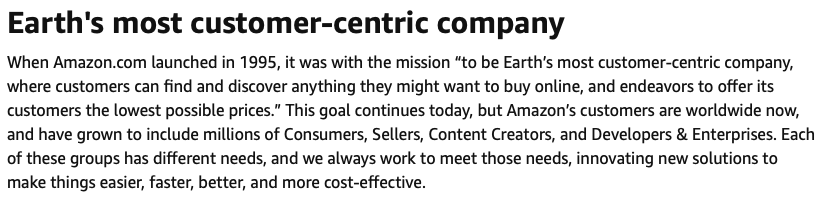
I really, really like Amazon’s mission statement:

Numbers 6 and 7 above can be very powerful when done well and I’ve seen the idea of a customer feedback wall used very well and to great effect – where you include and share the very, very good, the good, the bad and the ugly.

Do these ideas resonate with you? What things have you done in your organisations to drive the journey to being more customer centric? And what has the impact been with your customers?

If you’re interested in chatting customer centricity or customer success, please do reach out to me – I always love hearing your own journeys and challenges and ideas (and good coffee).

And don’t forget to listen to my latest podcast with Jason Whitehead from Trituns on getting your customer onboarding right from earlier this month. Click here to listen to this one and others in the series.

Being customer centric

A great way to think about customer centricity that really resonates with me:

“A business is customer centric when it delivers on-going growing value to and for their customers.”

I really like this because…

  1. It’s not just for the short term and the now
  2. It’s about the what (the value) and the who
  3. It allows for customers to include customers as we know them, employees and shareholders and investors

The reason being customer centric is important is not only the obvious – that our customers stay loyal when they have good experiences and the product and sales are delivering on our promises, but also as our customers keep evolving and changing, so too are the ways that we operationalise that and support those customers.

If you are customer centric, it means that you are observing that evolution that’s happening to your customer base, and you’re able to be very agile and nimble in responding to that as a business.

Being customer centric is easy to say but hard to do and it doesn’t come organically. It needs organisation wide buy-in and sponsorship, from sales, to finance, to operations, to support, to customer success, to delivery! We live at a time of unprecedented customer expectations both for business customers and our end consumers, and being customer centric is critical. Why now? Think about your ultimate consumers – they’re you and your expectations have changed. Forrester research have stated “This new world requires leaders to think and act differently“ and George Colony, Forrester CEO predicts, if a company is not customer-centric, they’ll simply be out of business between 5 – 10 years. What are you doing to be more customer centric today? I’m going to share some practical ideas and examples over the next couple of days of things I’ve seen work very well with different companies.

“Customer Centricity is a journey and not a destination.”

Who’s looking after your customers’ success?

What a great question to ask. Do you know the answer, and if not, who’s finding it out for you? And even more importantly, do you know what your customers need to achieve to be successful?

Often as business owners and leaders, we naturally need to be focused on our company’s success and how we evolve and grow our business, building new products and services and acquiring new customers.  

We’ve seen a shift in the last ten years to the new world of Customer Success and the consumerisation of business services, where our business customers’ expectations are driven by their experiences as consumers. This has been and continues to be a huge change and a very challenging one. I say ‘ new world’ here, but it’s not new as in ‘ we’ve never done it before’ – just in that we need a different (and new) approach today.

How do we provide the same levels of services (and amazing products and platforms) that organisations like Amazon, Apple and Netflix do? They’re in completely different markets and you could see them as being irrelevant to the lettings industry. But many of your own customers use them – and many others like them – on a daily basis, and they just expect things to work and deliver, as and when and where they need and want.

Our customers are now more willing and able to leave us if we don’t do what they need or provide the value they expect – and they expect this level of flexibility. The so-called age of the customer is all about this flexibility – it’s about how businesses push value to customers, and ensuring customers become the focus and that customers are attracted to use them, not stuck with them.

When our customers are successful, and they can directly see the value our products and services give them, they will naturally gravitate more to us, use more of our services, grow with us and become great advocates.

I heard a great quote at Gainsight’s recent Chief Customer Officer Summit Europe 2018 that resonates so well and sums this up perfectly: “Make your product value painlessly obvious“.

Customer Success has to be a business-wide strategy and way of working, it isn’t just the responsibility of one team , one job function or one person , and you need a customer-centric culture to achieve this.

It often starts with one team – your customer facing team – but that team’s objectives and strategy and planning have to align with the rest of the business and radiate out to influence other teams and stakeholders.

This team absolutely can be – and often is – the starting point for this refocus back to the customer. They can plan and start new customer-based initiatives, projects and activities that then flow out across the wider business. In this fast-growing world of Customer Success, many organisations are leading the way and developing new and improved approaches that can be replicated elsewhere and by other companies, even in different industries.

How do you ensure Customer Success?

So what does a customer-centric culture look like?   At a number of startups I’ve worked with Customer Success has been a a core part of our operating philosophy from day one but in the early days it often starts with that team doing everything for customers. As you grow and expand as a business, so your Customer Success team and approach has to grow, and of course your customer-base. You move from being mainly reactive and often seemingly on the backfoot, to having a full single customer view that covers everything from commercial information, support details, customer sentiment, survey feedback, product usage, contractual information, sales information and much more. This is a critical part of our success and it continues to grow, with the right technology and tools (including a Customer Success Management platform).  

The teams have to also evolve and I’ve seen success in creating dedicated functions for onboarding and implementation (and customer education), customer and commercial operations, documentation and configuration and customer success management (that includes customer renewals, escalations, training, customer feedback, consultancy and advisory services, relationship management and customer advocacy and customer value reviews). All of these involve working very closely with the other teams and helping to make sure that customer feedback is being fed through the right channels, listened to and responded to in the appropriate way.

There is of course a balance needed between providing the level of services required (and achieving those desired customer outcomes) and over-delivering and over-servicing, and it can be challenging to strike the right balance. It’s critical to sometimes say no and to route our customers through the most appropriate channels into the business, for them to get the outcomes they require, and for this to be repeatable for them and scalable to grow with our business and our customers’ businesses.

How we measure Customer Success is critical to us – and that statement is even more powerful when reworded slightly… how do you measure your customers’ success?

There are a number of key metrics we can and do use for this, including Net Promoter Score. NPS is an easy-to-use measure to gauge customer loyalty and how it trends over time, and is used by many global businesses in many different industries. I’ve used NPS successfully in a number of different businesses, asking that one ultimate question – how likely are you to recommend us? – but also with a number of optional additional questions to get more customer insight. The score at a particular time is less important than the trend over time or the details and sentiment behind the score. When we receive completed surveys, the Customer Success Managers then carry out detailed feedback calls and campaigns with customers to understand better the reasons behind the feedback and to explore how we can improve.

It’s important to note – and this can be often overlooked – that Net Promoter Score and customers’ sentiment and feedback is not something that is just owned by your Customer Success team. These are and have to be company-wide measures and, ultimately, key business objectives. Your detractors ultimately aren’t getting the value they need and they can be calling in more for support and help, so what we need to do is help move these customers towards being promoters, and ensure that they are successful.

So the answer to the new ultimate question – the title of this post – is you and your company. Your Customer Success team helps you understand better what your customers’ success looks like, alongside of course your sales teams, and then works with the rest of the company to help achieve that success.

Customer Success is about both good outcomes and good experience and getting the mix right for that customer and what they need. If one of these isn’t right or isn’t working, you will not help your customers be successful.

Nothing is more important than your customers’ success.