Most Customer Success problems aren’t technology problems.
They’re people problems.
That’s becoming even more obvious as AI changes how SaaS companies operate.
We spend huge amounts of time talking about onboarding frameworks, customer health scores, playbooks, QBRs and adoption metrics.
Yet one of the biggest challenges remains surprisingly simple.
Customers don’t always do what we expect them to do.
They don’t always follow best practice.
They don’t always adopt new processes.
They don’t always use the features that would help them most.
And they don’t always change simply because we tell them they should.
The reason is straightforward.
Customer Success is not just about software.
It’s about human behaviour.
The mistake many SaaS companies make
Many post-sale teams still assume that if a customer understands the value, they will automatically take action.
Experience suggests otherwise.
Most customers already know what they should be doing.
The problem is rarely a lack of information.
The problem is motivation, competing priorities, organisational politics and resistance to change.
A customer may agree with every recommendation you make.
That doesn’t mean they will act on it.
They still have a day job.
They still have internal pressures.
They still have other stakeholders pulling them in different directions.
Customer Success leaders who understand this tend to be more effective than those who simply focus on process and activity.
Every customer is dealing with a different set of incentives
One of the biggest lessons in Customer Success is that organisations don’t buy software.
People do.
And those people often have very different motivations.
The executive sponsor may be focused on revenue growth.
The department leader may be focused on operational efficiency.
The end user may simply want their day to be easier.
All three can be using the same platform.
All three can have completely different definitions of success.
This is why customer engagement often breaks down.
The Customer Success team is talking about business outcomes.
The customer is thinking about workload, internal politics and competing priorities.
Both sides believe they are having the same conversation.
Often they are not.
Why change is so difficult
Most Customer Success initiatives require customers to change something.
That might be:
- A process
- A workflow
- A reporting structure
- A technology stack
- A way of thinking
The challenge is that people rarely change because they are told to.
They change when the benefits outweigh the perceived risks.
The bigger the change, the more important psychology becomes.
This is one reason why adoption often stalls after implementation.
The software works.
The project is technically complete.
But the organisation has not fully changed its behaviour.
The technology is live.
The transformation is not.
The role of emotional intelligence
The best Customer Success professionals understand that success is not driven by presentations.
It’s driven by conversations.
Specifically, conversations that help customers think differently.
This requires emotional intelligence.
It requires the ability to:
- Listen carefully
- Understand motivations
- Recognise concerns
- Build trust
- Challenge assumptions
- Ask better questions
In many cases, the right question creates more progress than the perfect slide deck.
The goal is not simply to provide answers.
The goal is to help customers see problems differently.
Why this matters even more in the age of AI
AI is making Customer Success more efficient.
It is not making customers less human.
In fact, the opposite may be happening.
As automation increases, the human elements become more valuable.
- Empathy
- Trust
- Judgement
- Influence
The ability to navigate organisational complexity.
These are increasingly difficult to automate.
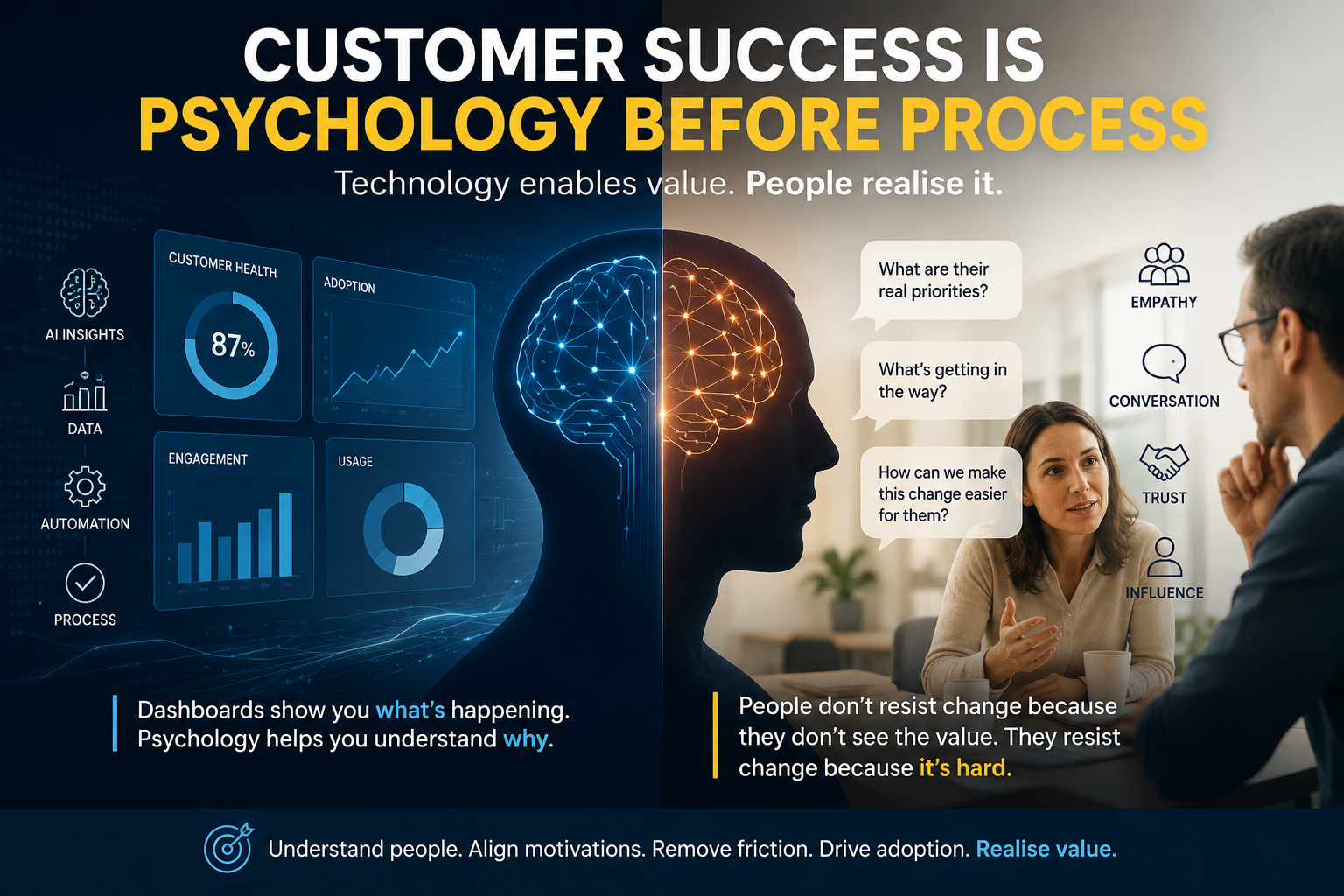
AI can tell you which customer is at risk.
It cannot always tell you why people inside that organisation are behaving the way they are.
That is why I’ve argued before that AI won’t fix your Customer Success mode if the underlying post-sale operating model is already weak.
That still requires human understanding.
The real job of Customer Success
Customer Success is often described as helping customers achieve value.
That’s true.
But beneath that is something more fundamental.
The real job is helping people change.
Helping organisations adopt new behaviours.
Helping teams work differently.
Helping leaders make better decisions.
Helping customers overcome the barriers that stop value being realised.
The companies that understand customer psychology tend to achieve stronger adoption, better retention and more expansion.
Not because they have better software.
Because they understand the people using it.
And in Customer Success, people remain the most important variable of all.
Final thought
The future of Customer Success will involve more automation, more AI and more data.
But it will also require a deeper understanding of human behaviour.
Customers are not workflows.
They are people.
The sooner SaaS companies recognise that, the more effective their Customer Success strategies will become.


