Tag Archives: Digital

What is AI-enabled Customer Success (and how to do it properly)

Introduction

AI is everywhere right now. Every SaaS company claims to be using it. Every Customer Success team is being told to adopt it.

But most teams are layering AI onto a weak Customer Success model and hoping it fixes the problem. It won’t.

AI doesn’t fix Customer Success. It exposes it.

So what does AI-enabled Customer Success actually mean and how do you do it properly?


What is AI-enabled Customer Success?

At its core, AI-enabled Customer Success is simple.

It’s using AI to help customers achieve outcomes faster and more consistently at scale.

Not more emails. Not more dashboards. Not more activity.

Better outcomes.

That means:

  • Identifying risk earlier
  • Spotting expansion opportunities sooner
  • Guiding customers to value faster
  • Helping teams focus on what actually drives revenue

AI should amplify good Customer Success. Not replace it.


Where most companies get it wrong

Most teams start in the wrong place.

They ask…

“How can we use AI in Customer Success?”

Instead of…

“Where are we failing to deliver value today?”

So what happens? They add…

  • AI-generated emails
  • Automated health scores
  • Chatbots that answer basic questions

It looks impressive but nothing really changes.

Churn doesn’t move. Expansion doesn’t grow.

Because the underlying problem hasn’t been solved.

The value story is still unclear.


The real shift: from activity to outcomes

AI only works when your Customer Success model is built around outcomes.

Not activity.

That’s the shift most companies haven’t made yet.

Traditional CS focuses on:

  • Touchpoints
  • QBRs
  • Adoption metrics

AI-enabled CS focuses on:

  • Customer outcomes
  • Value realisation
  • Commercial impact

If you can’t clearly define the value your customer is getting, AI has nothing useful to optimise.


Where AI actually adds value

When used properly, AI can transform how Customer Success operates.

1. Early risk detection

AI can analyse usage patterns, engagement signals and behavioural trends to spot risk before it’s visible. Not when the customer is already leaving, but months earlier.


2. Expansion signals

The best growth opportunities are already in your customer base.

AI helps identify:

  • Underused features
  • Teams ready to scale
  • Accounts with growing demand

This turns expansion from reactive to proactive.


3. Personalised guidance at scale

Customers don’t want generic playbooks. They want relevance.

AI can tailor onboarding, recommendations and next steps based on how each customer actually uses your product.


4. CSM focus

Your CSMs shouldn’t be chasing data.

They should be driving conversations that lead to outcomes.

AI can remove the noise so they focus on:

  • Value conversations
  • Commercial alignment
  • Growth opportunities

How to do AI-enabled Customer Success properly

This is where most companies struggle.

Here’s the right order.

1. Define customer outcomes clearly

Start here.

What does success look like for your customer in commercial terms?

Revenue growth? Cost reduction? Efficiency?

If you can’t answer this, stop.

AI won’t help.


2. Fix your value story

Your CSMs need to articulate value in a way that resonates with the customer and their CFO.

Not features, not usage

Value.


3. Align your data

AI is only as good as the data behind it.

That means connecting:

  • Product usage
  • Commercial metrics
  • Customer goals

Most companies have this data. It’s just not connected.


4. Redesign your operating model

This is the big one. AI doesn’t sit on top of your model.

It changes it.

  • Lower-value activities should be automated
  • High-value conversations should be elevated
  • Roles and responsibilities should shift

5. Start small and scale

Don’t try to transform everything at once.

Pick one area:

  • Onboarding
  • Risk detection
  • Expansion

Get it working. Then scale.


The bottom line

AI-enabled Customer Success isn’t about tools. It’s about focus.

If your Customer Success team is already aligned to outcomes, AI will accelerate growth.

If it isn’t, AI will expose the gaps.

That’s why some companies are seeing real results and others are just adding noise.


Final thought

The question isn’t…

“Are we using AI in Customer Success?”

It’s…

“Are we delivering real, measurable value to our customers?”

Because if you’re not, AI won’t save you – iIt will just make it more obvious.


Need more help?

If you’re rethinking how Customer Success drives retention and expansion in an AI-driven world, that’s exactly where I focus.

Happy to share what’s working and what isn’t.

AI has already arrived in Customer Success, the question now is what we do with it?

AI isn’t coming for Customer Success jobs. It’s already here.

Most of the work we used to treat as essential has quietly moved into the background.
Health scores. Renewal reminders. Basic check-ins. The admin that once filled our days is now handled by systems that never get tired.

And that’s a good thing.

Because it forces us to confront something the industry has avoided for too long. The value of a CSM has never been in tasks. It’s always been in thinking.

AI in customer success.


The Shift Nobody Can Ignore

As automation expands across the customer journey, the gap between activity and impact gets wider. CS teams that still define value by volume will struggle. Teams that define value by commercial thinking will thrive.

In 2025, every CSM needs a commercial mindset. Not to sell. But to understand the economics behind every customer conversation.

That’s the real shift.


Why Commercial Thinking Matters

The best CSMs already know the answer to one simple question:

How does our product make this customer more successful in a measurable way?

  • They understand margins
  • They understand cost savings
  • They understand how technology changes the economics of a customer’s business

They talk about return not renewal. Impact not activity. Value not volume.

And that’s where AI draws a sharper line than many expected.

If you’re looking at how AI fits into customer success more broadly, this guide to AI in customer success breaks it down.


Automation Doesn’t Replace Judgment

AI can process. It can surface insights. It can flag risk.

But it can’t replace partnership, judgment or business acumen.

These are the skills that turn a CSM from a task executor into a strategic operator. These are the skills that get Customer Success a seat at the table. And these are the skills that AI only makes more important, not less.


The New Line Between Replaceable & Essential

As more of the workflow becomes automated, the industry is heading towards a split. Not between junior and senior roles. But between replaceable and essential roles.

Replaceable roles cling to tasks. Essential roles understand the customer’s economics and use that understanding to guide decisions.

That’s where the profession is heading. And it’s where the opportunity lies for every CSM who wants to build a durable career as AI scales.


Here’s The Real Question

If Customer Success wants to evolve, it has to speak the language of business, not tasks. It has to show how decisions drive outcomes, not how many activities got logged.

And that means one thing.

Every CS leader needs to help their teams build commercial muscle.

Every CSM needs to learn how to anchor conversations in value.

And every organisation needs to decide whether CS will be a cost centre or a growth engine.

AI has already changed the role. Now it’s on us to decide what Customer Success becomes next.

How are you helping your team develop that commercial edge this year?


Want To Go deeper?

If you’re thinking about retention, expansion or how AI fits into your strategy, I work with a small number of SaaS companies on exactly this.

👉 If you’re rethinking your approach, let’s talk.

Customer-Led Growth: Why the Best Companies Now Grow with Their Customers

Growth models come and go.

For years, companies believed success came from selling harder, marketing louder or building flashier products. But something fundamental has shifted in how growth actually happens and the smartest organisations are responding.

That shift is what we call Customer-Led Growth (CLG).

It’s not a buzzword. It’s a structural change in how businesses grow and how customers expect to be treated.


How We Got Here

If you zoom out over the last two decades, you can see a clear evolution in how companies approached growth:

  • Sales-Led Growth (SLG): The old world of cold calls, quotas and closing deals – growth depended on the size and skill of the sales team

  • Marketing-Led Growth (MLG): Then came the era of brand and lead generation – marketing became the growth engine, filling the top of the funnel with demand

  • Product-Led Growth (PLG): The SaaS revolution flipped things again. Users could try before they buy and the product itself became the salesperson, think Slack, Zoom or Notion

Each of these models worked in its time. But as markets matured and customers gained power, the economics changed.

Acquisition costs rose. Switching costs fell. Buyers became more informed, more connected and far less patient.

The next evolution – Customer-Led Growth – isn’t about selling to customers at all. It’s about growing with them.


What Customer-Led Growth Really Means

Customer-Led Growth is simple in principle – your growth comes from helping customers achieve the outcomes they care about most.

When customers succeed they:

  • Stay longer (reducing churn)
  • Buy more (expansion revenue)
  • Tell others (advocacy).

That creates a compounding loop of growth powered not by marketing spend or sales pressure but by real, measurable customer value.

In plain English: you win because your customers do.

Imagine pushing a heavy car up a hill (sales-led). Exhausting. Then imagine cresting the top, and gravity takes over – the car starts rolling itself (customer-led). CLG is that gravity: momentum created by genuine customer success.


The Problem CLG Solves

For years, companies have measured the wrong thing. They’ve obsessed over acquisition metrics – leads, MQLs and pipeline coverage – without real proof that customers were succeeding after the sale.

The result?

Leaky buckets. Growth targets met one quarter, lost the next.

Customer-Led Growth changes the operating model. It forces teams to answer harder questions:

  • Are our customers realising value from what we’ve sold?
  • Can we prove it?
  • How quickly can we identify and fix friction before it becomes churn?

That shift changes how every team works – not just Customer Success.

Product, marketing, sales, support and leadership all align around one core idea – sustainable growth depends on recurring, compounding customer value.


A Quick Bit of History

The roots of CLG stretch back to three movements that collided over the last 15 years:

  1. Relationship marketing: The idea that long-term customer relationships are more profitable than one-off transactions.

  2. Customer Success: Born in SaaS, it turned retention into a discipline rather than an afterthought.

  3. The “Jobs To Be Done” framework: Focused on understanding what customers are really trying to achieve, not just what they’re buying.

Combine these and you get the foundation of Customer-Led Growth – listen deeply, deliver measurable outcomes and feed that insight back into the business.


The Early Pioneers

Several companies quietly pioneered CLG before the term existed:

  • HubSpot built its “flywheel” model around customer advocacy rather than lead funnels

  • Salesforce scaled Customer Success as a growth engine, not a support function

  • Adobe restructured its business from selling software licences to measuring active usage because usage equals value

  • Atlassian let its customers sell for them by creating self-serve journeys and community-driven growth

Each realised the same truth – the most reliable growth doesn’t come from new customers, it comes from the success of existing ones.


Why Now

Several forces are making CLG not just smart but essential:

  • Economic pressure: It’s now 5-7 times cheaper to keep a customer than acquire a new one

  • Market saturation: In SaaS and tech especially, buyers have near-infinite choice and differentiation comes from outcomes, not features

  • Data and AI: Companies can now see exactly where customers succeed or struggle and can act before they churn

  • Changing buyer psychology: Customers expect partnership, not persuasion, they want proof of value, not just promises

The modern customer isn’t looking for a vendor. They’re looking for a co-pilot and long term partner.


The Core Principle

Customer-Led Growth rests on one idea: Growth is the natural by-product of customers being  successful.

That sounds obvious but operationalising it is hard.

It means:

  • Success teams measured not on happiness (NPS) but on value realisation
  • Sales comp plans tied to long-term retention, not short-term bookings
  • Product roadmaps prioritising customer outcomes, not internal politics

It’s not a campaign. It’s a culture.


Takeaway

Customer-Led Growth isn’t about being nicer to customers. It’s about building businesses that last. When customers see clear, measurable success – they don’t just renew. They expand, advocate and bring others with them.

That’s growth you can trust – because it’s built on proof, not persuasion.


Want To Go deeper?

If you’re thinking about retention, expansion or how AI fits into your strategy, I work with a small number of SaaS companies on exactly this.

👉 If you’re rethinking your approach, let’s talk.

The Future of Customer Success with AI: Why Human + Machine Wins Every Time

The era of reactive Customer Success – firefighting churn and hoping renewals stick – is well and truly over. We’re entering a new phase where AI becomes a force-multiplier for CS teams.
And yes, it means some uncomfortable shifts for us – here’s what that means.

From Operations To Strategic Growth

Many CS teams still run like service desks – onboarding, adoption monitoring, renewals.
But with the AI tools now available, that model’s outdated.

AI helps you:

  • Spot early churn signals before it’s too late
  • Surface expansion opportunities inside existing accounts
  • Turn data from reporting to revenue-shaping

Infographic showing "The AI-Powered Customer Success Flywheel" - how data, insight, action, value, and retention form a continuous loop.

I explore this shift further in AI and customer retention value, where we look at how predictive data models are changing renewal strategy and growth forecasting.

My take: If you’re still tracking logins as a measure of success, you’re playing last decade’s game. Start measuring expansion rate, health-score movement and churn proactively averted.


The Hybrid Human & AI Dynamic

Let’s settle it: AI won’t replace CSMs. It will redefine them.

  • Low-touch accounts will be handled by automation
  • High-value accounts will get human, strategic focus

AI clears the admin noise so CSMs can focus on relationships, outcomes and (measurable) value creation.

This kind of shift demands new leadership models – I break that down in fractional leadership in Customer Success, including how part-time senior leaders can scale AI adoption faster than traditional org structures.

My take: Future-proof your role by mastering adoption analytics, customer value mapping and data-driven storytelling. The check-in and help model is over.


Hyper-Personalisation At Scale

AI makes it possible to deliver personalised experiences at scale. From predictive onboarding to sentiment-based renewal timing – your customers now expect it.

Diagram comparing AI automation and human CSM roles - "Let AI handle volume. Let humans handle value."

Examples:

  • Predict which onboarding path works best for a specific persona
  • Trigger interventions based on real-time usage or sentiment
  • Tailor renewal outreach to context, not template

My take: The winners in 2026 will treat every customer – even low-tier ones – as growth potential. AI gives you that lever.


Ethics, Governance & Trust

With power comes responsibility. AI in CS isn’t just about dashboards and prediction models – it’s about trust.

Guardrails matter:

  • Be transparent when AI is acting on behalf of your team
  • Audit outputs for bias or unfairness
  • Protect data and get explicit consent where needed

My take: Without governance, your AI strategy becomes a liability. Treat ethics as part of your operating model – not an afterthought.


The Next-Gen Playbook

Focus Area What to Do
Start with small wins Pilot churn prediction or personalised onboarding
Build your data foundation Standardise usage, sentiment, and engagement metrics
Redefine roles Upskill CSMs in data literacy and strategy
Scale intelligently Use AI for volume; use people for value
Govern everything Audit outputs, define KPIs, track both efficiency and outcomes

Many organisations need outside perspective to implement this playbook. My Customer Success advisory and consulting services help define those AI-enabled strategies and operational changes.


Closing Thoughts

If you treat AI as optional, you’ll fall behind. AI isn’t here to replace Customer Success – it’s here to amplify it.

Let machines handle volume. Let humans handle value.

That’s the model of the future.

For more real-world conversations on AI, growth, and leadership, tune in to the Breakthrough SaaS Growth with The Jasons podcast.


Sources


Want To Go deeper?

If you’re thinking about retention, expansion or how AI fits into your strategy, I work with a small number of SaaS companies on exactly this.

👉 If you’re rethinking your approach, let’s talk.

Customer Success: The Growth Lever Most Founders Still Undervalue

For years, growth meant acquisition. Sales targets ruled. Marketing filled the funnel. The faster you won customers, the faster you scaled.

But the SaaS model changed the maths. When revenue depends on renewals, growth isn’t just about winning new business – it’s about keeping and growing it.

Every founder eventually realises: acquisition fuels headlines, retention fuels valuations.

That’s where Customer Success comes in.

What Customer Success Really Does

Customer Success isn’t a support function or a post-sales box-tick. It’s the engine that drives sustainable growth.

What customer success means for founders.

What customer success means for founders.

Its job is simple: make sure customers achieve measurable outcomes, fast. When they do, they renew, expand and advocate. When they don’t, churn rises – and so does your cost of acquisition.

In other words, Customer Success protects your revenue base and amplifies lifetime value.


Why It Matters More Than Ever

In today’s market, investors are rewarding efficiency over expansion. The companies outperforming their peers aren’t adding headcount or spend – they’re maximising value from existing customers.

Customer Success is how they do it.

  • It turns data into foresight – spotting churn before it happens

  • It aligns teams around value, not activity

  • And it makes renewals predictable, not painful

This is what separates sustainable growth from growth theatre.


What It’s Not

  • It’s not customer service: CS doesn’t wait for problems, it prevents them.

  • It’s not a cost centre: Done right, it’s a profit multiplier.

  • It’s not a SaaS-only concept: Any business with recurring customers can apply it.


The Bottom Line

Customer Success isn’t about being nice to customers. It’s about being smart with capital. If your go-to-market still ends at the sale, you’re leaving margin, advocacy and predictable growth on the table.

The best founders already know: Customer Success isn’t a department. It’s the strategy.


Want To Go deeper?

If you’re thinking about retention, expansion or how AI fits into your strategy, I work with a small number of SaaS companies on exactly this.

👉 If you’re rethinking your approach, let’s talk.

AI Didn’t Rewrite Customer Success – It Rewired It

For years, we’ve obsessed over dashboards – health scores, usage data, adoption charts and a lot more.

All useful, but all missing something – and something super important for both our customers and us.

AI’s pulled the rug a bit. It’s made us look past the numbers and ask a harder question – what value do customers actually feel?

That’s where the real work is now. The tech can show us what’s happening, but only people can explain why it matters. Only people can connect the dots between insight and impact.

It’s not that Customer Success has become easier. Far from it. The job’s getting sharper. More strategic. Less about coverage, more about clarity.

I’ve always said data without context is noise. AI has turned up the volume.

If you’re looking at how AI fits into customer success more broadly, this guide to AI in customer success breaks it down.

And that’s the shift smart CS leaders are already leaning into – where human judgment becomes the real competitive edge.

If you’re looking at how AI fits into customer success more broadly, this guide to AI in customer success breaks it down.


Want To Go deeper?

If you’re thinking about retention, expansion or how AI fits into your strategy, I work with a small number of SaaS companies on exactly this.

👉 If you’re rethinking your approach, let’s talk.

From Retention To Expansion: How AI Drives Compounding Growth

In one of my last posts, I looked at how AI helps protect retention – the real growth engine. But retention is only half the story. The real prize in SaaS comes when customers not only stay, but grow.


Why Expansion Is Harder Than It Looks

Most SaaS teams talk about “land & expand” – but the expand part often relies on heroic effort:

  • CSMs spotting upsell chances by instinct

  • Leaders scrambling to pull value data together before renewals

  • Execs parachuted in to save shaky deals

That model doesn’t scale, and it leaves too much growth on the table.


How AI Changes The Expansion Playbook

AI turns guesswork into foresight:

  • Expansion scoring: pinpoints which accounts are most likely to grow

  • Predictive renewals: shows which deals need early attention

  • Automated ROI stories: packages the evidence in the customer’s own business terms

Instead of reacting late, teams can walk into renewal and expansion conversations armed with data-backed growth paths.


Embedding AI Into Everyday CS

The best CS teams are already using AI to:

  • Map whitespace opportunities in account planning

  • Auto-build outcome packs for customer value reviews (the old QBRs and EBRs)

  • Identify promoters ready for advocacy programmes

Each of these increases revenue without burning out people.


The Compounding Effect

Retention gives you stability. Expansion gives you momentum. AI is what makes both scalable. The companies that crack AI-powered expansion won’t just hit renewal targets – they’ll create a compounding loop where customers renew, grow and advocate, driving growth from within.


Want To Go deeper?

If you’re thinking about retention, expansion or how AI fits into your strategy, I work with a small number of SaaS companies on exactly this.

👉 If you’re rethinking your approach, let’s talk.

OpenAI’s AI Agent Operator: A New Shift

AI developments are continuing to accelerate and we’re moving more to enabling autonomous complex problem solving. OpenAI’s upcoming AI Agent Operator looks to be a fantastic development in this on-going evolution, with AI agents now handling more complex tasks and processes, with little human intervention – and this has real potential to reshape how we work and deliver value to customers.

Here’s why this matters:

(1) From Task Automation to Intelligent Execution: This role bridges the gap between AI capability and business execution, allowing operators to guide AI agents to not just complete tasks but to now navigate complex and specific workflows. It’s a shift to more fully integrated, decision making systems.

(2) Human-AI Collaboration Redefined: Operators will act as intermediaries, steering AI agents to align with our human goals. It’s not about replacing people but enabling us to focus on the more strategic, creative or high impact areas while AI handles the repetitive or highly technical tasks.

(3) Unparalleled Productivity Gains: AI’s ability to autonomously manage complex, multi-step tasks will unlock efficiency at a scale that we simply haven’t seen before. Think of workflows that can update themselves, customer requests being handled instantly (whilst really being personal) and our administrative workloads lightened.

(4) Integration Without Overhaul: The AI Agent Operator is designed to work with existing systems, not to replace them. This means businesses can adopt it with minimal disruption while benefiting from its capabilities almost immediately.

(5) A New Kind of Expertise: This role introduces a hybrid skillset, part strategic thinker and part technical specialist. It’s an exciting new opportunity to shape how AI supports businesses across many different industries.

The potential here is incredible. For businesses, it’s a chance to rethink operations and invest in what drives real value for customers, and for professionals (us humans), it’s a new frontier of expertise in guiding and collaborating with AI.

This isn’t just about doing things faster – it’s about doing them smarter and better (which we all want). The organisations that embrace this shift early will lead the way.

What are your thoughts on this new wave of AI? How could this change your approach to work or innovation?

Embracing Cultural Evolution in the Tech-Driven World

I wrote about company culture over 10 years ago and that previous post has been getting a lot of attention over recent weeks. That made me think – how has culture changed over the years and how important now is the interplay with culture, technology and both employee and customer success.

Since 2013 when I wrote the last culture article, the integration of advanced technology in the workplace has transformed company cultures globally. And this evolution necessitates a reassessment of how company culture and technology together foster a conducive environment for employee motivation and customer success. The rise of remote work, digital collaboration tools and AI-driven analytics has not only changed how we work but also how we interact, learn, and grow within organisations.

The core principles of a strong company culture – continuous hiring, encouraging entrepreneurship and leading by example – remain crucial. However, their application has transformed. Today, fostering a culture of adaptability, inclusivity and digital savviness is imperative. Encouraging a culture that embraces change, values digital skillsets and promotes a work-life balance in a digitally connected world is key to attracting top talent.

The transparent and data-driven culture facilitated by technology leads to more informed decision-making, enhancing employee satisfaction and efficiency. A culture that leverages technology to understand customer needs better and respond to them swiftly contributes significantly to customer success.

In essence, the synergy of a robust company culture and cutting-edge technology is a powerful driver of growth. It’s about creating an environment where motivated employees thrive, leading to innovative solutions and heightened customer satisfaction.

How does your company culture stack up in 2024? And what’s the future of a good company culture?

Combined thoughts on “Everything As A Service“

These are some thoughts captured and co-written by Stephen Danelutti and Jason Noble, two long time contributors to the world of Everything As a Service (XaaS) who met again recently. We realised our common background and insights and decided to produce this combined thought piece – hope you enjoy.

Background

We worked at Sony together many years back and only discovered this recently when we met. Funny how our orbits work as people and then you collide.

We worked in different parts of a division at Sony called DADC, which invented the CD and developed digital content streaming services. This was before iPod, iPhone and Spotify. Stephen has written about that, including a demo: The end of ownership and the rise of usership. This experience was a good precursor to our thinking on Everything as a Service (XaaS).
The as a service iceberg

We met when we both were (and still are) professionally in Customer Success management leadership roles, a function of SaaS companies that is, amongst others, being translated into XaaS. So we are both rather well positioned to talk on this topic.

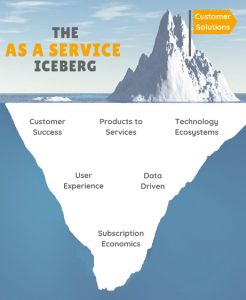
Stephen is writing an eBook on the subject which you can find out more about here. We decided to use that as a framework (The As a Service Iceberg) for exploring our mutual thoughts. While we divided subtopics up between us, we worked collaboratively throughout to edit and progress in tandem and what you read is very much a joint effort.


Everything as a Service (XaaS)

There is a distinction between the purely technological view which is where the term XaaS comes from and the one we refer to in this article. In ours we have jumped from technology to other industries – we have crossed the chasm. Essentially we are talking about taking the learnings from the Software as a Service (SaaS) industry and applying it to other industries.

Some examples

SaaS has been around now for a good few years, and we’ve seen other as-a-service philosophies and approaches pop up since – most related to technology (e.g. infrastructure as a service) but there are more and more examples now across all industries. Some great ones include:

  • Mobility and transport – think of an extension of your Oyster card
  • Property – renting plus add-on services and services like airbnb
  • Shopping – home delivery pre-prepared meals
  • Healthcare – shaving services
  • Airlines – yes even some airlines are often monthly subscription
  • Digital content – not just music, but now movies, TV, games and books
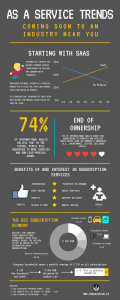
It’s not just about what is being delivered, but how it is being delivered – and the level of experience offered that takes these examples into the true as-a-service arena.

In times of crisis, like COVID-19, there is a stronger need to justify new technology services and innovations, and many businesses are looking at rapid return on investments as part of it. We will see a continued development of new as-a-service ideas coming over the coming years that have been accelerated by the need to innovate and change.

The as a service iceberg

1. Customer solutions

This is the outward manifestation of all of the others and is all about solving problems and meeting needs. No longer is something purchased just for its intrinsic value but what it will help a person or organisation achieve. Several sub components or theories support this and some have been around a while:

  • Systems thinking views a system as a cohesive conglomeration of interrelated and interdependent parts and in the case of customer solutions, it represents how products are now increasingly being viewed as tangible goods plus services.
  • Business outcomes management entails identifying, measuring and achieving business outcomes for the customer, often with the help of Customer Success teams (see the next influence).
  • Jobs to be done theory is a framework for understanding customer needs and innovating around them with new offerings.
  • Solution selling is an approach taken by sales teams that incorporates a consultative approach to identifying solutions to best meet a customer’s needs in the most cost efficient way, especially with multiple product offerings.

More elaborated on this in this post: As a Service trend research – customer solutions.

2. Customer success

With the shift to XaaS, the way we interact, work with and deliver to our customers has also evolved. Our customers’ expectations have risen rapidly and we need to focus on what experience they require and want, and also what it is that they are ultimately looking for, in outcome or value terms. The idea from SaaS vendors, that gave rise to customer success, is that they work with customers proactively to drive value and growth for the customer, in turn justifying the vendors offering. The old reactive way was letting the customer figure things out for themselves after the sale. This has been a monumental industry shift and it’s one that is still evolving and maturing. The role of a customer success manager (CSM) is one of the fastest growing roles today as more and more companies understand that it is critical to their own and their customers’ growth and ultimate success.

CSMs are generalists and facilitators, skilled across the business, commercial, technology and product functions. They are uniquely positioned to be able to guide and help customers achieve the outcomes they need, through the (technology) services they acquire. CSM’s act as trusted advisors, facilitators, business and growth consultants, analysts, project and programme managers, even as change managers for their customers.

3. From products to services

This fits alongside the customer solutions view where products play a role in a much wider ecosystem that includes services. It’s not just about technology and technology products, it’s much broader. Having said that, technology does enable this to a far greater degree, see next point. Think about how Apple has taken its iPhone and built an app (and services) ecosystem that serves to add value to Apple hardware and creates new revenue streams for them and third party app developers. These apps are increasingly being sold on a subscription basis which is also interrelated. For the broader context which incorporates service-dominant logic, check out this post: As a Service trend research – products to services.

4. Technology ecosystems

Technology has played a massive part in the shift to as a service. As we’ve seen the rise of technology services over the last 30 years, many more traditional companies (for example content creators and manufacturers) are now working with technology partners, for their technology development and almost outsourcing it. The focus now is about being enabled and empowered to use technology, as opposed to having to own and build it directly. Think of your internal IT department and how that’s changed. They’re now there to help you better utilise technology within the business and integrate with much wider technology ecosystems with external partners.

5. Being data-driven

Collecting data and understanding usage so that it drives greater insight, which in turn drives better products and services, has become a competitive differentiator. Translating this data into meaningful insights is the real challenge that only the leading companies are mastering. Questions like who is using what, how much and to what end, with which outcomes, need answering. You also need to consider where the data is, who can access it and whether this falls within regulatory compliance or not. These are big questions that require a holistic approach. Data science is a growing field that serves this area well and smart as a service companies are investing heavily into building their capabilities in this. A data-driven, decision making culture is also imperative.

6. Customer and user experience

The terms user and customer experience are front and centre now when it comes to technology. This has been driven by the rise of the consumer application ecosystem and high bars being set by companies like Amazon, Netflix and Apple (amongst many others) in how they interact with customers. Customer experience starts from the initial engagement with your customers and potentially through your marketing campaigns and outreaches. It then follows through with onboarding and implementation, project management, delivery, support and more. The challenge is ensuring that you deliver a constant customer experience and that it is specific to that customer (or segment of customers). The key to remember is that not every customer needs, wants or expects the same levels of customer experience.

7. Subscription economics

One of the biggest aspects of the as a service business model is the shift away from one-off payments to recurring payments, or subscription economics. Products and/or services are purchased in this way (on subscription) and sometimes even on an on-demand basis. Especially for B2B firms, this has shifted the financial impact from big capital expenditures upfront (capex) to more manageable on-going operational expenditure over time (opex). Many factors that this model of payment enables, need to be considered. One of the foremost on the vendors side is the emphasis this places on ensuring the customer continues to renew their subscription (not churning) by providing excellent service. For this the customer success managers role is key. Conversely, this makes the model very flexible for customers who can stop payments if they are not receiving any benefit or value. Take a look at this post for some graphics covering other aspects of what makes subscription models successful: Subscription Model Success Factors.

Other examples of where we’re seeing this shift

The shift to as a service as we’ve said started off in the world of technology but we are now seeing it everywhere across all industries. Some great examples include:

  • Gaming – all the big players like Sony and Microsoft have game subscription services, and even Google and Apple are now also in this booming market. From our days back at Sony, this way an area that we both were both closely involved with – the digitisation of content and streaming services.
  • Groceries – this is one to watch. The big supermarkets all have loyalty plans and they know what we like to buy and when. It won’t be long before this data is used to determine what our weekly grocery deliveries should be and we pay for a subscription service and food is just delivered at the frequency we pay for, and best of all most of what is delivered is exactly what we need.
  • Technology – infrastructure as a service, platform as a service and more. With the like of AWS and Azure, we can now subscribe to technology services including CPU power and data storage (and the related sub-services) and we can expand or contract our technology operations in response to demand from our own customers (this is all part of the big shift we’ve seen over recent years out to the cloud).

Other considerations

Customer centricity

There’s a lot of talk today about organisations making moves to be more customer centric and it’s something we have spoken and written about many times before (see link here to previous blogs). It boils down to really understanding your customers, as an organisation and being able to be agile and responsive to change as your customers’ needs and requirements change.
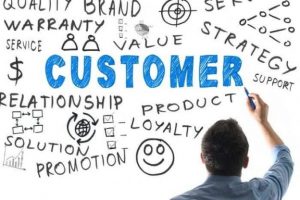
From a previous talk Jason did with a firm of VCs, the reason being customer centric is important is not only the obvious – that your customers stay loyal when they have good experiences – but also as our customers keep evolving and changing, so too are the ways that we operationalise that and support those customers.

A great way to think about customer centricity that really resonates with us is – “A business is customer centric when it delivers on-going growing value to and for their customers.“

Business transformation

Becoming an as a service business is not something you can easily tack on, like a plaster. That’s because of the overarching reach of so many of the factors listed above that are required for success. So wholesale transformation is often required for long term success. That doesn’t mean you have to do it all at once – see diagram for different stages and an approach you could take. This is like a product portfolio view of the transformation and tackles it one stage at a time, eventually rolling up into wholesale organisational transformation.

Keep an eye out for more joint blog posts we’ll be working on in the future.