Introduction
AI is everywhere right now. Every SaaS company claims to be using it. Every Customer Success team is being told to adopt it.
But most teams are layering AI onto a weak Customer Success model and hoping it fixes the problem. It won’t.
AI doesn’t fix Customer Success. It exposes it.
So what does AI-enabled Customer Success actually mean and how do you do it properly?
What is AI-enabled Customer Success?

At its core, AI-enabled Customer Success is simple.
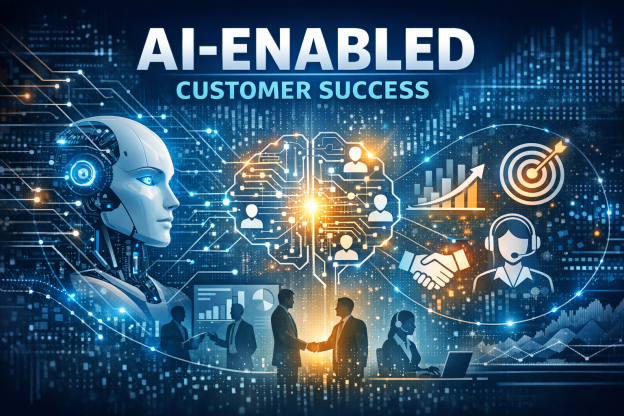
It’s using AI to help customers achieve outcomes faster and more consistently at scale.
Not more emails. Not more dashboards. Not more activity.
Better outcomes.
That means:
- Identifying risk earlier
- Spotting expansion opportunities sooner
- Guiding customers to value faster
- Helping teams focus on what actually drives revenue
AI should amplify good Customer Success. Not replace it.
Where most companies get it wrong
Most teams start in the wrong place.
They ask…
“How can we use AI in Customer Success?”
Instead of…
“Where are we failing to deliver value today?”
So what happens? They add…
- AI-generated emails
- Automated health scores
- Chatbots that answer basic questions
It looks impressive but nothing really changes.
Churn doesn’t move. Expansion doesn’t grow.
Because the underlying problem hasn’t been solved.
The value story is still unclear.
The real shift: from activity to outcomes
AI only works when your Customer Success model is built around outcomes.
Not activity.
That’s the shift most companies haven’t made yet.
Traditional CS focuses on:
- Touchpoints
- QBRs
- Adoption metrics
AI-enabled CS focuses on:
- Customer outcomes
- Value realisation
- Commercial impact
If you can’t clearly define the value your customer is getting, AI has nothing useful to optimise.
Where AI actually adds value
When used properly, AI can transform how Customer Success operates.
1. Early risk detection
AI can analyse usage patterns, engagement signals and behavioural trends to spot risk before it’s visible. Not when the customer is already leaving, but months earlier.
2. Expansion signals
The best growth opportunities are already in your customer base.
AI helps identify:
- Underused features
- Teams ready to scale
- Accounts with growing demand
This turns expansion from reactive to proactive.
3. Personalised guidance at scale
Customers don’t want generic playbooks. They want relevance.
AI can tailor onboarding, recommendations and next steps based on how each customer actually uses your product.
4. CSM focus
Your CSMs shouldn’t be chasing data.
They should be driving conversations that lead to outcomes.
AI can remove the noise so they focus on:
- Value conversations
- Commercial alignment
- Growth opportunities
How to do AI-enabled Customer Success properly
This is where most companies struggle.
Here’s the right order.
1. Define customer outcomes clearly
Start here.
What does success look like for your customer in commercial terms?
Revenue growth? Cost reduction? Efficiency?
If you can’t answer this, stop.
AI won’t help.
2. Fix your value story
Your CSMs need to articulate value in a way that resonates with the customer and their CFO.
Not features, not usage
Value.
3. Align your data
AI is only as good as the data behind it.
That means connecting:
- Product usage
- Commercial metrics
- Customer goals
Most companies have this data. It’s just not connected.
4. Redesign your operating model
This is the big one. AI doesn’t sit on top of your model.
It changes it.
- Lower-value activities should be automated
- High-value conversations should be elevated
- Roles and responsibilities should shift
5. Start small and scale
Don’t try to transform everything at once.
Pick one area:
- Onboarding
- Risk detection
- Expansion
Get it working. Then scale.
The bottom line
AI-enabled Customer Success isn’t about tools. It’s about focus.
If your Customer Success team is already aligned to outcomes, AI will accelerate growth.
If it isn’t, AI will expose the gaps.
That’s why some companies are seeing real results and others are just adding noise.
Final thought
The question isn’t…
“Are we using AI in Customer Success?”
It’s…
“Are we delivering real, measurable value to our customers?”
Because if you’re not, AI won’t save you – iIt will just make it more obvious.
Need more help?
If you’re rethinking how Customer Success drives retention and expansion in an AI-driven world, that’s exactly where I focus.
Happy to share what’s working and what isn’t.