Most SaaS companies have become very good at measuring what they sell.
Bookings.
ARR.
Pipeline.
Win rates.
Some are reasonably good at measuring what they deliver.
Implementation completed.
Training delivered.
Success plans created.
Support tickets resolved.
Far fewer can tell you whether customers are actually achieving the outcomes they bought the product to achieve in the first place.
That gap matters more than most leadership teams realise.
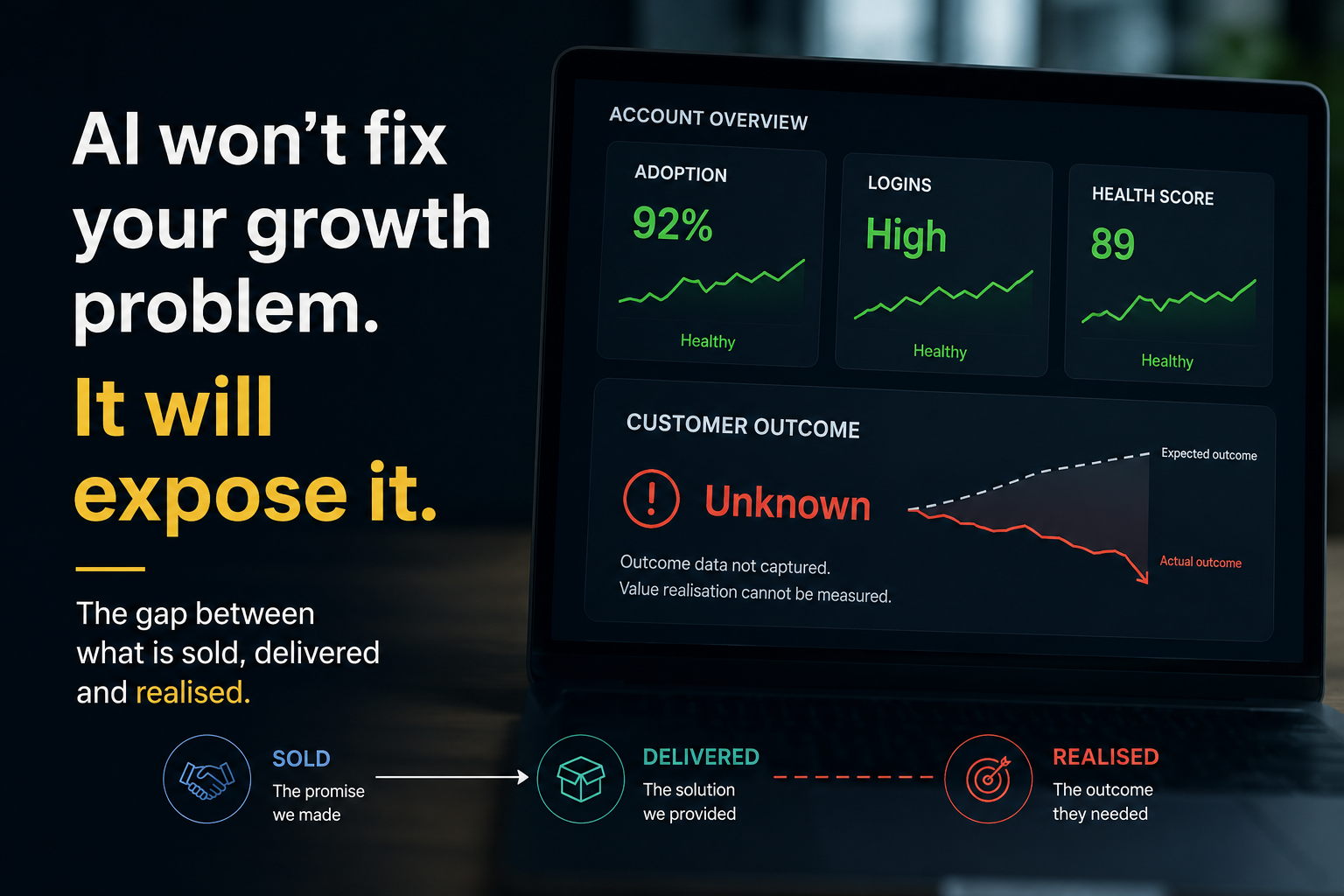
It’s the gap between what was sold, what was delivered and what was ultimately realised by the customer.
And it’s where churn begins.
The most dangerous metric nobody measures
Imagine a customer buys your platform to reduce onboarding time from 30 days to 10.
The sales team closes the deal.
The implementation team deploys the product.
The Customer Success team runs training sessions.
Usage looks healthy.
Everyone internally believes the account is a success.
But six months later the customer is still taking 28 days to onboard new users.
The software was deployed.
The customer logged in.
The project was completed.
Yet the outcome never happened.
From the customer’s perspective, the investment failed.
Most SaaS businesses have no systematic way of spotting this.
They track activity.
They track adoption.
They track engagement.
They rarely track whether the original business problem was solved.
Why AI is making this problem impossible to hide
Many SaaS leaders believe AI will help them improve retention.
They’re partly right.
AI can identify patterns humans miss.
It can analyse usage data at scale.
It can spot declining engagement.
It can flag customers who look likely to churn.
It can even suggest actions for Customer Success teams to take.
But there is a problem.
AI can only analyse the data it can see.
If your business isn’t measuring customer outcomes, AI cannot magically create them.
Instead, it exposes the weakness.
Faster.
More accurately.
And often more publicly.
AI might tell you a customer’s usage is falling.
What it cannot tell you is whether the customer ever achieved the outcome they bought your solution for.
Because most companies never captured that information in the first place.
The three gaps that quietly destroy growth
Gap 1: The sales reality gap
The customer buys based on one expectation.
The product delivers something slightly different.
Nobody notices until renewal.
The wider the gap between promise and reality, the greater the retention risk.
Gap 2: The delivery gap
The customer receives the software but never fully adopts it.
Features are available.
Processes remain unchanged.
People revert to old ways of working.
The implementation succeeds.
The transformation fails.
Gap 3: The value realisation gap
The customer uses the platform regularly.
Adoption metrics look healthy.
Yet the business outcome never materialises.
Usage exists.
Value does not.
This is often the most dangerous gap because traditional SaaS metrics make everything look healthy.
Why expansion revenue depends on realised value
Many leadership teams view renewals and expansion as separate motions.
Customers don’t.
A customer who achieves meaningful outcomes naturally becomes more open to expansion.
A customer who is still waiting to see value rarely wants to buy more.
This is why the strongest Net Revenue Retention figures usually come from organisations that obsess over customer outcomes rather than product usage.
Expansion is often a lagging indicator of realised value.
Customers buy more when they believe the first investment worked.
Simple.
The question every leadership team should ask
If I stopped one of your account teams in the corridor and asked:
“Why did this customer buy?”
Could they answer?
More importantly:
“What measurable business outcome has the customer achieved since buying?”
Could they answer that too?
If not, you may have a value realisation problem hiding behind healthy-looking adoption metrics.
What to do next
- What business outcome were they trying to achieve when they purchased?
- How will that outcome be measured?
- Has it actually been achieved?
Not implemented.
Not trained.
Not onboarded.
Achieved.
Then build your customer operating model around those answers.
Track them during onboarding.
Review them in customer meetings.
Report them to executives.
Use AI to help analyse them.
But don’t expect AI to create them.
Because AI won’t fix your growth problem.
It will expose it.
And if your customers are not achieving value today, the evidence is about to become impossible to ignore.
Final thought
The next generation of SaaS winners won’t be the companies with the most AI.
They’ll be the companies with the clearest understanding of customer value.
AI will simply make that difference visible.