Your sales engine is running.
Pipeline looks healthy. New logos are coming in. Revenue targets appear achievable.
But your NRR is telling a different story.
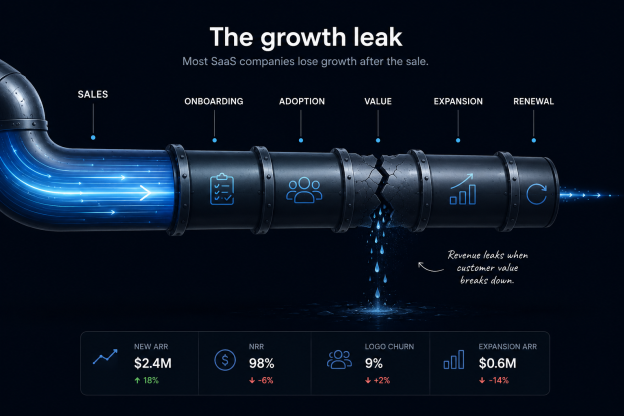
Somewhere between contract signature and renewal, growth is leaking.
Customers are going live but not expanding. Adoption exists but commercial momentum stalls. Customer Success teams are busy, yet leadership still struggles to clearly connect post-sale activity to retention and expansion outcomes.
This is one of the most common problems in SaaS right now.
And most companies feel it long before they can properly articulate it.
Why SaaS growth leaks after the sale
Most SaaS organisations are heavily optimised around acquisition.
Sales, marketing and product investment often dominate strategic conversations because they are easier to measure in the short term. Pipeline growth feels visible. New ARR feels tangible.
Post-sale execution is different.
The warning signs usually appear gradually:
- Renewals become reactive
- Expansion becomes unpredictable
- Onboarding drags
- Customers stay “active” without achieving meaningful outcomes
- Customer Success becomes overloaded with activity but commercially unclear
Over time, growth slows despite continued acquisition investment.
That is when leadership teams start asking harder questions about retention, customer value and operational efficiency.
The gap between adoption and customer value
One of the biggest mistakes SaaS companies make is confusing product usage with realised value.
A customer logging in regularly does not automatically mean they are successful.
Many organisations measure:
- logins
- feature usage
- meeting volume
- ticket response times
But customers do not renew because they attended QBRs.
They renew because the product helped them achieve a business outcome that mattered.
That gap between activity and realised value is where many SaaS businesses quietly lose expansion opportunities.
The strongest Customer Success organisations understand this clearly. They align onboarding, adoption and ongoing engagement around measurable customer outcomes rather than internal process metrics.
Why Customer Success becomes commercially unclear
In many SaaS businesses, Customer Success evolves reactively.
The function grows quickly as customer numbers increase, but ownership boundaries often remain vague.
Sales owns revenue.
Support owns problems.
Product owns features.
Customer Success ends up sitting somewhere in the middle trying to hold everything together.
The result is predictable:
- unclear commercial accountability
- inconsistent customer experiences
- fragmented definitions of value
- poor cross-functional alignment
This is why some CS teams appear extremely busy while leadership still struggles to see measurable commercial impact.
The issue is rarely effort. It is operating design.
We recently discussed this exact shift on our podcast Breakthrough SaaS Growth with The Jasons in our episode From Customer Success to Customer Growth – The Next Evolution of SaaS, where we explored why Customer Success is increasingly evolving into a commercial growth function rather than simply a post-sale support layer.
How AI is exposing weak post-sale execution
As I covered in my article on AI-enabled Customer Success, the companies gaining advantage are not simply automating support tasks. They are redesigning how customer value is delivered.
Not because AI itself is causing churn, but because it exposes operational weaknesses much faster than before.
Weak onboarding becomes visible earlier.
Poor adoption patterns surface sooner.
Customers expect faster time-to-value and more proactive engagement.
Companies that simply automate broken post-sale processes will struggle.
The organisations gaining advantage are the ones redesigning how customer value is delivered in the first place.
They are using AI to:
- identify churn risk earlier
- improve customer visibility
- reduce onboarding friction
- surface expansion opportunities
- scale proactive engagement
But the technology only works when the underlying operating model is aligned around customer outcomes.
AI does not fix value delivery problems.
It exposes them.
What high-performing SaaS companies do differently
The strongest SaaS companies treat post-sale execution as a growth function, not a support function.
They align sales, product and Customer Success around shared customer outcomes.
They focus on:
- faster time-to-value
- measurable business impact
- operational clarity
- scalable customer engagement
- retention and expansion as board-level metrics
Most importantly, they understand that sustainable SaaS growth does not break at acquisition.
It breaks after the sale when customers stop progressing.
By the time NRR starts falling, the underlying problems have usually existed for months.
Sometimes years.
That is why the companies outperforming right now are not necessarily the ones automating the most.
They are the ones aligning their organisation around realised customer value.
Many SaaS companies already know something is breaking post-sale. The challenge is diagnosing where the operational gaps actually sit.
That’s typically where a Customer Success advisor can help bring clarity.