Tag Archives: CCO

The revenue leak starts after the sale

Most SaaS founders know revenue is leaking somewhere.

They can see it in the numbers.

Renewals are harder than they should be.
Expansion is slower than expected.
NRR starts to drift.
Customers look fine until they suddenly are not.

So the business looks at the usual suspects.

The renewal process.
The onboarding journey.
The sales handover.
The health score.
The CSM cadence.

All useful places to look.

But often, they are not where the leak starts.

The leak starts earlier.

It starts the moment a customer signs and nobody clearly owns whether they achieve what was promised.

The deal is not the outcome

A signed deal feels like progress.

And it is.

But for the customer, nothing has been realised yet.

  • They have not bought a contract
  • They have not bought access to software
  • They have not bought an onboarding plan

They have bought an outcome.

That might be faster reporting, lower risk, reduced manual work, better visibility, higher productivity or stronger revenue performance.

Whatever it is, someone inside your business needs to own whether the customer gets there.

  • Not loosely
  • Not culturally
  • Not “the team”

Actually own it.

Because when everyone owns the customer outcome, nobody does.

Where the gap opens

The gap opens between what sales commits and what the customer experiences.

  • Sales sells the promise
  • Onboarding gets the customer live
  • Customer Success runs the cadence
  • Support handles the issues
  • Product tracks usage
  • Finance watches the renewal number

But who owns the customer getting what they paid for?

That is the uncomfortable question.

Because in many SaaS businesses, the answer is vague.

  • Everyone is involved
  • Nobody is accountable

And that is where churn starts to build.

  • Not at renewal
  • Not when the customer complains
  • Not when usage drops

Much earlier.

It starts when the business loses sight of the original promise.

Usage is not proof of value

This is where many SaaS teams fool themselves.

A customer can be onboarded and still not be successful.

They can log in and still not see value.

They can attend QBRs and still not believe the product is critical.

They can use the software and still struggle to explain the commercial impact.

Usage matters.

But usage is not the same as value.

Activity is not the same as progress.

A completed onboarding is not the same as a customer who has achieved what they were sold.

That distinction matters because renewals are not won by activity.

They are won by evidence of value.

Customer Success cannot fix this alone

When retention weakens, companies often assume they have a Customer Success problem.

Sometimes they do.

But often, they have a post-sale ownership problem.

Customer Success cannot fully own value if the sales promise was never captured properly.

It cannot prove impact if success criteria were never agreed.

It cannot drive expansion if the customer never reached first value.

It cannot rescue a relationship if the business treated the sale as the finish line.

CS has a critical role.

But post-sale value is not a department.

It is a commercial operating discipline.

That means sales, onboarding, product, support, finance and leadership all need to be aligned around the same question:

Did the customer get what they paid for?

A simple test

Ask five questions after every deal closes:

  1. What outcome did the customer buy?
  2. What did sales promise or imply?
  3. Who owns first value?
  4. How will we prove value has been realised?
  5. When will leadership know if the customer is off track?

If the answers are vague, you have found the leak.

Not a theoretical leak.

A commercial one.

The kind that shows up later as slow adoption, weak expansion, renewal risk and declining NRR.

The real ownership question

The best SaaS businesses do not treat the sale as the finish line.

They treat it as the start of the value obligation.

That is the shift.

From “we sold it” to “they realised it”.

From customer handoff to customer ownership.

From activity tracking to value evidence.

So the real question is not:

“Do we have a Customer Success team?”

Most companies do.

The better question is:

Who in your business owns what happens after the sale?

If the answer is unclear, that is where the revenue is leaking.

Retention vs Acquisition: Why CEOs Should Bet on Customer Success

SaaS companies love chasing new logos. But the truth is, growth doesn’t come from acquisition alone – it comes from keeping and expanding the customers you already have. For CEOs, the smart bet is on customer retention.

The maths of retention vs acquisition

It costs far more to acquire a new customer than to keep an existing one. And the impact on revenue is dramatic: a small increase in retention drives a much bigger increase in lifetime value. Retention compounds – acquisition resets every month.

Customer success as a revenue engine

Customer success isn’t just support. It’s the engine that drives expansion, advocacy and predictable renewals. By focusing on customer outcomes, you create growth from within.

What CEOs can do today

  • Make net revenue retention a board-level metric
  • Involve CS leadership in strategic discussions
  • Invest in customer health monitoring and adoption tracking.

Customer-led growth is the future. If you want to understand how to make retention work for your business, get in touch.

A practical guide to customer centricity

We know the theory and we know we need to be more customer centric. The biggest challenge for many organisations is how do it, at both the strategic organisational level and at the more tactical operational level.

I’ve worked with and for many organisations going through their own journey to be more customer centric, at both large well-established global organisations and more niche startup organisations and have been privileged to be in positions with them where I’ve been part of that change.

One of the more strategic level changes that is crucial for success is getting your customer leadership at the right level. It’s great to see more and more organisations across different industries and sectors investing in Chief Customer Officer or similar exec level roles now and the number has grown significantly over the last few years (and continues to grow).

Having the right leadership gives you the voice of the customer at the leadership table, having someone focused on driving customer growth and value and bringing the customer conversations to the exec and board level.

I really like this concise definition of a Chief Customer Officer:

“An executive who provides the comprehensive and authoritative view of the customer and creates corporate and customer strategy at the highest levels of the company to maximise customer acquisition, retention, and profitability.”

The customer leadership role – Chief Customer Officer or other – gives you:

  • Visibility – to understand and see what is happening to your customers
  • Clarity – of what happens when a prospect becomes a customer
  • Balance of power – creating the 3rd organisational pillar (with sales and operations)
  • Sales focus – allowing sales to focus on new business without customer distractions
  • Feedback – into what is happening outside of the business (the so called magic loop)
  • Signalling – the external messaging that we are customer centric

The magic loop above is:

Plan and Build (product management and engineering) vs. Demand and Sales (Marketing and Sales) vs. Customer Experience (Customer Success).

At the more tactical level though – in terms of things you could do more immediately – here are a number of great practical ideas for driving customer centricity in your organisation:

  1. Create a mission statement that impacts your customers and that includes customers
  2. Be a customer – yes role play (across all teams)
  3. Visit your customers – all execs and, even better, all teams
  4. Implement a customer forum or community (customers talking to each other)
  5. Create a voice of customer programme (and close that feedback loop)
  6. Bring your customer feedback into every meeting across the business
  7. Democratise customer insights and make them visible to everyone in the organisation
  8. Link team compensation to the customer and have customer focused goals
  9. Hire for customer orientation and customer empathy (and onboard them like customers)

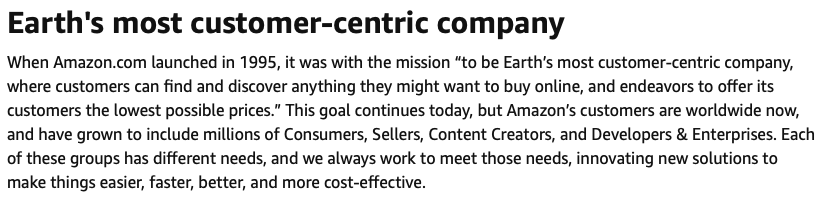
I really, really like Amazon’s mission statement:

Numbers 6 and 7 above can be very powerful when done well and I’ve seen the idea of a customer feedback wall used very well and to great effect – where you include and share the very, very good, the good, the bad and the ugly.

Do these ideas resonate with you? What things have you done in your organisations to drive the journey to being more customer centric? And what has the impact been with your customers?

If you’re interested in chatting customer centricity or customer success, please do reach out to me – I always love hearing your own journeys and challenges and ideas (and good coffee).

And don’t forget to listen to my latest podcast with Jason Whitehead from Trituns on getting your customer onboarding right from earlier this month. Click here to listen to this one and others in the series.

Who’s looking after your customers’ success?

What a great question to ask. Do you know the answer, and if not, who’s finding it out for you? And even more importantly, do you know what your customers need to achieve to be successful?

Often as business owners and leaders, we naturally need to be focused on our company’s success and how we evolve and grow our business, building new products and services and acquiring new customers.  

We’ve seen a shift in the last ten years to the new world of Customer Success and the consumerisation of business services, where our business customers’ expectations are driven by their experiences as consumers. This has been and continues to be a huge change and a very challenging one. I say ‘ new world’ here, but it’s not new as in ‘ we’ve never done it before’ – just in that we need a different (and new) approach today.

How do we provide the same levels of services (and amazing products and platforms) that organisations like Amazon, Apple and Netflix do? They’re in completely different markets and you could see them as being irrelevant to the lettings industry. But many of your own customers use them – and many others like them – on a daily basis, and they just expect things to work and deliver, as and when and where they need and want.

Our customers are now more willing and able to leave us if we don’t do what they need or provide the value they expect – and they expect this level of flexibility. The so-called age of the customer is all about this flexibility – it’s about how businesses push value to customers, and ensuring customers become the focus and that customers are attracted to use them, not stuck with them.

When our customers are successful, and they can directly see the value our products and services give them, they will naturally gravitate more to us, use more of our services, grow with us and become great advocates.

I heard a great quote at Gainsight’s recent Chief Customer Officer Summit Europe 2018 that resonates so well and sums this up perfectly: “Make your product value painlessly obvious“.

Customer Success has to be a business-wide strategy and way of working, it isn’t just the responsibility of one team , one job function or one person , and you need a customer-centric culture to achieve this.

It often starts with one team – your customer facing team – but that team’s objectives and strategy and planning have to align with the rest of the business and radiate out to influence other teams and stakeholders.

This team absolutely can be – and often is – the starting point for this refocus back to the customer. They can plan and start new customer-based initiatives, projects and activities that then flow out across the wider business. In this fast-growing world of Customer Success, many organisations are leading the way and developing new and improved approaches that can be replicated elsewhere and by other companies, even in different industries.

How do you ensure Customer Success?

So what does a customer-centric culture look like?   At a number of startups I’ve worked with Customer Success has been a a core part of our operating philosophy from day one but in the early days it often starts with that team doing everything for customers. As you grow and expand as a business, so your Customer Success team and approach has to grow, and of course your customer-base. You move from being mainly reactive and often seemingly on the backfoot, to having a full single customer view that covers everything from commercial information, support details, customer sentiment, survey feedback, product usage, contractual information, sales information and much more. This is a critical part of our success and it continues to grow, with the right technology and tools (including a Customer Success Management platform).  

The teams have to also evolve and I’ve seen success in creating dedicated functions for onboarding and implementation (and customer education), customer and commercial operations, documentation and configuration and customer success management (that includes customer renewals, escalations, training, customer feedback, consultancy and advisory services, relationship management and customer advocacy and customer value reviews). All of these involve working very closely with the other teams and helping to make sure that customer feedback is being fed through the right channels, listened to and responded to in the appropriate way.

There is of course a balance needed between providing the level of services required (and achieving those desired customer outcomes) and over-delivering and over-servicing, and it can be challenging to strike the right balance. It’s critical to sometimes say no and to route our customers through the most appropriate channels into the business, for them to get the outcomes they require, and for this to be repeatable for them and scalable to grow with our business and our customers’ businesses.

How we measure Customer Success is critical to us – and that statement is even more powerful when reworded slightly… how do you measure your customers’ success?

There are a number of key metrics we can and do use for this, including Net Promoter Score. NPS is an easy-to-use measure to gauge customer loyalty and how it trends over time, and is used by many global businesses in many different industries. I’ve used NPS successfully in a number of different businesses, asking that one ultimate question – how likely are you to recommend us? – but also with a number of optional additional questions to get more customer insight. The score at a particular time is less important than the trend over time or the details and sentiment behind the score. When we receive completed surveys, the Customer Success Managers then carry out detailed feedback calls and campaigns with customers to understand better the reasons behind the feedback and to explore how we can improve.

It’s important to note – and this can be often overlooked – that Net Promoter Score and customers’ sentiment and feedback is not something that is just owned by your Customer Success team. These are and have to be company-wide measures and, ultimately, key business objectives. Your detractors ultimately aren’t getting the value they need and they can be calling in more for support and help, so what we need to do is help move these customers towards being promoters, and ensure that they are successful.

So the answer to the new ultimate question – the title of this post – is you and your company. Your Customer Success team helps you understand better what your customers’ success looks like, alongside of course your sales teams, and then works with the rest of the company to help achieve that success.

Customer Success is about both good outcomes and good experience and getting the mix right for that customer and what they need. If one of these isn’t right or isn’t working, you will not help your customers be successful.

Nothing is more important than your customers’ success.