Tag Archives: Service

Customer Growth Isn’t Magic – It’s Design

It’s tempting to see growth as something mystical. A viral moment. A product that “sells itself”. A lucky hire who changes everything.

But sustainable customer growth isn’t about chance. It’s about design. The businesses that consistently retain and expand customers are deliberate about how they build the experience.

Here’s what that design looks like in practice.

1. Start with outcomes, not outputs:

Your customers don’t care about features. They care about results. Growth begins when you define success in the customer’s own terms – whether that’s higher revenue, efficiency gains, or risk reduction. Companies that design for growth measure these outcomes and tie them directly to renewal and expansion conversations.

2. Align the journey to deliver value:

Acquisition is only the opening chapter. From onboarding through adoption and support, every stage should move the customer closer to their outcomes. Misalignment kills growth – like when sales oversells, onboarding under-delivers, or success teams focus on activity instead of impact. Design means stitching the journey together so every handoff is seamless.

3. Build for evolution, not stasis:

Customer needs change. Market conditions shift. A “set and forget” model quickly becomes irrelevant. High-growth companies bake feedback loops into their design: health scores that adapt, playbooks that iterate, and leadership reviews that revisit strategy. Growth comes from learning fast and recalibrating often.

4. Balance strategy with execution:

Designing growth is both big picture and hands-on. At board level, it’s about governance, renewal predictability, and customer-led revenue strategy. On the ground, it’s about practical playbooks, adoption frameworks, and success metrics that teams can actually use. Both matter.

Customer growth isn’t magic. It’s design.

The question is whether you’ve designed for retention, expansion, and advocacy – or if you’re still relying on chance.

Most SaaS Startups Don’t Fail From Lack of Customers – They Fail From Lack of Retention

Customer retention

Customer retention – image copyright Harvard Business School Online

Too many early-stage SaaS teams celebrate sign-ups and activity:

❌ New accounts added but no adoption
❌ Onboarding calls logged but no outcomes
❌ Product usage stats with no link to retention

That’s busyness, not growth.

The real test in the first 12 months is:

✅ Are customers adopting the product in ways that prove value?
✅ Can you spot renewal risk before it’s too late?
✅ Do you have clear signals for expansion opportunities?

This is what separates founders who fight churn from those who scale predictably.

Customer Success isn’t a cost centre. For startups, it’s the difference between burning through cash and building customer-led growth.

If you want more practical ideas to fight churn early, check out my post on how founders can reduce SaaS churn in the first 12 months.

How Founders Can Reduce SaaS Churn in the First 12 Months

Churn is the silent killer of early-stage SaaS. You can win new customers, but if they leave quickly, growth stalls before it even begins. In the first twelve months, reducing churn is the single biggest lever for sustainable growth.

Here are three practical ways founders can make an immediate impact.

(1) Onboarding is everything:

The first experience sets the tone. If customers don’t see value quickly, they drift away. Onboarding should be more than product walkthroughs – it’s about proving outcomes. Make the first 30 days a success story, with clear milestones and check-ins.

(2) Measure adoption, not just logins:

Too many founders track vanity metrics like account sign-ups. What really matters is adoption – are users actually achieving what they came for? Define success behaviours in your product and measure against them. Low adoption early on is the clearest warning signal for churn.

(3) Talk to customers before it’s too late:

Silence doesn’t mean satisfaction. Set up feedback loops and proactive check-ins, especially in the first 90 days. Health scores, NPS and customer calls give you the insight to fix issues before they become cancellations.

Reducing churn isn’t glamorous, but it’s the foundation of growth. If you’re a founder struggling to keep customers, I can help.

But the bigger picture is clear – most SaaS startups fail not from lack of customers, but from lack of retention.

Amp It Up – Leading For Hypergrowth

I love Christmas for having more time for diving into great book – and not just those you were lucky enough to get for Christmas presents.

A great one I’ve read this year is Amp It Up by Frank Slootman.

In today’s dynamic business environment, ‘Amp It Up’ is a must-read for leaders and entrepreneurs eager to turbocharge their companies. The book skillfully bridges the gap between theoretical strategies and real-world applications. It offers a treasure trove of actionable insights on enhancing team productivity, fostering innovation, and instilling a culture of continuous growth. What sets ‘Amp It Up’ apart is its relatable content, filled with practical advice and inspiring examples that resonate with both new and seasoned professionals.

This book is not just another business guide; it’s a catalyst for transformation. Whether you’re steering a startup or managing a well-established enterprise, ‘Amp It Up’ provides the tools to elevate your business strategy and operational efficiency. If you’re looking to ignite a new spark in your leadership approach and drive your business to new heights, ‘Amp It Up’ is your roadmap to success.

Ready to revolutionise your business journey? Get your copy today and start amplifying your impact!

Why Is Customer Experience So Bad?

A huge generalisation but why is customer service not where it should be today (particularly when it comes to big organisations and call centres)?

5 common mistakes made time after time:

1. Lack of empathy.
→ Not understanding customer’s feelings or perspectives.

Do this instead
↳ • Practice active listening.
• Show genuine interest in their concerns.

2. Ignoring feedback and not listening.
→ Not considering customer’s suggestions or complaints.

Do this instead
↳ • Regularly review customer feedback.
• Implement necessary changes accordingly.

3. Poor communication.
→ Not conveying information clearly and effectively.

Do this instead
↳ • Use simple, understandable language.
• Ensure your message is concise and clear.

4. Inconsistency in service.
→ Varying levels of service quality.

Do this instead
↳ • Maintain a consistent service standard.
• Regularly train your team.

5. Neglecting follow-ups.
→ Not checking back with customers post-service.

Do this instead
↳ • Regularly touch base with customers.
• Ask for their feedback on the service.

How are you ensuring top-level customer service in your organisation?

Combined thoughts on “Everything As A Service“

These are some thoughts captured and co-written by Stephen Danelutti and Jason Noble, two long time contributors to the world of Everything As a Service (XaaS) who met again recently. We realised our common background and insights and decided to produce this combined thought piece – hope you enjoy.

Background

We worked at Sony together many years back and only discovered this recently when we met. Funny how our orbits work as people and then you collide.

We worked in different parts of a division at Sony called DADC, which invented the CD and developed digital content streaming services. This was before iPod, iPhone and Spotify. Stephen has written about that, including a demo: The end of ownership and the rise of usership. This experience was a good precursor to our thinking on Everything as a Service (XaaS).
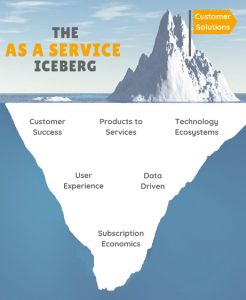
The as a service iceberg

We met when we both were (and still are) professionally in Customer Success management leadership roles, a function of SaaS companies that is, amongst others, being translated into XaaS. So we are both rather well positioned to talk on this topic.

Stephen is writing an eBook on the subject which you can find out more about here. We decided to use that as a framework (The As a Service Iceberg) for exploring our mutual thoughts. While we divided subtopics up between us, we worked collaboratively throughout to edit and progress in tandem and what you read is very much a joint effort.


Everything as a Service (XaaS)

There is a distinction between the purely technological view which is where the term XaaS comes from and the one we refer to in this article. In ours we have jumped from technology to other industries – we have crossed the chasm. Essentially we are talking about taking the learnings from the Software as a Service (SaaS) industry and applying it to other industries.

Some examples

SaaS has been around now for a good few years, and we’ve seen other as-a-service philosophies and approaches pop up since – most related to technology (e.g. infrastructure as a service) but there are more and more examples now across all industries. Some great ones include:

  • Mobility and transport – think of an extension of your Oyster card
  • Property – renting plus add-on services and services like airbnb
  • Shopping – home delivery pre-prepared meals
  • Healthcare – shaving services
  • Airlines – yes even some airlines are often monthly subscription
  • Digital content – not just music, but now movies, TV, games and books
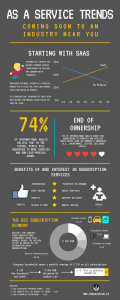
It’s not just about what is being delivered, but how it is being delivered – and the level of experience offered that takes these examples into the true as-a-service arena.

In times of crisis, like COVID-19, there is a stronger need to justify new technology services and innovations, and many businesses are looking at rapid return on investments as part of it. We will see a continued development of new as-a-service ideas coming over the coming years that have been accelerated by the need to innovate and change.

The as a service iceberg

1. Customer solutions

This is the outward manifestation of all of the others and is all about solving problems and meeting needs. No longer is something purchased just for its intrinsic value but what it will help a person or organisation achieve. Several sub components or theories support this and some have been around a while:

  • Systems thinking views a system as a cohesive conglomeration of interrelated and interdependent parts and in the case of customer solutions, it represents how products are now increasingly being viewed as tangible goods plus services.
  • Business outcomes management entails identifying, measuring and achieving business outcomes for the customer, often with the help of Customer Success teams (see the next influence).
  • Jobs to be done theory is a framework for understanding customer needs and innovating around them with new offerings.
  • Solution selling is an approach taken by sales teams that incorporates a consultative approach to identifying solutions to best meet a customer’s needs in the most cost efficient way, especially with multiple product offerings.

More elaborated on this in this post: As a Service trend research – customer solutions.

2. Customer success

With the shift to XaaS, the way we interact, work with and deliver to our customers has also evolved. Our customers’ expectations have risen rapidly and we need to focus on what experience they require and want, and also what it is that they are ultimately looking for, in outcome or value terms. The idea from SaaS vendors, that gave rise to customer success, is that they work with customers proactively to drive value and growth for the customer, in turn justifying the vendors offering. The old reactive way was letting the customer figure things out for themselves after the sale. This has been a monumental industry shift and it’s one that is still evolving and maturing. The role of a customer success manager (CSM) is one of the fastest growing roles today as more and more companies understand that it is critical to their own and their customers’ growth and ultimate success.

CSMs are generalists and facilitators, skilled across the business, commercial, technology and product functions. They are uniquely positioned to be able to guide and help customers achieve the outcomes they need, through the (technology) services they acquire. CSM’s act as trusted advisors, facilitators, business and growth consultants, analysts, project and programme managers, even as change managers for their customers.

3. From products to services

This fits alongside the customer solutions view where products play a role in a much wider ecosystem that includes services. It’s not just about technology and technology products, it’s much broader. Having said that, technology does enable this to a far greater degree, see next point. Think about how Apple has taken its iPhone and built an app (and services) ecosystem that serves to add value to Apple hardware and creates new revenue streams for them and third party app developers. These apps are increasingly being sold on a subscription basis which is also interrelated. For the broader context which incorporates service-dominant logic, check out this post: As a Service trend research – products to services.

4. Technology ecosystems

Technology has played a massive part in the shift to as a service. As we’ve seen the rise of technology services over the last 30 years, many more traditional companies (for example content creators and manufacturers) are now working with technology partners, for their technology development and almost outsourcing it. The focus now is about being enabled and empowered to use technology, as opposed to having to own and build it directly. Think of your internal IT department and how that’s changed. They’re now there to help you better utilise technology within the business and integrate with much wider technology ecosystems with external partners.

5. Being data-driven

Collecting data and understanding usage so that it drives greater insight, which in turn drives better products and services, has become a competitive differentiator. Translating this data into meaningful insights is the real challenge that only the leading companies are mastering. Questions like who is using what, how much and to what end, with which outcomes, need answering. You also need to consider where the data is, who can access it and whether this falls within regulatory compliance or not. These are big questions that require a holistic approach. Data science is a growing field that serves this area well and smart as a service companies are investing heavily into building their capabilities in this. A data-driven, decision making culture is also imperative.

6. Customer and user experience

The terms user and customer experience are front and centre now when it comes to technology. This has been driven by the rise of the consumer application ecosystem and high bars being set by companies like Amazon, Netflix and Apple (amongst many others) in how they interact with customers. Customer experience starts from the initial engagement with your customers and potentially through your marketing campaigns and outreaches. It then follows through with onboarding and implementation, project management, delivery, support and more. The challenge is ensuring that you deliver a constant customer experience and that it is specific to that customer (or segment of customers). The key to remember is that not every customer needs, wants or expects the same levels of customer experience.

7. Subscription economics

One of the biggest aspects of the as a service business model is the shift away from one-off payments to recurring payments, or subscription economics. Products and/or services are purchased in this way (on subscription) and sometimes even on an on-demand basis. Especially for B2B firms, this has shifted the financial impact from big capital expenditures upfront (capex) to more manageable on-going operational expenditure over time (opex). Many factors that this model of payment enables, need to be considered. One of the foremost on the vendors side is the emphasis this places on ensuring the customer continues to renew their subscription (not churning) by providing excellent service. For this the customer success managers role is key. Conversely, this makes the model very flexible for customers who can stop payments if they are not receiving any benefit or value. Take a look at this post for some graphics covering other aspects of what makes subscription models successful: Subscription Model Success Factors.

Other examples of where we’re seeing this shift

The shift to as a service as we’ve said started off in the world of technology but we are now seeing it everywhere across all industries. Some great examples include:

  • Gaming – all the big players like Sony and Microsoft have game subscription services, and even Google and Apple are now also in this booming market. From our days back at Sony, this way an area that we both were both closely involved with – the digitisation of content and streaming services.
  • Groceries – this is one to watch. The big supermarkets all have loyalty plans and they know what we like to buy and when. It won’t be long before this data is used to determine what our weekly grocery deliveries should be and we pay for a subscription service and food is just delivered at the frequency we pay for, and best of all most of what is delivered is exactly what we need.
  • Technology – infrastructure as a service, platform as a service and more. With the like of AWS and Azure, we can now subscribe to technology services including CPU power and data storage (and the related sub-services) and we can expand or contract our technology operations in response to demand from our own customers (this is all part of the big shift we’ve seen over recent years out to the cloud).

Other considerations

Customer centricity

There’s a lot of talk today about organisations making moves to be more customer centric and it’s something we have spoken and written about many times before (see link here to previous blogs). It boils down to really understanding your customers, as an organisation and being able to be agile and responsive to change as your customers’ needs and requirements change.
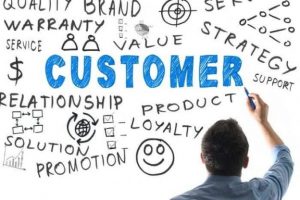
From a previous talk Jason did with a firm of VCs, the reason being customer centric is important is not only the obvious – that your customers stay loyal when they have good experiences – but also as our customers keep evolving and changing, so too are the ways that we operationalise that and support those customers.

A great way to think about customer centricity that really resonates with us is – “A business is customer centric when it delivers on-going growing value to and for their customers.“

Business transformation

Becoming an as a service business is not something you can easily tack on, like a plaster. That’s because of the overarching reach of so many of the factors listed above that are required for success. So wholesale transformation is often required for long term success. That doesn’t mean you have to do it all at once – see diagram for different stages and an approach you could take. This is like a product portfolio view of the transformation and tackles it one stage at a time, eventually rolling up into wholesale organisational transformation.

Keep an eye out for more joint blog posts we’ll be working on in the future.
Who’s looking after your customers’ success?

What a great question to ask. Do you know the answer, and if not, who’s finding it out for you? And even more importantly, do you know what your customers need to achieve to be successful?

Often as business owners and leaders, we naturally need to be focused on our company’s success and how we evolve and grow our business, building new products and services and acquiring new customers.  

We’ve seen a shift in the last ten years to the new world of Customer Success and the consumerisation of business services, where our business customers’ expectations are driven by their experiences as consumers. This has been and continues to be a huge change and a very challenging one. I say ‘ new world’ here, but it’s not new as in ‘ we’ve never done it before’ – just in that we need a different (and new) approach today.

How do we provide the same levels of services (and amazing products and platforms) that organisations like Amazon, Apple and Netflix do? They’re in completely different markets and you could see them as being irrelevant to the lettings industry. But many of your own customers use them – and many others like them – on a daily basis, and they just expect things to work and deliver, as and when and where they need and want.

Our customers are now more willing and able to leave us if we don’t do what they need or provide the value they expect – and they expect this level of flexibility. The so-called age of the customer is all about this flexibility – it’s about how businesses push value to customers, and ensuring customers become the focus and that customers are attracted to use them, not stuck with them.

When our customers are successful, and they can directly see the value our products and services give them, they will naturally gravitate more to us, use more of our services, grow with us and become great advocates.

I heard a great quote at Gainsight’s recent Chief Customer Officer Summit Europe 2018 that resonates so well and sums this up perfectly: “Make your product value painlessly obvious“.

Customer Success has to be a business-wide strategy and way of working, it isn’t just the responsibility of one team , one job function or one person , and you need a customer-centric culture to achieve this.

It often starts with one team – your customer facing team – but that team’s objectives and strategy and planning have to align with the rest of the business and radiate out to influence other teams and stakeholders.

This team absolutely can be – and often is – the starting point for this refocus back to the customer. They can plan and start new customer-based initiatives, projects and activities that then flow out across the wider business. In this fast-growing world of Customer Success, many organisations are leading the way and developing new and improved approaches that can be replicated elsewhere and by other companies, even in different industries.

How do you ensure Customer Success?

So what does a customer-centric culture look like?   At a number of startups I’ve worked with Customer Success has been a a core part of our operating philosophy from day one but in the early days it often starts with that team doing everything for customers. As you grow and expand as a business, so your Customer Success team and approach has to grow, and of course your customer-base. You move from being mainly reactive and often seemingly on the backfoot, to having a full single customer view that covers everything from commercial information, support details, customer sentiment, survey feedback, product usage, contractual information, sales information and much more. This is a critical part of our success and it continues to grow, with the right technology and tools (including a Customer Success Management platform).  

The teams have to also evolve and I’ve seen success in creating dedicated functions for onboarding and implementation (and customer education), customer and commercial operations, documentation and configuration and customer success management (that includes customer renewals, escalations, training, customer feedback, consultancy and advisory services, relationship management and customer advocacy and customer value reviews). All of these involve working very closely with the other teams and helping to make sure that customer feedback is being fed through the right channels, listened to and responded to in the appropriate way.

There is of course a balance needed between providing the level of services required (and achieving those desired customer outcomes) and over-delivering and over-servicing, and it can be challenging to strike the right balance. It’s critical to sometimes say no and to route our customers through the most appropriate channels into the business, for them to get the outcomes they require, and for this to be repeatable for them and scalable to grow with our business and our customers’ businesses.

How we measure Customer Success is critical to us – and that statement is even more powerful when reworded slightly… how do you measure your customers’ success?

There are a number of key metrics we can and do use for this, including Net Promoter Score. NPS is an easy-to-use measure to gauge customer loyalty and how it trends over time, and is used by many global businesses in many different industries. I’ve used NPS successfully in a number of different businesses, asking that one ultimate question – how likely are you to recommend us? – but also with a number of optional additional questions to get more customer insight. The score at a particular time is less important than the trend over time or the details and sentiment behind the score. When we receive completed surveys, the Customer Success Managers then carry out detailed feedback calls and campaigns with customers to understand better the reasons behind the feedback and to explore how we can improve.

It’s important to note – and this can be often overlooked – that Net Promoter Score and customers’ sentiment and feedback is not something that is just owned by your Customer Success team. These are and have to be company-wide measures and, ultimately, key business objectives. Your detractors ultimately aren’t getting the value they need and they can be calling in more for support and help, so what we need to do is help move these customers towards being promoters, and ensure that they are successful.

So the answer to the new ultimate question – the title of this post – is you and your company. Your Customer Success team helps you understand better what your customers’ success looks like, alongside of course your sales teams, and then works with the rest of the company to help achieve that success.

Customer Success is about both good outcomes and good experience and getting the mix right for that customer and what they need. If one of these isn’t right or isn’t working, you will not help your customers be successful.

Nothing is more important than your customers’ success.