Tag Archives: Leadership

Commanding the Ship: Astronaut Strategies for Navigating Success and Leadership

Ever wondered what it takes to think like an astronaut? Chris Hadfield’s ‘An Astronaut’s Guide to Life on Earth’ offers a rare peek into the mind of a spacefarer and the lessons learned from a career that’s literally out of this world. This is one of the most inspirational books I’ve ever read –  it’s amazing to see someone so focused who at a very young age new what they wanted to do and did everything they could to make it happen.

In his candid memoir, Hadfield presents life lessons honed during his missions aboard the International Space Station. He shares the surprising truth that the path to achieving astronomical dreams is paved with minute attention to detail, rigorous preparation, and the profound commitment to teamwork.

But this isn’t just about space. Hadfield’s insights are a blueprint for earthly success. He teaches us to embrace the ‘Sweat the small stuff’ philosophy, demonstrating how even the tiniest components can have mission-critical implications. His philosophy of ‘thinking like an astronaut’ can transform how you approach every aspect of daily life, making you more effective, resilient, and ready for any challenge that comes your way.

So, strap in and prepare for a transformative journey that will elevate your perspective from the terrestrial to the celestial. Whether you’re launching a new project, aspiring to leadership, or navigating life’s unpredictabilities, this book is your mission control for success.

Discover ‘An Astronaut’s Guide to Life on Earth’ on Amazon and unlock the astronaut mindset to revolutionize your life here on Earth. 🚀

If you’ve not read it yet – head over to Amazon and grab yourself a copy. Highly highly recommended.

Dare To Lead

Christmas is my favourite time of the year and I always love getting new books (well actually that’s not just at Christmas). One book I’d highly recommend and one that truly transformed my perspective is:

(And it’s not “How to Win Friends and Influence People”)

→ “Dare to Lead” by Brené Brown

4 lessons I learned

👉🏼 1. Embrace Vulnerability.

– Being vulnerable doesn’t mean being weak. It means having the courage to show up when you can’t control the outcome.

👉🏼 2. The Value of Trust.

– Trust isn’t built overnight. It’s a series of small moments where integrity, accountability, and reliability are proven.

👉🏼 3. Self-awareness Leads to Empathy.

– Understanding our own emotions helps us empathise with others. This paves the way for stronger, more meaningful connections.

👉🏼4. Clear is Kind.

– Clear, honest feedback, even when uncomfortable, is kinder than vague, unhelpful criticism.

Learn these lessons → you’ll become an exemplary leader.

A practical guide to customer centricity

We know the theory and we know we need to be more customer centric. The biggest challenge for many organisations is how do it, at both the strategic organisational level and at the more tactical operational level.

I’ve worked with and for many organisations going through their own journey to be more customer centric, at both large well-established global organisations and more niche startup organisations and have been privileged to be in positions with them where I’ve been part of that change.

One of the more strategic level changes that is crucial for success is getting your customer leadership at the right level. It’s great to see more and more organisations across different industries and sectors investing in Chief Customer Officer or similar exec level roles now and the number has grown significantly over the last few years (and continues to grow).

Having the right leadership gives you the voice of the customer at the leadership table, having someone focused on driving customer growth and value and bringing the customer conversations to the exec and board level.

I really like this concise definition of a Chief Customer Officer:

“An executive who provides the comprehensive and authoritative view of the customer and creates corporate and customer strategy at the highest levels of the company to maximise customer acquisition, retention, and profitability.”

The customer leadership role – Chief Customer Officer or other – gives you:

  • Visibility – to understand and see what is happening to your customers
  • Clarity – of what happens when a prospect becomes a customer
  • Balance of power – creating the 3rd organisational pillar (with sales and operations)
  • Sales focus – allowing sales to focus on new business without customer distractions
  • Feedback – into what is happening outside of the business (the so called magic loop)
  • Signalling – the external messaging that we are customer centric

The magic loop above is:

Plan and Build (product management and engineering) vs. Demand and Sales (Marketing and Sales) vs. Customer Experience (Customer Success).

At the more tactical level though – in terms of things you could do more immediately – here are a number of great practical ideas for driving customer centricity in your organisation:

  1. Create a mission statement that impacts your customers and that includes customers
  2. Be a customer – yes role play (across all teams)
  3. Visit your customers – all execs and, even better, all teams
  4. Implement a customer forum or community (customers talking to each other)
  5. Create a voice of customer programme (and close that feedback loop)
  6. Bring your customer feedback into every meeting across the business
  7. Democratise customer insights and make them visible to everyone in the organisation
  8. Link team compensation to the customer and have customer focused goals
  9. Hire for customer orientation and customer empathy (and onboard them like customers)

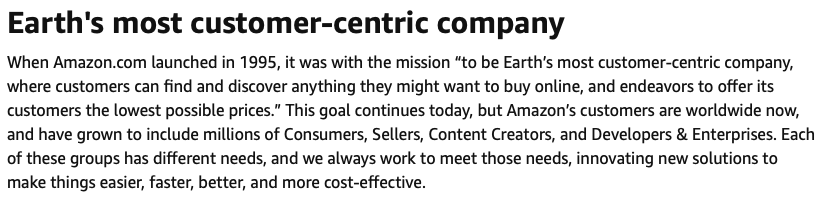
I really, really like Amazon’s mission statement:

Numbers 6 and 7 above can be very powerful when done well and I’ve seen the idea of a customer feedback wall used very well and to great effect – where you include and share the very, very good, the good, the bad and the ugly.

Do these ideas resonate with you? What things have you done in your organisations to drive the journey to being more customer centric? And what has the impact been with your customers?

If you’re interested in chatting customer centricity or customer success, please do reach out to me – I always love hearing your own journeys and challenges and ideas (and good coffee).

And don’t forget to listen to my latest podcast with Jason Whitehead from Trituns on getting your customer onboarding right from earlier this month. Click here to listen to this one and others in the series.

Being customer centric

A great way to think about customer centricity that really resonates with me:

“A business is customer centric when it delivers on-going growing value to and for their customers.”

I really like this because…

  1. It’s not just for the short term and the now
  2. It’s about the what (the value) and the who
  3. It allows for customers to include customers as we know them, employees and shareholders and investors

The reason being customer centric is important is not only the obvious – that our customers stay loyal when they have good experiences and the product and sales are delivering on our promises, but also as our customers keep evolving and changing, so too are the ways that we operationalise that and support those customers.

If you are customer centric, it means that you are observing that evolution that’s happening to your customer base, and you’re able to be very agile and nimble in responding to that as a business.

Being customer centric is easy to say but hard to do and it doesn’t come organically. It needs organisation wide buy-in and sponsorship, from sales, to finance, to operations, to support, to customer success, to delivery! We live at a time of unprecedented customer expectations both for business customers and our end consumers, and being customer centric is critical. Why now? Think about your ultimate consumers – they’re you and your expectations have changed. Forrester research have stated “This new world requires leaders to think and act differently“ and George Colony, Forrester CEO predicts, if a company is not customer-centric, they’ll simply be out of business between 5 – 10 years. What are you doing to be more customer centric today? I’m going to share some practical ideas and examples over the next couple of days of things I’ve seen work very well with different companies.

“Customer Centricity is a journey and not a destination.”